

2026: The Year Crypto Lost Its Tax Anonymity
Since January 1, 2026, the global landscape for crypto assets has changed irreversibly. The OECD's Crypto-Asset Reporting Framework (CARF) went live across 48 jurisdictions, the EU's DAC8 directive began requiring exchanges to collect and report user transaction data, and in the United States, the IRS rolled out Form 1099-DA for digital asset broker reporting. For the first time, crypto activity is subject to the same cross-border transparency standards that have governed traditional financial accounts for over a decade.
But here is the critical question that tax scholars, practitioners, and policymakers must confront: Are these frameworks actually adequate to handle the unique challenges posed by crypto assets?
Crypto Tax Transparency by Thomas Dilen, published by Kluwer Law International in March 2026, is the first comprehensive academic study to answer that question — and it does so with remarkable depth and precision.
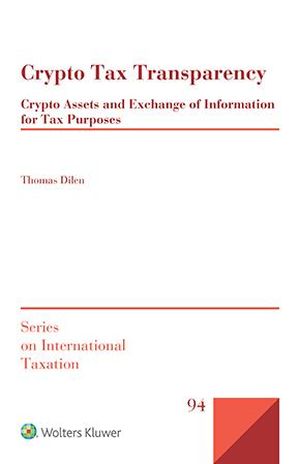
Crypto Tax Transparency: Crypto Assets and Exchange of Information for Tax Purposes
Author: Thomas Dilen
Publisher: Kluwer Law International
Published: March 2026
Format: Hardcover
ISBN: 9789403545295
Language: English
Why This Book Matters Now
The timing of this publication could not be more relevant. As CARF takes effect and tax authorities prepare for the first automatic exchanges of crypto data in 2027, practitioners and academics need a rigorous, neutral framework to assess what works, what doesn't, and what rights taxpayers retain in the process.
Dilen's work stands out because it does not simply describe these frameworks — it critically evaluates them. The book examines whether CARF, DAC8, and FATCA are truly equipped to deal with the pseudonymity of blockchain transactions, the decentralised nature of crypto networks, and the fundamental difficulty of establishing where a crypto asset is "located" for tax purposes.
The comparative analysis of Switzerland, Belgium, and the United States adds particular value. Each jurisdiction represents a fundamentally different approach to crypto taxation, and the contrasts illuminate how the same international transparency standards operate in practice under very different domestic rules.
Who Should Read This Book
This is essential reading for international tax lawyers, tax policy researchers, compliance officers at crypto exchanges and financial institutions, law faculty specializing in tax or fintech, and university law libraries building their digital economy collections. If your work touches the intersection of blockchain technology and tax compliance — at any level — this book belongs on your shelf.
Order Your Copy Today
Price includes worldwide shipping via international courier. Pay securely with credit card or PayPal.
View at CLNZ Books →Frequently Asked Questions
1. What is the OECD Crypto-Asset Reporting Framework (CARF)?
CARF is an international standard developed by the OECD to enable the automatic exchange of tax information related to crypto assets between participating jurisdictions. It requires crypto-asset service providers to collect user identity data and report transaction details to domestic tax authorities, who then share this data across borders. As of January 2026, 48 countries have committed to implementing CARF, with first exchanges scheduled for 2027.
2. How does the EU's DAC8 relate to CARF?
DAC8 is the European Union's implementation of the CARF framework through an amendment to the Directive on Administrative Cooperation. It applies to all EU member states from January 1, 2026, and aligns with the Markets in Crypto-Assets Regulation (MiCA). DAC8 extends beyond the OECD rules in some respects, as it has extraterritorial scope and requires reporting of certain transfers to unhosted wallets.
3. What role does FATCA play in crypto tax reporting?
The United States does not participate in CARF or the Common Reporting Standard but has established its own digital asset reporting regime through the IRS Form 1099-DA and proposed Treasury regulations governing broker reporting. FATCA may also apply to crypto assets held in foreign accounts. Dilen's book analyses how FATCA and US Treasury regulations interact with the OECD framework.
4. Why are crypto assets particularly challenging for tax transparency?
Three characteristics make crypto assets fundamentally different from traditional financial assets: pseudonymity (users transact without revealing their real-world identity), decentralisation (no single intermediary controls the network), and lack of clear situs (it is difficult to determine where a crypto asset is "located" for tax purposes). These challenges are at the core of Dilen's analysis.
5. Which jurisdictions does the book compare for crypto tax treatment?
The book provides a detailed comparative analysis of Switzerland, Belgium, and the United States. These jurisdictions were selected because they represent contrasting approaches to the taxation of crypto assets — from Switzerland's relatively permissive framework to Belgium's complex classification system and the US's evolving regulatory landscape.
6. Does the book address taxpayer rights in crypto information exchange?
Yes. A significant portion of the book is dedicated to assessing the rights of crypto asset users as taxpayers involved in exchange of information procedures. This includes the right to be informed, the right to challenge data transfers, and the procedural safeguards available under different legal systems — a topic that is increasingly important as automated data exchange becomes the norm.
7. What is the Global Forum's role in crypto tax transparency?
The OECD's Global Forum on Transparency and Exchange of Information for Tax Purposes oversees the implementation of both the Common Reporting Standard (CRS) and CARF. It monitors compliance, supports capacity building, and coordinates the timeline for jurisdictions to begin exchanging crypto-related tax data. Dilen's book examines the Global Forum's exchange of information on request (EOIR) standard and its application to crypto assets.
📄 Read our professional analysis of this title on LinkedIn →
About CLNZ Books
CLNZ Books is a specialist bookseller for professionals worldwide, headquartered in Auckland, New Zealand. We deliver academic, legal, and professional titles to institutions and individuals across the globe. All prices include worldwide shipping via international courier. Pay securely with credit card or PayPal.
📘 Learn more about shipping, delivery times, and returns — see our FAQ here