

Digital Finance Now Reaches Billions. Why Does Inclusion Still Stall?
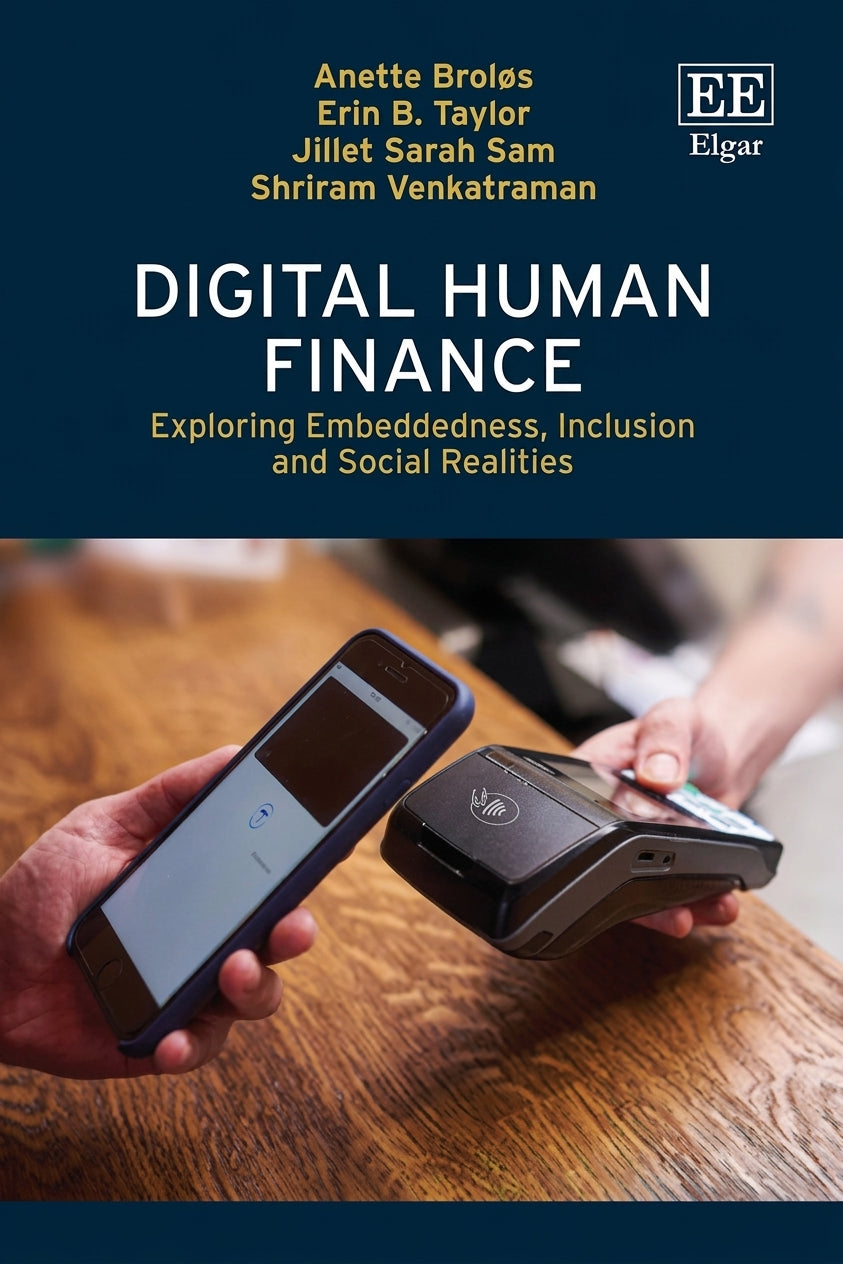
The World Bank's Global Findex 2025 reports that 79% of adults worldwide now hold an account with a bank, similar institution or mobile money provider, up from 74% in 2021. Yet 1.3 billion adults still have no account, even though 86% of adults own a mobile phone. Owning a phone or an account is not the same as using it. The Visa Economic Empowerment Institute's reading of the Findex data points to habit and low financial confidence as reasons people keep paying in cash.
Digital Human Finance (Edward Elgar, 2026) addresses that gap. Anette Broløs and Erin B. Taylor of Finthropology, Jillet Sarah Sam of the Indian Institute of Technology Kanpur and Shriram Venkatraman of the University of Southern Denmark argue that digital finance is as much a social and cultural phenomenon as a technical one. Outcomes are shaped by existing social hierarchies, cultural norms and power dynamics, which is why the authors challenge techno-optimistic narratives.
The book has two parts. Part I covers theory, the "high hopes" of digital finance, the complexities of trust, and what makes inclusion sustainable. Part II, "The Playbook", looks at everyday practices: how people think and feel about digital money, household financial relations, digital gift-giving, debt from a human-economy perspective, and savings from mobile piggybanks to virtual portfolios. The publisher lists endorsements from Bill Maurer (University of California, Irvine), Isabelle Guérin (French Research Institute for Sustainable Development) and Lana Swartz (University of Virginia).
Where it applies
- Fintech product and strategy teams: the chapters on household relations and gift-giving look at how money moves between people, not just individual users.
- Regulators and policymakers: the chapters on trust and on debt shift attention from account-opening counts to how digital credit and savings work inside real households.
- Graduate teaching: it is a shared reference for development studies, economic anthropology, sociology and science and technology studies.
For libraries. Edward Elgar classifies the title under Development Economics, Economics of Innovation and Disruptive Technologies and AI, and links it to the Sustainable Development Goals on No Poverty and Reduced Inequalities. It gives economics, sociology and development studies collections an interdisciplinary counterpart to more technical fintech titles. Browse more titles in our collections.
Ordering. CLNZ Books supplies this title to institutions and individual professionals worldwide. The price includes worldwide shipping, institutional invoicing is available, and quote requests are answered within 24 hours.
Q&A
1. What is "digital human finance"?
It is a human-centred approach that treats digital financial services, from mobile banking to AI-based fintech, as both economic instruments and drivers of sociocultural change.
2. Why can financial inclusion stall even where phones and accounts are widespread?
The authors show that outcomes depend on social hierarchies, cultural norms and power dynamics, not technology adoption alone. Findex 2025 shows the same gap: 1.3 billion adults without an account despite 86% mobile phone ownership.
3. Which disciplines does the book draw on?
Anthropology, sociology, finance, business, economics, development studies and science and technology studies.
4. Who is the book written for?
Students and academics in those fields, plus finance professionals, policymakers and technology innovators.
5. Which topics does it cover beyond access to accounts?
Trust in digital systems, household financial relations, digital monetary gift-giving, debt, and savings and investment behaviour.