Edward Elgar Publishing
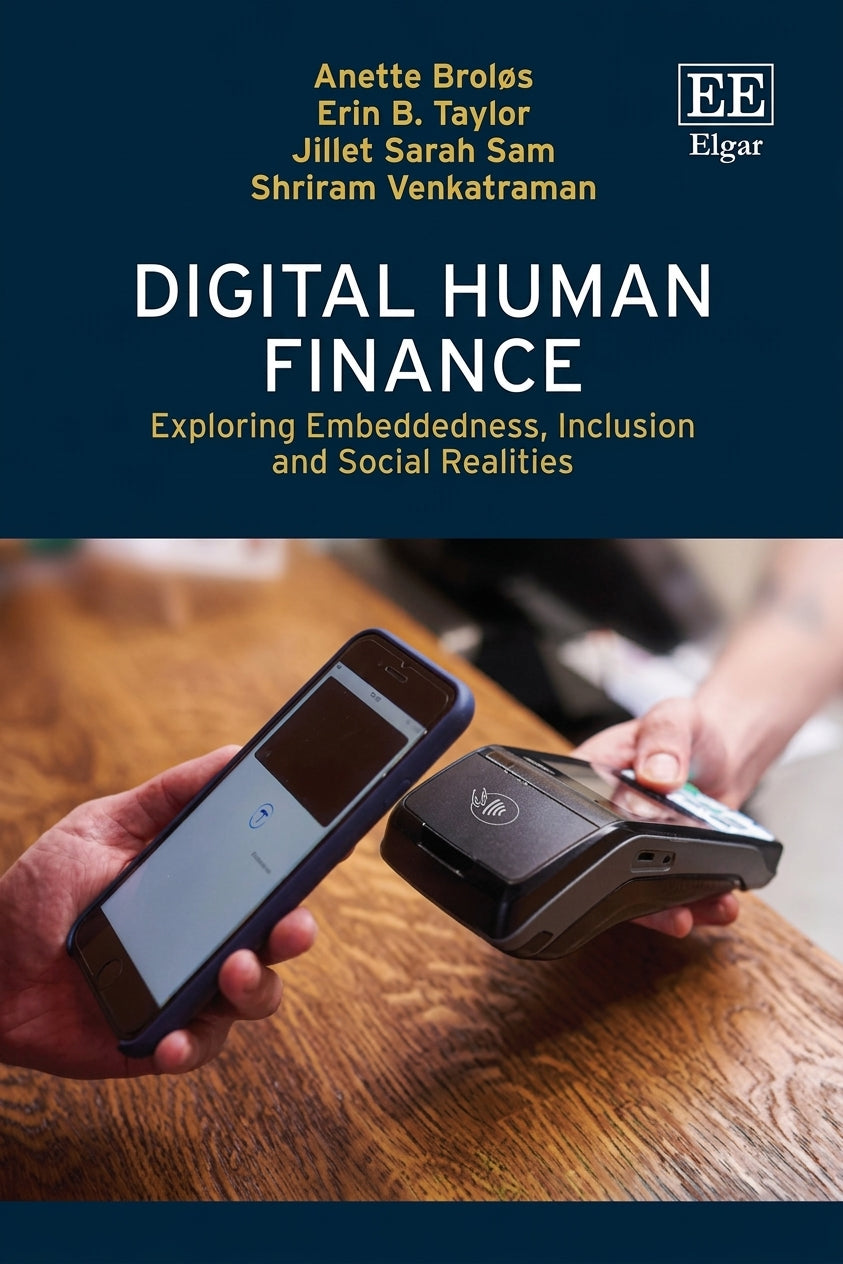
Digital Human Finance: Exploring Embeddedness, Inclusion and Social Realities
Digital Human Finance: Exploring Embeddedness, Inclusion and Social Realities
Quote response within 24h · Institutional invoicing available
Couldn't load pickup availability
Authors
Anette Broløs; Erin B. Taylor; Jillet Sarah Sam; Shriram Venkatraman
ISBN: 9781035344925
Published: 2026
Format: Hardcover
Language: English
Publisher: Edward Elgar Publishing
Description
Digital financial services now reach billions of people through mobile banking, AI-based fintech, and digital payment platforms, yet most analysis treats these tools as purely technical instruments. This book challenges that narrow framing by examining digital finance as a social and cultural phenomenon as much as an economic one, drawing on research across diverse socio-economic contexts to show how digital money functions simultaneously as an economic instrument and a driver of cultural change.
The authors move from the theoretical foundations of human-centred digital finance and the sociology of trust, through the everyday practices of household financial management, monetary gift-giving, debt, and digital savings, to a concluding assessment of what a genuinely equitable, context-sensitive approach to financial inclusion requires. Throughout, the book argues that outcomes depend fundamentally on existing social hierarchies, cultural norms, and power dynamics, not on technology alone.
For institutions building financial inclusion strategy or fintech policy, the book offers a corrective to techno-optimistic narratives, replacing them with an evidence-based account of how digital financial tools actually function inside households and communities.
Key Features
- A human-centred framework for analyzing digital financial inclusion that goes beyond technology adoption metrics
- Cross-cultural evidence on household financial decision-making, trust, and digital monetary practices
- Practical guidance for designing fintech products and financial inclusion programs that account for social hierarchies and cultural norms
- Direct challenge to techno-optimistic assumptions common in fintech policy and development literature
- Coverage of digital debt, gift-giving, and savings practices as distinct case studies
Coverage
The book covers the theoretical foundations of human-centred digital finance; trust in digital financial systems; sustainable digital financial inclusion; how people think and feel about digital money; household financial relations; digital monetary gift-giving; debt from a human economy perspective; and digital savings and investment behaviour, from mobile piggybanks to virtual portfolios.
About the Authors
Anette Broløs and Erin B. Taylor are researchers at Finthropology, a research practice focused on the human and cultural dimensions of financial technology. Jillet Sarah Sam is affiliated with the Indian Institute of Technology Kanpur, and Shriram Venkatraman with the University of Southern Denmark. Together, the authors bring a combined background in anthropology, sociology, and finance to the study of digital financial inclusion.
Table of Contents
Foreword — Part I: The Big Picture: Contexts of Digital Human Finance — Chapter 1: Introduction: The World of Human-Centred Digital Finance — Chapter 2: The Theories Behind the Thinking — Chapter 3: High Hopes for People in Digital Finance — Chapter 4: The Complexities of Trust in Digital Finance — Chapter 5: Making Digital Financial Inclusion Sustainable — Part II: The Playbook: Practices of Digital Human Finance — Chapter 6: How People Think (and Feel) About Digital Money — Chapter 7: 'Relating' to Finance in the Household — Chapter 8: Digital Monetary Gift-Giving Practices — Chapter 9: Debt: A Human Economy Perspective — Chapter 10: Navigating Savings and Investments: From Digital Piggybanks to Virtual Portfolios — Chapter 11: Conclusion: The Human in Digital Finance — Reflections and Future Trajectories — References, Glossary, Index
Why buy this book?
As fintech and digital financial inclusion strategies expand globally, most guidance remains technology-first. This book is a rare research-based counterpoint, combining anthropology, sociology, and finance to show why digital financial tools succeed or fail depending on social context, not code. For institutional and university libraries building collections in financial inclusion, development economics, or fintech policy, it offers a distinct interdisciplinary angle that pairs well with more technical or purely economic titles already on the shelf.
Keywords
digital finance, financial inclusion, fintech, mobile banking, digital financial services, household finance, financial technology adoption, digital payments, development economics, human-centred design
Target Audience
Policymakers and regulators working on digital financial inclusion, international business and development professionals, academic libraries in economics, sociology, and development studies, fintech product and policy teams, graduate programs in development studies and economic anthropology
Genre
Digital Finance, Financial Inclusion, Fintech, Development Economics, Economic Sociology
Q&A
What does Digital Human Finance cover?
It examines digital financial services—from mobile banking to AI-based fintech—as both economic instruments and drivers of sociocultural change, covering trust, household finance, digital gift-giving, debt, and savings practices across diverse socio-economic contexts.
Why does the book challenge techno-optimistic views of fintech?
The authors show through cross-cultural research that digital financial inclusion outcomes depend on existing social hierarchies, cultural norms, and power dynamics, not on technology adoption alone.
How is digital financial inclusion made sustainable, according to the book?
By combining innovation with equity and cultural pluralism, and by designing financial systems that account for how people actually think, feel, and relate to money in their specific social context.
Who should read Digital Human Finance?
Policymakers and regulators working on financial inclusion, fintech product and strategy teams, development economists, and academic libraries in economics, sociology, and development studies.
What disciplines does Digital Human Finance draw on?
The book combines anthropology, sociology, finance, business, economics, development studies, and science and technology studies into a single human-centred framework.
Where can I buy Digital Human Finance?
Digital Human Finance is available now from CLNZ Books, with worldwide shipping and secure payment by credit card or PayPal.
📘 Learn more about shipping, delivery times, and returns, see our FAQ here
📦 New to ordering with us? See our How to Order guide for payment, shipping, and institutional order options.