

Digital Planning Is Reshaping Orthognathic Surgery — the Technique Fundamentals Still Decide the Outcome
The computer-aided oral and maxillofacial surgery market is projected to grow from USD 1.13 billion in 2025 to USD 1.22 billion in 2026, an 8.2% annual increase, driven by wider adoption of virtual surgical planning, 3D-printed surgical guides, and CAD/CAM workflows — with orthognathic and dental surgery named among the market's core end uses. Planning has gone digital. The underlying surgical technique it plans around has not changed nearly as fast, and that is exactly where this book operates.
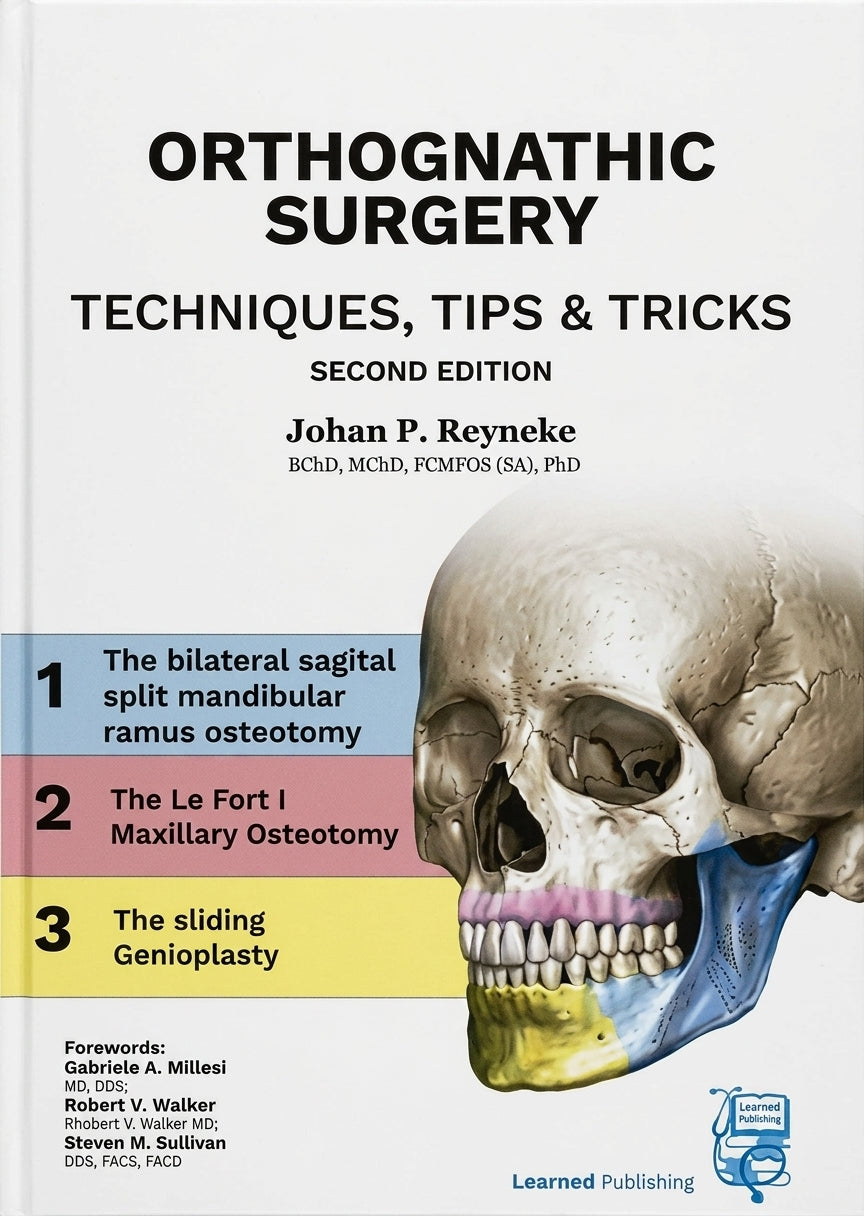
Orthognathic Surgery: Techniques, Tips, Tricks & Traps, 2nd Edition (Lisermed Publishing, 2025) is Prof. Johan P. Reyneke's manual on the mandibular sagittal ramus osteotomy, the LeFort I maxillary osteotomy, and the sliding genioplasty — the three procedures every digital plan ultimately has to translate into cuts, movements, and fixation in the operating room. Reyneke has performed close to 9,000 orthognathic procedures over more than four decades, directs the Centre for Orthognathic Surgery at Sunninghill Hospital in Johannesburg, and has held professorships at the Universities of Oklahoma, Florida and the Witwatersrand.
Where This Book Earns Its Place on the Shelf
- Executing the bilateral sagittal split mandibular ramus osteotomy with the variations and pitfalls that surgical planning software cannot fully anticipate
- Sequencing the LeFort I maxillary osteotomy so that the planned movement survives contact with soft tissue and vascular reality
- Managing the sliding genioplasty — mobilisation, augmentation, reduction, and correction of chin asymmetry — as a distinct technical problem from the jaw osteotomies it often accompanies
For Academic and Hospital Libraries
As digital planning tools spread and surgical caseloads scale with them, oral and maxillofacial surgery programmes need trainees who understand the manual technique a plan is built to execute — not only the software that generated the plan. This manual is a standard trainee reference precisely because it stays at that level, with tips and complication management drawn from thousands of cases rather than a single idealised sequence.
CLNZ Books ships this title worldwide via trusted international courier, with secure payment by card or PayPal, and offers institutional invoicing for library and department purchase orders.
Q&A
Who is this book written for?
Oral and maxillofacial surgery trainees and practising surgeons specialising in orthognathic techniques.
What procedures does it cover?
The bilateral sagittal split mandibular ramus osteotomy, the LeFort I maxillary osteotomy, and the sliding genioplasty.
Does it address surgical complications?
Yes — the book provides practical suggestions and tricks for avoiding and managing complications at each surgical step, drawn from the author's experience across thousands of cases.
Who is the author?
Prof. Johan P. Reyneke, Director of the Centre for Orthognathic Surgery at Sunninghill Hospital, Johannesburg, and a former President of the College of Maxillofacial and Oral Surgeons of South Africa.
Where can libraries order this title?
Use the Order Now! button below for direct purchase — card or PayPal, price includes worldwide shipping. For institutional purchase orders or invoicing, use the Request a Quote button beside it.