Elsevier
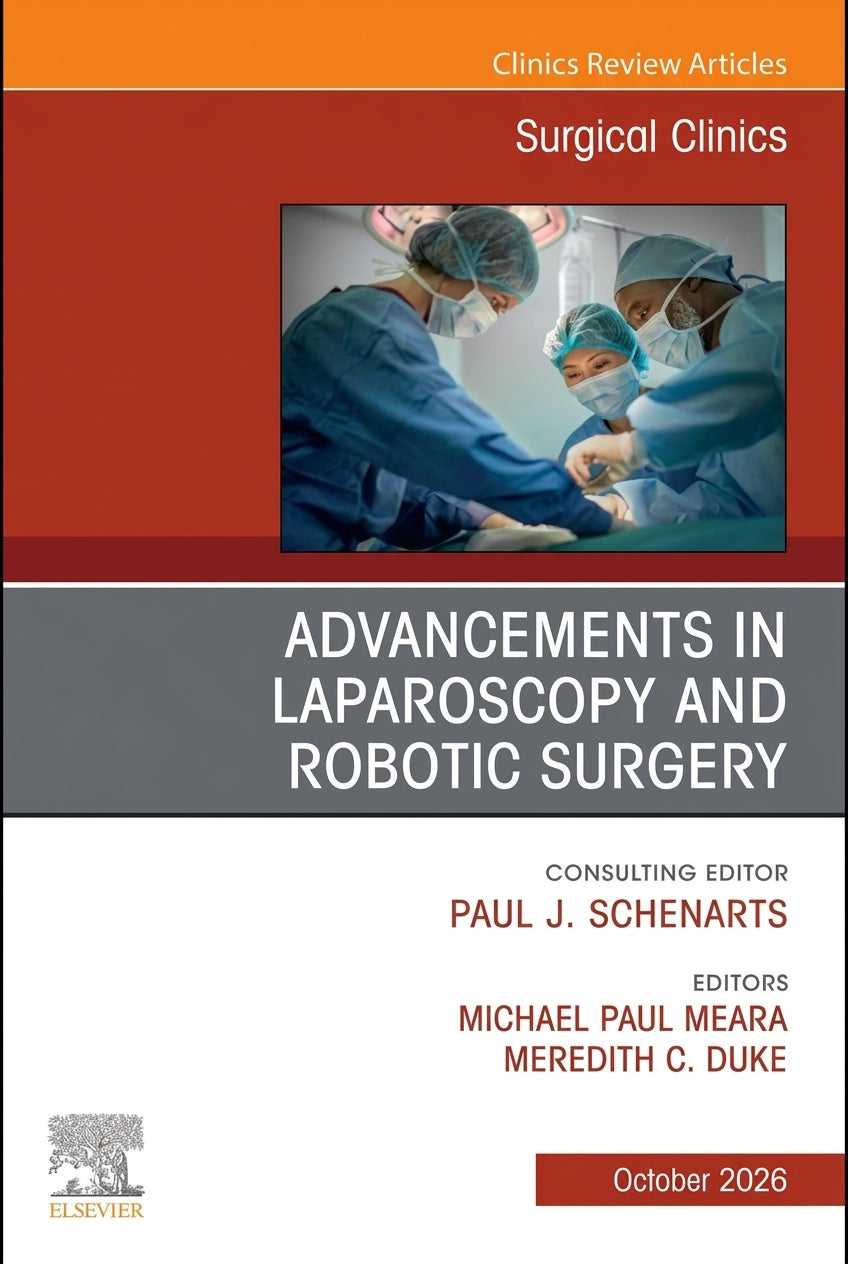
Advancements in Laparoscopy and Robotic Surgery, An Issue of Surgical Clinics
Advancements in Laparoscopy and Robotic Surgery, An Issue of Surgical Clinics
Quote response within 24h · Institutional invoicing available
Couldn't load pickup availability
Michael Paul Meara & Meredith C. Duke (Guest Editors); Paul J. Schenarts (Consulting Editor)
ISBN: 9780443429491
Published: September 10, 2026
Format: Hardcover
Language: English
Publisher: Elsevier
Description
Advancements in Laparoscopy and Robotic Surgery is a focused issue of Surgical Clinics (Volume 106-5) built around a single, fast-moving shift in operative practice: the convergence of laparoscopic and robotic technique with artificial intelligence and advanced imaging. Guest edited by Michael Paul Meara and Meredith C. Duke (Vanderbilt University Medical Center), with Paul J. Schenarts as consulting editor, the issue assembles practice-oriented reviews from specialists across general and subspecialty surgery, giving practicing surgeons a single, current reference on where minimally invasive technique is heading and how to apply it safely.
Key Features
- Eleven practice-oriented reviews spanning the history of minimally invasive surgery through to artificial intelligence and technology integration in current practice.
- Dedicated chapters on foregut, bariatric, colorectal, hepatobiliary/pancreatic, and complex abdominal wall reconstruction, reflecting where robotic and laparoscopic technique is advancing fastest.
- Coverage of robotics in pediatric surgery and the expanding indications now being explored in that population.
- A chapter addressing surgeon ergonomics and well-being in minimally invasive surgery, a growing occupational-health concern as case volumes and console time increase.
- Clinical reviews written to synthesize current research and practice guidelines into actionable insight, not just a literature summary.
Coverage
- History and evolution of minimally invasive surgery, and artificial intelligence/technology integration in surgical practice
- Endoscopy's role in laparoscopic and robotic-assisted surgery, and emergency management in minimally invasive cases
- Foregut, bariatric, colorectal, and hepatobiliary/pancreatic surgery: innovations, reoperative technique, and complication management
- Complex abdominal wall reconstruction and robotics in pediatric surgery
- Surgeon ergonomics and well-being in minimally invasive practice
About the Editors
Meredith C. Duke, MD, is Assistant Professor of Surgery in the Division of General Surgery, Department of Surgery, at Vanderbilt University Medical Center, Nashville, Tennessee. Michael Paul Meara co-edits this issue alongside Dr. Duke, drawing on practicing-surgeon experience in laparoscopic and robotic technique. Paul J. Schenarts serves as consulting editor for the Surgical Clinics series, overseeing the editorial standard applied across each quarterly issue.
Table of Contents
1. The History of Minimally Invasive Surgery
2. Integrating Artificial Intelligence and Technology in Surgical Practice
3. The Role of Endoscopy in Laparoscopic and Robotic-assisted Surgery
4. Emergency Management in Laparoscopic and Robotic Surgery
5. Foregut Surgery: Innovations and Reoperative Techniques
6. Bariatric Surgery: Managing Complications and Emerging Technologies
7. Colorectal Surgery: Advances in Minimally Invasive and Robotic Techniques
8. Minimally Invasive Hepatobiliary and Pancreatic Surgery
9. Advanced Techniques in Complex Abdominal Wall Reconstruction
10. Robotics in Pediatric Surgery: Expanding Indications and Techniques
11. Ergonomics and Surgeon Well-Being in Minimally Invasive Surgery
Why buy this book?
Robotic and laparoscopic platforms are advancing faster than most single-institution experience can track, and this issue gives general and subspecialty surgeons a current, peer-reviewed synthesis across eleven of the fastest-moving areas in minimally invasive practice — from AI-assisted technique to pediatric robotics and surgeon well-being. For surgical residency programs and hospital or academic libraries, it is a compact, quarterly-updated reference that keeps a surgical department's collection current without requiring a full textbook replacement cycle.
Browse more titles in our Medicine collection.
📖 Read our blog on this book

J&J's Ottava robot just cleared the FDA, ending Intuitive Surgical's 25-year run unchallenged — see what it means for surgical practice and where this book fits in: J&J's Ottava Clears the FDA: What a New Robotic Platform Means for Surgical Practice
Keywords
laparoscopic surgery, robotic surgery, minimally invasive surgery, artificial intelligence in surgery, bariatric surgery, colorectal surgery, hepatobiliary surgery, surgical technology, surgeon ergonomics, Surgical Clinics of North America
Target Audience
General surgeons, colorectal surgeons, bariatric surgeons, surgical residents and fellows, academic medical libraries, hospital libraries
Genre
Surgery, Surgical Reference, Minimally Invasive Surgery
Q&A
What does this issue of Surgical Clinics cover?
It covers eleven practice-oriented reviews on laparoscopic and robotic surgery, including AI and technology integration, foregut, bariatric, colorectal, and hepatobiliary/pancreatic surgery, complex abdominal wall reconstruction, pediatric robotics, and surgeon ergonomics.
How is artificial intelligence being integrated into laparoscopic and robotic surgery?
Chapter 2 is dedicated to this topic, reviewing how AI and related technology are being incorporated into surgical practice to support more personalized, effective operative decision-making.
Does this issue address complications in bariatric and colorectal robotic surgery?
Yes. Chapters 6 and 7 cover managing complications and emerging technologies in bariatric surgery, and advances in minimally invasive and robotic colorectal technique, respectively.
Is surgeon ergonomics and well-being addressed in this issue?
Yes. The closing chapter focuses specifically on ergonomics and surgeon well-being in minimally invasive surgery, an increasingly recognized occupational concern.
Who is this book written for?
It is written primarily for general surgeons and surgical subspecialists working with laparoscopic and robotic platforms, as well as surgical residents, fellows, and academic or hospital surgical libraries.
📘 Learn more about shipping, delivery times, and returns, see our FAQ here
📦 New to ordering with us? See our How to Order guide for payment, shipping, and institutional order options.