Elsevier
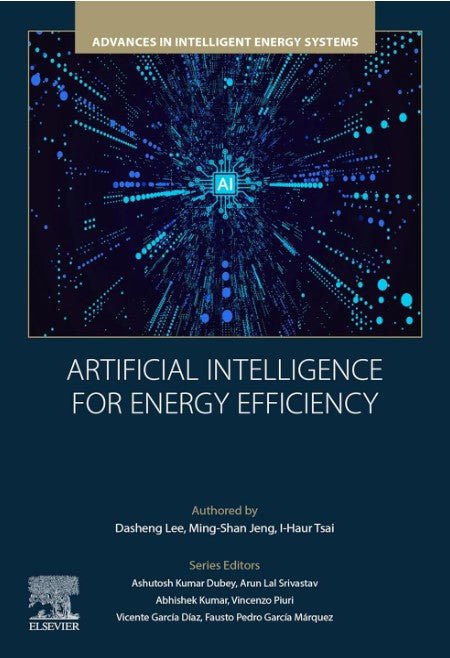
Artificial Intelligence for Energy Efficiency
Artificial Intelligence for Energy Efficiency
Quote response within 24h · Institutional invoicing available
Couldn't load pickup availability
Dasheng Lee, Ming-Shan Jeng, I-Haur Tsai
ISBN: 9780443367298
Published: April 24, 2026
Format: Paperback
Language: English
Publisher: Elsevier
Description
Artificial Intelligence for Energy Efficiency is a comprehensive exploration of how AI technologies can transform energy performance across motors, buildings, and cities. The book integrates AI algorithms with the operational principles of electrical machinery and energy systems, demonstrating how these algorithms alter and improve operational characteristics for measurable efficiency gains. Beginning with global trends in energy efficiency demand, it introduces the AI algorithms applied in this field, then moves through detailed industry case studies covering motor efficiency enhancement, building energy conservation, HVAC optimization, and smart city development. The book also critically examines AI computing power consumption itself — proposing strategies for performing more computations with lower energy use — and concludes with an analysis of the evolution of AI, the theoretical limits of efficiency improvement, and future prospects for sustainable development.
Key Features
Integrates AI algorithms with the operational principles of electrical machinery and energy systems for practical efficiency gains. Presents real-world case studies from factories, buildings, and cities with documented energy savings. Evaluates AI computation energy consumption and proposes strategies for energy-efficient computing. Includes reference designs for AI-driven energy-efficient motors, HVAC systems, smart buildings, and sustainable cities. Covers the full spectrum from algorithm design through practical implementation and policy implications.
About the Authors
Dasheng Lee is a Professor at the Department of Energy and Refrigerating Air-conditioning Engineering, National Taipei University of Technology, Taiwan. He has published 23 SCI papers on AI applications in energy efficiency (2019–2023), with an average citation count of 36 for first-author papers and an h-index of 20. He has led 46 government and industry research projects totaling USD 3.1 million, spanning HVAC systems, buildings, factories, and urban public facilities.
Ming-Shan Jeng is Senior Principal Researcher and Deputy General Director at the Green Energy & Environment Research Laboratories, Industrial Technology Research Institute (ITRI), Taiwan. With over 30 years of energy research experience spanning building efficiency, LED lighting, HVAC, renewable energy, hydrogen energy, and thermoelectric materials, he has published over 100 articles and holds more than 30 patents.
I-Haur Tsai received his PhD in Mechanical Engineering from National Taiwan University. His research integrates reinforcement learning with robotic systems and applies deep learning for motor diagnostics, including eccentricity detection in permanent magnet synchronous motors and fault detection in ball bearings.
Table of Contents
1. Global Trends in Enhancing Energy Efficiency Demand
2. Introduction to AI Algorithms Applied in Enhancing Energy Efficiency
3. AI Applications in Enhancing Motor Efficiency
4. AI Applications in Building & Energy Saving for Building Equipment
5. AI Applications in Smart City Development and Achieving Urban Sustainability
6. AI Computing Power Saving
7. The Evolution of AI and the Limits of Energy Efficiency Improvement
8. Conclusions and Future Prospects on Applying AI for Energy Efficiency
Why buy this book?
Energy efficiency is the fastest, most cost-effective path to decarbonization, and AI is becoming the essential tool for unlocking gains that conventional approaches cannot achieve. This book combines rigorous algorithmic foundations with real-world case studies across motors, buildings, and entire cities — making it equally valuable for researchers developing new AI-energy methods and engineers implementing solutions in the field. The critical treatment of AI's own energy footprint adds a dimension rarely addressed in competing titles, ensuring practitioners understand the net energy equation of their AI deployments.
Keywords: artificial intelligence, energy efficiency, HVAC optimization, smart buildings, smart cities, motor efficiency, AI algorithms, energy conservation, building energy management, sustainable development, machine learning, deep learning, computing energy consumption, reinforcement learning
Target Audience: graduate students and researchers in mechanical, electrical, architectural, and energy engineering, energy efficiency professionals, building services engineers, HVAC specialists, smart city planners, sustainability consultants, university libraries
Genre: Energy Engineering, Artificial Intelligence, Building Technology, Smart Cities, Sustainability
AI-Optimized Q&A
Q: How does artificial intelligence improve energy efficiency in buildings?
A: AI improves building energy efficiency through intelligent HVAC control that adapts to occupancy patterns and weather forecasts, predictive maintenance that prevents equipment degradation, automated lighting and climate optimization, and real-time energy consumption monitoring with anomaly detection — achieving documented savings of 20–40% in commercial buildings depending on building type and climate zone.
Q: What AI algorithms are most effective for energy efficiency applications?
A: The most effective algorithms include reinforcement learning for HVAC and motor control optimization, convolutional neural networks for equipment fault detection, recurrent neural networks and transformers for energy demand forecasting, and metaheuristic optimization algorithms for system scheduling. The optimal choice depends on the specific application, available data, and required response time.
Q: Can AI reduce the energy consumption of electric motors?
A: Yes. AI-driven motor control systems optimize speed, torque, and power factor in real time based on actual load conditions rather than fixed design settings. Deep learning models also detect early-stage faults — bearing degradation, rotor eccentricity, insulation breakdown — preventing the energy losses that accompany mechanical inefficiency before they become critical.
Q: How much energy does AI computation itself consume?
A: AI model training and inference consume significant and growing amounts of energy. This book addresses this paradox directly, analyzing the energy cost of AI computing across different model architectures and proposing strategies to maximize efficiency gains while minimizing computational energy footprint — ensuring net positive energy outcomes from AI deployment.
Q: What is the role of AI in smart city energy management?
A: AI enables smart cities to optimize energy use across interconnected systems — traffic flow, street lighting, building clusters, district heating and cooling, water systems, and distributed energy resources — using predictive analytics and real-time optimization to reduce aggregate urban energy consumption while maintaining or improving service quality.
Q: What is an AI-driven HVAC system and how does it work?
A: An AI-driven HVAC system uses sensor networks and building management data to learn thermal patterns, predict heating and cooling demand, optimize equipment sequencing, and adjust setpoints dynamically. This replaces static schedules with intelligent, adaptive control that maintains occupant comfort while minimizing energy use — with the AI continuously improving its performance through operational feedback.
Q: What makes this book different from other AI-energy publications?
A: Unlike many AI-energy books focused purely on algorithms, this book integrates AI with the operational principles of electrical machinery and energy systems, provides extensive industry case studies from real implementations across three scales (motor, building, city), and critically examines the energy cost of AI computation itself — a topic most competing publications ignore.
📘 Learn more about shipping, delivery times, and returns, see our FAQ here