Kluwer Law International
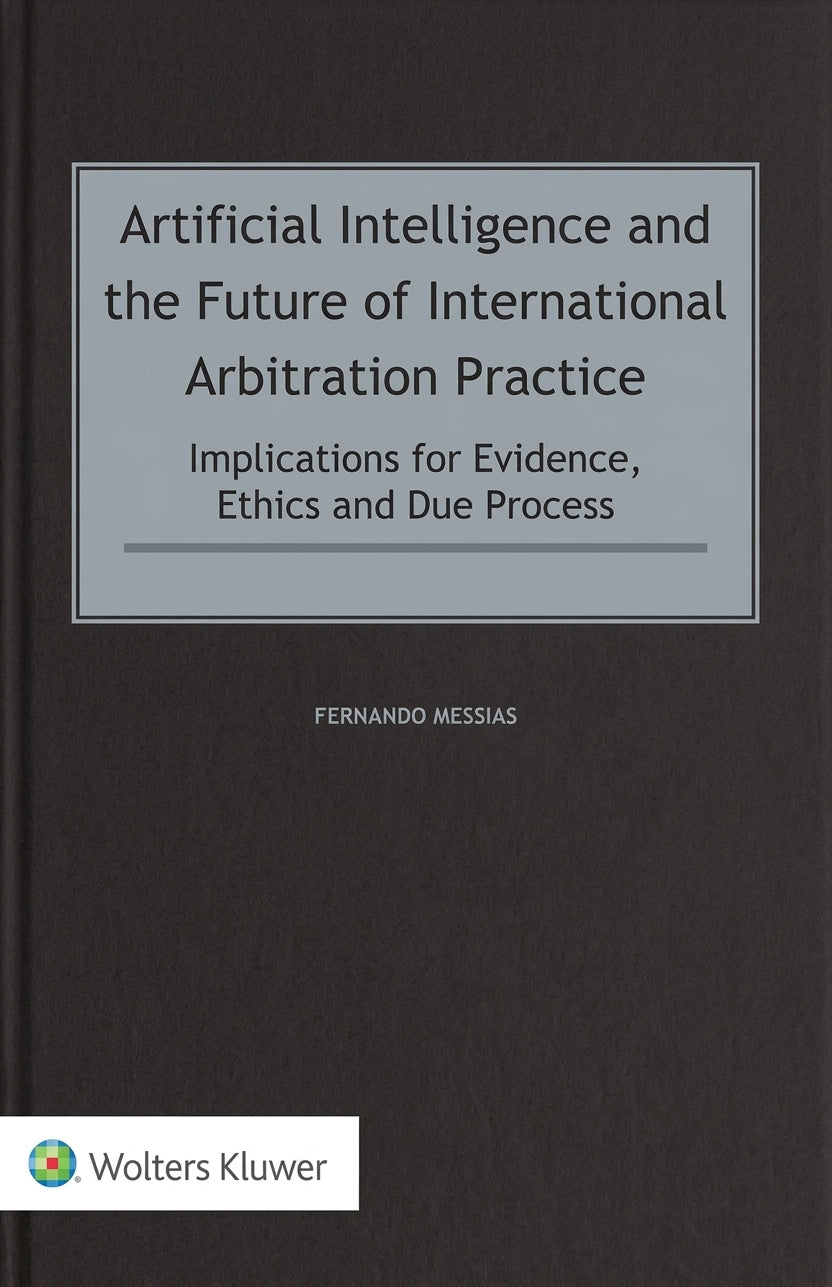
Artificial Intelligence and the Future of International Arbitration Practice: Implications for Evidence, Ethics and Due Process
Artificial Intelligence and the Future of International Arbitration Practice: Implications for Evidence, Ethics and Due Process
Quote response within 24h · Institutional invoicing available
Couldn't load pickup availability
Author
Fernando Messias
ISBN: 9789403563305
Published: October 2026
Format: Hardback
Language: English
Publisher: Kluwer Law International
Description
The rapid adoption of artificial intelligence tools across legal practice has reached international arbitration, raising questions that go well beyond efficiency: how AI affects the taking and assessment of evidence, the reasoning behind arbitral awards, and the procedural fairness owed to the parties. This volume is a practitioner-oriented analysis of how AI is being integrated into arbitral procedure, and of the governance gap that integration has exposed.
Using doctrinal, conceptual, comparative, and institutional methods, the author proposes a working framework for governing AI in arbitration, addressing equality of arms, due process, reasoned awards, tribunal independence, and algorithmic bias. A dedicated appendix reproduces the leading institutional guidelines on AI use in arbitration — ICCA, UNCITRAL, LCIA, HKIAC, and the CIArb Guideline — alongside a glossary of AI and arbitration terminology and a review of emerging case law.
The book is directed at arbitrators, counsel, and arbitral institutions who need a working map of where AI assistance is permissible and where it risks becoming an impermissible delegation of arbitral authority, as well as academic libraries building collections on legal technology and dispute resolution.
Key Features
- Chapter-by-chapter analysis of how AI reshapes arbitral procedure, evidence-gathering, and tribunal decision-making
- Full-text appendix reproducing five leading institutional AI guidelines (ICCA, UNCITRAL, LCIA, HKIAC, CIArb) in one reference source
- Practical framework for assessing when AI assistance crosses into impermissible delegation of arbitral authority — directly applicable when drafting procedural orders on the use of AI
- Glossary of AI and arbitration terminology for counsel and arbitrators working with these tools for the first time
- Survey of emerging case law and early jurisprudence on AI in international arbitration
Coverage
The convergence of law, technology and international arbitration; AI and the transformation of arbitral procedure; evidence, proof and procedural integrity; ethics, due process and decision-making; governance, regulation and the AI-ready arbitrator; the EU AI Act and UNCITRAL developments; institutional guidelines (ICCA, UNCITRAL, LCIA, HKIAC, CIArb); case summaries and emerging jurisprudence on AI and arbitration.
About the Authors
Fernando Messias writes on the intersection of technology and international arbitration practice, building on earlier published work examining the role of artificial intelligence in arbitration and legal practice more broadly.
Table of Contents
Chapter 1: The Convergence of Law, Technology and International Arbitration. Chapter 2: AI and the Transformation of Arbitral Procedure. Chapter 3: Evidence, Proof and Procedural Integrity. Chapter 4: Ethics, Due Process and Decision-Making. Chapter 5: Governance, Regulation and the Future (including Regulation and the AI-Ready Arbitrator). Chapter 6: Epilogue. Appendices: Institutional Guidelines in International Arbitration — I: ICCA Guidelines; II: UNCITRAL Guidelines; III: LCIA Guidelines; IV: HKIAC Guidelines; V: CIArb Guideline on the Use of AI in Arbitration. Glossary of AI and Arbitration Terms. Case Summaries and Emerging Jurisprudence on AI and (International) Arbitration. Index.
Why buy this book?
This is the first book to bring together, in one practitioner-oriented volume, both a governance framework for AI in arbitration and the full text of the institutional guidelines that arbitrators and counsel now need to apply. As arbitral institutions race to issue their own AI guidance, it offers a single reference point for comparing them and for anticipating where the next guidance is likely to go.
Keywords
artificial intelligence arbitration, AI international arbitration, arbitration evidence AI, algorithmic bias arbitration, AI due process, CIArb AI guideline, UNCITRAL AI arbitration, arbitrator ethics AI, legal technology arbitration, AI governance dispute resolution
Target Audience
International arbitration practitioners, arbitrators, in-house counsel managing cross-border disputes, arbitral institutions, academic and research law libraries, legal technology researchers
Genre
Arbitration and Alternative Dispute Resolution, Artificial Intelligence Law, International Arbitration, Legal Technology
Q&A
Q: How is artificial intelligence changing international arbitration procedure?
A: AI tools are increasingly used in evidence review, document production, and drafting support, which is changing how arbitral procedure is organized and how tribunals assess the reliability of AI-assisted submissions.
Q: What ethical issues does AI raise for arbitrators and counsel?
A: Key concerns include algorithmic bias, the risk of delegating adjudicative reasoning to a tool, transparency toward the parties, and maintaining the reasoned-award standard expected of arbitral decision-making.
Q: Which institutions have issued guidelines on AI use in arbitration?
A: ICCA, UNCITRAL, the LCIA, HKIAC, and the Chartered Institute of Arbitrators (CIArb) have each issued guidance, all of which are reproduced in full in this book's appendix.
Q: Where is the line between permissible AI assistance and improper delegation of arbitral decision-making?
A: The book proposes a framework centred on equality of arms, due process, and the requirement that the arbitrator's own reasoning — not an AI output — remains the basis of the award.
Q: Where can I buy Artificial Intelligence and the Future of International Arbitration Practice?
A: This title is available now from CLNZ Books, with worldwide shipping included and institutional ordering options via our Request a Quote page.
📘 Learn more about shipping, delivery times, and returns, see our FAQ here
📦 New to ordering with us? See our How to Order guide for payment, shipping, and institutional order options.