Wiley-VCH
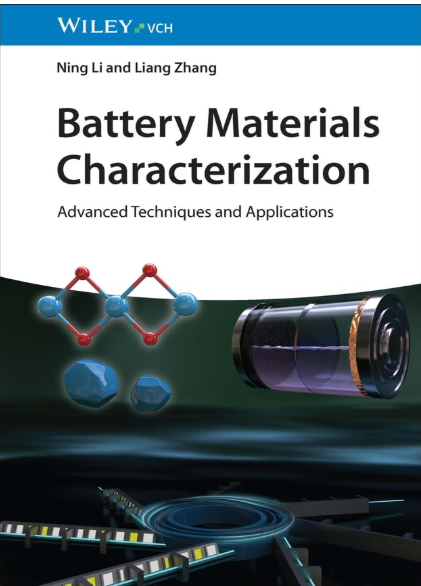
Battery Materials Characterization: Advanced Techniques and Applications
Battery Materials Characterization: Advanced Techniques and Applications
Quote response within 24h · Institutional invoicing available
Couldn't load pickup availability
Editors
Ning Li (Editor); Liang Zhang (Editor)
ISBN: 9783527355785
Published: September 2026
Format: Hardcover
Language: English
Publisher: Wiley-VCH
Description
Battery Materials Characterization brings together the full spectrum of advanced structural, spectroscopic and imaging techniques now used to understand how battery materials behave from the atomic scale to full-cell operation. Written by researchers at Beijing Institute of Technology and Soochow University's FUNSOM, the volume moves from neutron scattering and X-ray diffraction through transmission electron microscopy, transmission X-ray microscopy, synchrotron-based soft and hard X-ray absorption spectroscopy, resonant inelastic X-ray scattering, electron paramagnetic resonance, Raman spectroscopy and gas-evolution/surface-chemistry analysis by DEMS and TOF-SIMS, closing with a forward-looking chapter on where characterization science is heading next.
Key Features
Brings together 12 chapters covering the complete toolkit of structural, spectroscopic, microscopic and gas-evolution characterization methods for battery materials in a single reference. Explains both the physics behind each technique and its practical application to electrode, electrolyte and interface analysis. Draws on the editors' direct research experience with synchrotron-based characterization of energy materials, including work carried out at Lawrence Berkeley National Laboratory.
Coverage
12 chapters: Fundamentals of Battery Materials and the Evolution of Advanced Characterization Techniques; Neutron Scattering and Pair Distribution Function Analysis; X-ray Diffraction and Scattering Techniques; Transmission Electron Microscopy; Transmission X-ray Microscopy; Synchrotron-Based Soft X-ray Absorption Spectroscopy; Resonant Inelastic X-ray Scattering; Synchrotron-Based Hard X-ray Absorption Spectroscopy; Electron Paramagnetic Resonance Spectroscopy; Raman Spectroscopic Characterization; Gas Evolution and Surface Chemistry Analysis by DEMS and TOF-SIMS; Future Directions in Advanced Characterization of Battery Materials.
Three concrete applications of this volume's content: (1) diagnosing capacity fade and interfacial degradation mechanisms in commercial battery cells using combined X-ray and electron microscopy methods; (2) qualifying new cathode and anode chemistries for manufacturing scale-up with synchrotron-based structural analysis; (3) building in-house or contracted characterization programs for battery QA/QC and failure analysis using the technique comparisons in this volume.
About the Editors
Ning Li is an associate professor at Beijing Institute of Technology, where he leads a sub-platform and heads new energy technology research at the BIT Chongqing Innovation Center; from 2016 to 2020 he was a postdoctoral researcher at Lawrence Berkeley National Laboratory working on silicon-based anodes, layered cathodes and synchrotron radiation characterization, and has published more than 100 papers in high-impact journals. Liang Zhang has been a full professor at FUNSOM, Soochow University, since 2019, researching energy storage materials and synchrotron radiation methods, including in situ and operando X-ray spectroscopy and microscopy for high-energy, high-power secondary batteries, with more than 180 published papers.
Table of Contents
1. Fundamentals of Battery Materials and the Evolution of Advanced Characterization Techniques — 2. Neutron Scattering and Pair Distribution Function Analysis for Battery Materials — 3. X-ray Diffraction and Scattering Techniques — 4. Transmission Electron Microscopy for Atomic-Scale and Dynamic Characterization — 5. Transmission X-ray Microscopy for Multiphysics Imaging of Batteries — 6. Synchrotron-Based Soft X-ray Absorption Spectroscopy — 7. Resonant Inelastic X-ray Scattering — 8. Synchrotron-Based Hard X-ray Absorption Spectroscopy — 9. Electron Paramagnetic Resonance Spectroscopy for Defect and Redox Characterization — 10. Raman Spectroscopic Characterization of Structural and Interfacial Evolution — 11. Gas Evolution and Surface Chemistry Analysis by DEMS and TOF-SIMS — 12. Future Directions in Advanced Characterization of Battery Materials.
Why buy this book?
As battery manufacturers and research institutions race to qualify next-generation chemistries and diagnose failures faster, the ability to read a material's true structural and chemical state — not just its electrochemical output — has become a competitive necessity. This is one of the few references to bring the complete modern characterization toolkit for battery materials into a single volume, making it a practical acquisition for laboratories, QA/QC teams and graduate programs building characterization capability.
For the market context behind this volume, read our analysis of why synchrotron science is becoming central to battery manufacturing. To explore related titles, browse our Energy, Engineering & Environmental collection.
Keywords
battery materials characterization, synchrotron X-ray spectroscopy, neutron scattering, transmission electron microscopy, X-ray diffraction, battery degradation analysis, electrode interface characterization, operando battery diagnostics, energy storage materials, battery manufacturing QA
Target Audience
Materials scientists and electrochemists, battery and energy storage engineers, battery QA/QC and failure-analysis teams, academic and research libraries
Genre
Energy, Battery Technology, Materials Science, Electrochemistry
Q&A
Q: What makes battery materials characterization different from standard materials analysis?
A: Battery materials must often be studied while cycling (operando) or immediately after cycling to capture transient phases, interfacial reactions and degradation pathways that don't survive sample preparation for conventional ex-situ analysis, which is why synchrotron, neutron and in-situ electron microscopy methods dominate this book.
Q: Which characterization techniques does this book cover for studying electrode degradation?
A: It covers neutron scattering and pair distribution function analysis, X-ray diffraction and scattering, transmission electron and X-ray microscopy, synchrotron soft and hard X-ray absorption spectroscopy, resonant inelastic X-ray scattering, electron paramagnetic resonance, Raman spectroscopy, and gas-evolution/surface-chemistry analysis by DEMS and TOF-SIMS.
Q: Why are synchrotron-based methods increasingly important for battery research?
A: Synchrotron X-ray tools provide the spatial, temporal and chemical resolution needed to track electrode heterogeneity, internal defects and redox chemistry in real time — insight that is otherwise inaccessible and increasingly central to both battery manufacturing diagnostics and academic research.
Q: Who should use this book as a working reference?
A: Materials scientists, electrochemists and engineers in battery R&D and manufacturing, QA/QC and failure-analysis teams, and academic and industrial research libraries building or expanding battery characterization capability.
Q: Where can I buy Battery Materials Characterization: Advanced Techniques and Applications?
A: It is available directly from CLNZ Books — Bookseller for Professionals Worldwide — with worldwide shipping included.
📘 Learn more about shipping, delivery times, and returns, see our FAQ here
📦 New to ordering with us? See our How to Order guide for payment, shipping, and institutional order options.