Springer
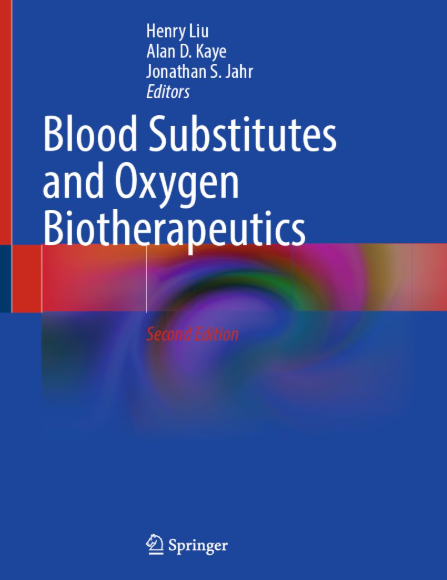
Blood Substitutes and Oxygen Biotherapeutics
Blood Substitutes and Oxygen Biotherapeutics
Quote response within 24h · Institutional invoicing available
Couldn't load pickup availability
Editors
Henry Liu (Editor), Alan D. Kaye (Editor), Jonathan S. Jahr (Editor)
ISBN: 9783032226556
Published: 11 July 2026
Format: Hardcover
Language: English
Publisher: Springer Cham
Description
Now in its second edition, Blood Substitutes and Oxygen Biotherapeutics delivers a comprehensive and authoritative update on the rapidly evolving field of artificial oxygen therapeutics and next-generation blood products. Across 48 chapters, editors Henry Liu (University of Pennsylvania), Alan D. Kaye (LSU Health Sciences), and Jonathan S. Jahr (UCLA) bring together hemoglobin-based and perfluorocarbon-based oxygen carriers, engineered proteins, vesicles, and nanotechnology-based approaches, alongside a significantly expanded set of chapters on plasma, platelets, and hemostasis. The work integrates foundational biochemistry with translational research, regulatory considerations, and real-world clinical application.
Key Features
48 chapters spanning basic science, oxygen carrier design, and clinical application; expanded coverage of lyophilized plasma, freeze-dried platelet hemostatic technologies, and cryopreserved platelets; 94 illustrations (13 black & white, 81 color); contributions relevant to surgery, anesthesiology, obstetrics, trauma care, hematology, cardiology, pediatrics, critical care, and military medicine.
Coverage
Basic science and technology: biochemistry of hemoglobin and hemoglobin-based oxygen carriers, platelet mimicry, recombinant hemoglobins, non-hemoglobin engineered protein oxygen carriers, metal-organic framework-based oxygen carriers, nitric oxide and hemoglobin physiology. Oxygen carriers: evolving concepts and clinical implications, protein engineering strategies, PEGylated carboxyhemoglobin manufacturing, encapsulated hemoglobin. Plasma, platelets, and hemostasis: lyophilized plasma, freeze-dried and cryopreserved platelet technologies. Serious adverse event mechanisms and molecular mitigation strategies.
About the Editors
Henry Liu, MD, is on the faculty of the Department of Anesthesiology and Critical Care at the Perelman School of Medicine, University of Pennsylvania. Alan D. Kaye, MD, PhD, is in the Department of Anesthesiology at Louisiana State University Health Sciences Center, Shreveport. Jonathan S. Jahr, MD, PhD, is in the Department of Anesthesiology and Perioperative Medicine at the David Geffen School of Medicine, UCLA. Together they lead a multidisciplinary panel of contributors from anesthesiology, surgery, hematology, and transfusion medicine.
Table of Contents
Basic Science and Technology: Biochemistry of Hemoglobin and Hemoglobin-Based Oxygen Carriers; Platelet Mimicry for Biomechanical Function; Hemoglobin-Based Oxygen Carrier: Impact Upon Vasoactive Effectors and Blood Flow; Recombinant Hemoglobins with Enhanced Oxidative Stability; Potential of Endothelial Nitric Oxide Protectants as Adjuncts to Certain HBOCs; Non-hemoglobin Engineered Protein Oxygen Carriers; Metal-Organic Framework-Based Oxygen Carriers; Coupled Cross-Linked Human Hemoglobins (Bis-Tetramers); HBOCs, Oxidative Stress, and Myocardial Infarction; Fractionated Polymerized Hemoglobin; Serious Adverse Event Mechanisms and Molecular Mitigation Strategies; Nitric Oxide and Hemoglobin: Physiological Implications; Ideal P50: Designing Self-Regulating Artificial Oxygen Carriers. Oxygen Carriers: Hemoglobin-Based Oxygen Carriers: Evolving Concepts and Clinical Implications; Protein Engineering Strategies for HBOC Design; PEGylated Carboxyhemoglobin Bovine (PP-007): Manufacturing and Characterization; Benefits and Risks of Encapsulated Hemoglobin as Artificial Oxygen Carrier. ...and 31 further chapters covering plasma and platelet hemostasis technologies and clinical applications in trauma, obstetrics, cardiology, pediatrics, critical care, and military medicine (48 chapters in total).
Why buy this book?
Blood supply shortages and the growing demand for trauma, surgical, and obstetric transfusion alternatives make this second edition a timely reference for departments working at the edge of transfusion medicine. Two concrete applications: (1) anesthesiology and surgical departments can use the oxygen carrier chapters as a reference when evaluating emerging HBOC and PFC-based products for trauma and perioperative use; (2) hematology and blood bank services can draw on the expanded plasma/platelet hemostasis chapters when assessing lyophilized and cryopreserved product technologies. For academic medical libraries, it is a single, current reference consolidating a fast-moving research field that previously required tracking dozens of separate primary sources.
Keywords
Blood Substitutes, Oxygen Biotherapeutics, Hemoglobin-Based Oxygen Carriers, Perfluorocarbon Oxygen Carriers, Transfusion Medicine, Anesthesiology, Hematology, Trauma Care, Critical Care Medicine
Target Audience
Anesthesiologists, surgeons, hematologists, trauma and critical care physicians, transfusion medicine specialists, academic medical libraries
Genre
Surgery, Anesthesiology, Hematology
Q&A
What is "Blood Substitutes and Oxygen Biotherapeutics" about?
It is the second edition of a comprehensive reference on artificial oxygen carriers and next-generation blood products, covering hemoglobin-based and perfluorocarbon-based technologies across 48 chapters.
Who should read this book?
Anesthesiologists, surgeons, hematologists, trauma and critical care physicians, transfusion medicine specialists, and academic medical libraries supporting surgery and critical care programs.
What topics does the book cover beyond oxygen carriers?
A significantly expanded set of chapters on plasma, platelets, and hemostasis, including lyophilized plasma and freeze-dried or cryopreserved platelet technologies, alongside regulatory and translational considerations.
How does the second edition differ from the first?
It expands coverage to include newer engineered proteins, vesicles, and nanotechnology-based oxygen carriers, plus a substantially larger section on plasma and platelet hemostasis reflecting recent advances in the field.
Where can I buy Blood Substitutes and Oxygen Biotherapeutics?
You can order it directly from CLNZ Books, with worldwide shipping included.
📘 Learn more about shipping, delivery times, and returns, see our FAQ here
📦 New to ordering with us? See our How to Order guide for payment, shipping, and institutional order options.