CRC Press
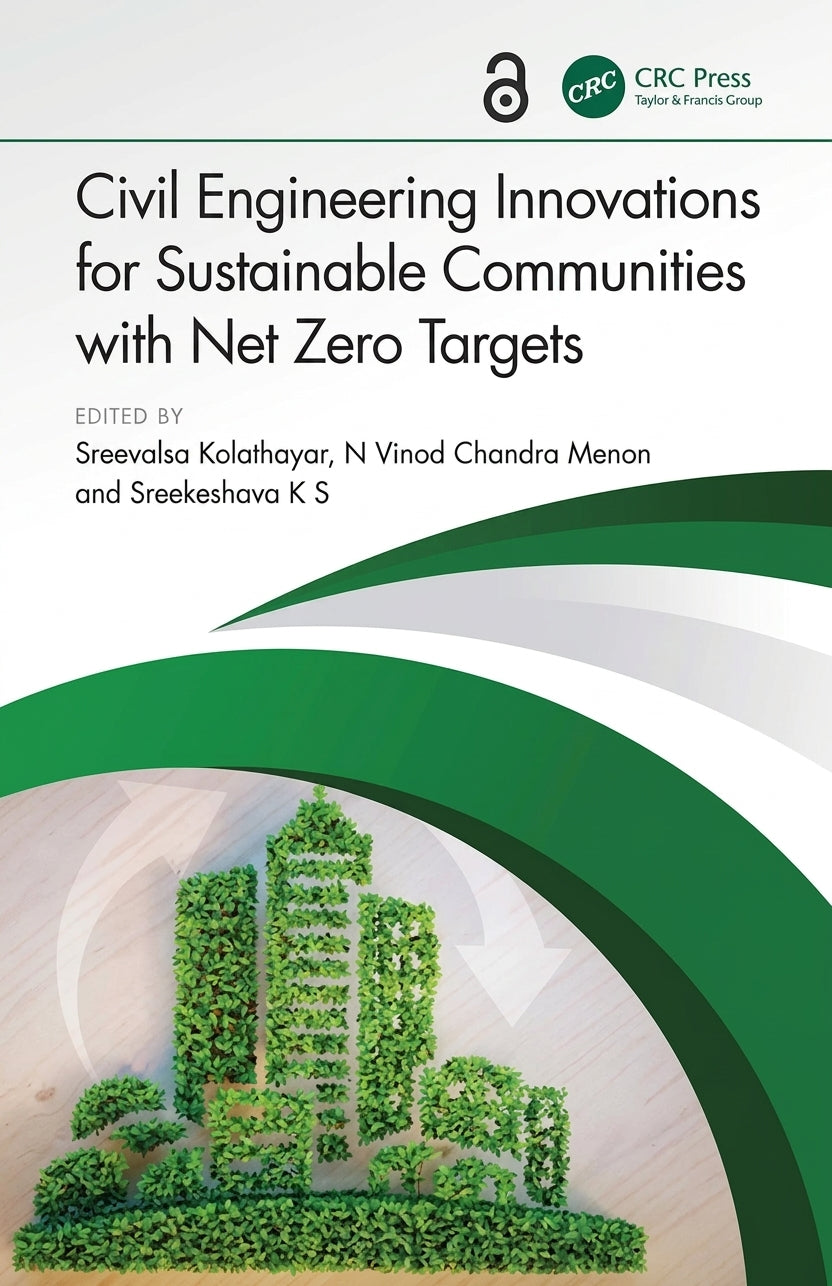
Civil Engineering Innovations for Sustainable Communities with Net Zero Targets
Civil Engineering Innovations for Sustainable Communities with Net Zero Targets
Quote response within 24h · Institutional invoicing available
Couldn't load pickup availability
Editors: Sreevalsa Kolathayar, N Vinod Chandra Menon, Sreekeshava K S
ISBN: 9781032849713
Published: 2026
Format: Paperback
Language: English
Publisher: CRC Press
Description
This volume on civil engineering innovations for sustainable communities with net zero targets aligns with the United Nations sustainable development goals in the context of civil engineering. Major topics covered include hydrological alterations under climate change, smart water management, sustainable slope stability solutions, climate-smart agriculture, conservation of wetlands, phase change materials for thermal properties, and building information modeling (BIM) for sustainable and affordable construction.
Key Features
Combines civil engineering and sustainable development concepts for future infrastructure planning, including hydrological alterations under climate change impacts. Covers prudent fiduciary discipline and cost-effective sustainable construction, including BIM applications. Reviews hybrid artificial intelligence in civil infrastructure to attain SDG 9 (industry, innovation and infrastructure) and SDG 11 (sustainable cities and communities). The Open Access version is available under a Creative Commons license.
Coverage
Nineteen chapters organized in five sections: Sustainable Development (resource utilization, sustainable construction technologies), Climate Change (hydrological alterations, water management, agriculture, biocomposites for climate mitigation), Critical Infrastructure (renewable energy strategies for net-zero buildings, offshore wind turbine vulnerability, urban transportation), Sustainable Construction (recycled concrete aggregates, agricultural residues, thin joint masonry, geopolymer materials), and Frugal Innovations (zero waste from agro-food wastes, landslide inventory mapping, satellite-based ice shelf monitoring).
About the Editors
Sreevalsa Kolathayar is Professor in-charge of the Institute Innovation Council and Associate Professor in Civil Engineering at NITK Surathkal, India, with an M.Tech from IIT Kanpur and PhD from IISc. He has authored five books, edited twelve, and holds two patents, with research focused on earthquake hazard assessment and disaster risk reduction.
N. Vinod Chandra Menon is Adjunct Professor at Amrita Vishwa Vidyapeetham, President of RedR India, and Regional Director of Asia for the International Emergency Management Society. He has over 37 years of experience in disaster risk reduction and climate change adaptation, and served on India's High-Powered Committee on Disaster Management.
K. S. Sreekeshava is Associate Professor and Head of Civil Engineering at Jyothy Institute of Technology, Bengaluru, with research interests in masonry structures, bio-composites and structural design, and organizing chair of the G20 C20 International Conference on Interdisciplinary Approaches in Civil Engineering for Sustainable Development.
Table of Contents
Section 1: Sustainable Development
1. Sustainable Communities with Net Zero Targets — An Introduction
2. Attainment of SDGs through Responsible Utilization of Resources as Building Materials
3. Sustainable Construction Technologies — A Way Forward
Section 2: Climate Change
4. Visualization of Ecologically Sensitive Regions in the Central Western Ghats
5. Hydrological Alterations under Climate Change
6. Sustainable Water Management and Climate-Smart Agriculture in India
7. Greenhouse Gas Emissions and Life-Cycle Assessment of Biocomposites
Section 3: Critical Infrastructure
8. Renewable Energy Strategies to Achieve Net-Zero Energy in Buildings
9. Wind and Wave Vulnerability of Monopile-Supported Offshore Wind Turbines
10. Factors Affecting Users' Safety at Bus Stops
11. Sustainable Urban Transportation in India
Section 4: Sustainable Construction
12. Applications of Civil Engineering in Disaster Risk Reduction
13. Towards Net-Zero Carbon Emissions Through Recycled Concrete Aggregates
14. Potential of Agricultural Residues as Sustainable Resources
15. Mortars for Thin Joint Masonry Utilizing Recycled Materials
16. Environmental Impact of Cement and Fly Ash Geopolymer
Section 5: Frugal Innovations
17. Biotechnological Approaches for Reaching Zero Waste from Agro-Food Wastes
18. Landslide Inventory Maps and Databases in Indian Context
19. Monitoring Melt Ponds and Supra-Glacial Lakes over East Antarctica
Why buy this book?
This volume connects civil engineering directly to net-zero targets and the UN SDGs, spanning hydrology, sustainable materials, renewable-ready infrastructure and disaster risk reduction in one collection. Available open access, it's a citable, freely accessible reference for civil engineering and sustainable development programs building net-zero infrastructure collections.
Keywords
Civil engineering, net zero targets, sustainable development goals, climate change adaptation, BIM sustainable construction, recycled concrete aggregates, hydrological alterations, disaster risk reduction, sustainable infrastructure, geopolymer construction
Target Audience
Graduate students and researchers in civil engineering, sustainable development, risk management, GIS and water resources
Genre
Civil Engineering, Sustainability, Climate Change Policy
Q&A
Where can I buy Civil Engineering Innovations for Sustainable Communities with Net Zero Targets?
You can order it directly from CLNZ Books, with worldwide shipping included in the price.
Is this book available open access?
Yes — the Open Access version, available at taylorfrancis.com, is published under a Creative Commons Attribution-Non Commercial-No Derivatives (CC-BY-NC-ND) 4.0 license.
How does the book connect to the UN SDGs?
Chapters map directly onto SDG 9 (industry, innovation and infrastructure) and SDG 11 (sustainable cities and communities), with hybrid artificial intelligence reviewed as a tool for attaining them.
Does the book cover renewable energy for buildings?
Yes, one chapter assesses renewable energy strategies specifically for achieving net-zero energy buildings.
Who should read this book?
Graduate students and researchers in civil engineering, sustainable development, disaster risk management, GIS and water resources.
📘 Learn more about shipping, delivery times, and returns, see our FAQ here