CRC Press
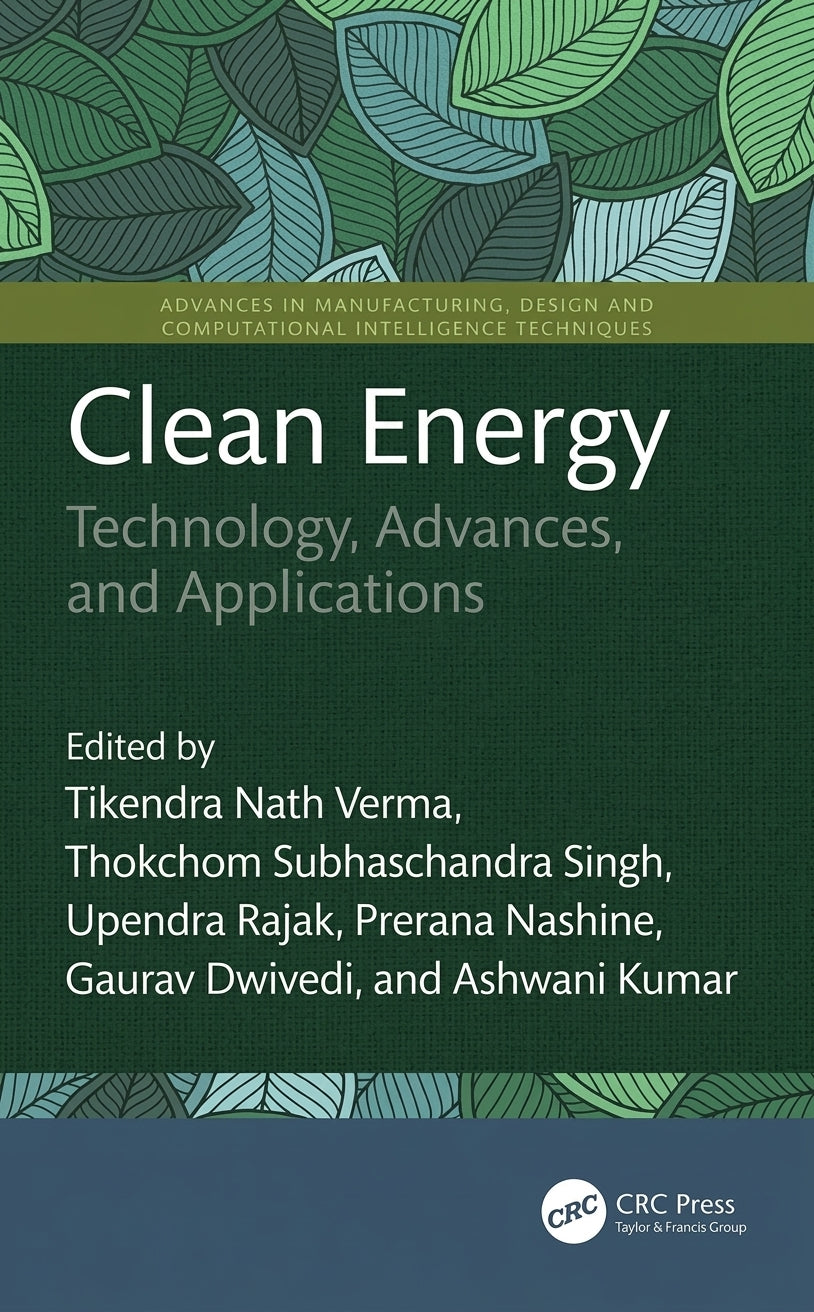
Clean Energy: Technology, Advances, and Applications
Clean Energy: Technology, Advances, and Applications
Quote response within 24h · Institutional invoicing available
Couldn't load pickup availability
Editors: Tikendra Nath Verma, Thokchom Subhaschandra Singh, Upendra Rajak, Prerana Nashine, Gaurav Dwivedi, Ashwani Kumar
ISBN: 9781032861036
Published: 2026
Format: Paperback
Language: English
Publisher: CRC Press
Description
This book discusses various technologies and methods that help in generating clean and renewable forms of energy. It covers the use of fuels in energy conversion media such as internal combustion engines and compares these with existing fossil fuels, and focuses on the green hydrogen revolution and the urban heat island effect. It covers sustainable biodiesel production, photovoltaic device optimization, energy-efficient green buildings, blue-green infrastructure, carbon capture, utilization and storage (CCUS) technology, and hydrogen production and utilization for electric vehicles.
Key Features
Covers sustainable biodiesel production, photovoltaic (PV) device optimization, and improving the reliability and performance of solar energy systems. Explains energy-efficient green buildings, blue-green infrastructure, solar chimney design, and urban green spaces for reducing the urban heat island effect. Discusses carbon sequestration in urban parks, CCUS technology evolution, hydrogen production technologies, and hydrogen utilization for electric vehicles.
Coverage
Twenty chapters spanning sustainable biodiesel production, artificial neural networks for PV system optimization, tin-based perovskites for photovoltaics, energy-efficient green buildings, solar chimney ventilation, blue-green infrastructure against urban heat islands, reactive power planning with FACTS, carbon sequestration in urban parks, CCUS technology, solar air heater optimization, alternative fuel technologies for commercial vehicles, hydrogen production technologies, solar-integrated hydrogen production, hydrogen for electric vehicles, vehicle carbon emissions, agro-residue biochar, indoor air quality, and urban air pollution comparisons.
About the Authors
Tikendra Nath Verma is Associate Professor at the Maulana Azad National Institute of Technology (MANIT), Bhopal, with over 213 published research articles and an h-index of 44. He is series editor for five book series including Renewable and Sustainable Energy Developments, and was featured in Stanford University's "Top 2% scientist of the world" survey.
Thokchom Subhaschandra Singh is Assistant Professor of Mechanical Engineering at the National Institute of Technology Manipur, with over 8 years of teaching experience and three granted Australian patents.
Upendra Rajak is Assistant Professor (Grade II) in Mechanical Engineering at Rajeev Gandhi Memorial College of Engineering and Technology, Nandyal, with over 100 papers in SCI- and Scopus-indexed journals.
Prerana Nashine is Assistant Professor at PSS Central Institute of Vocational Education (NCERT), with a PhD from NIT Rourkela and 37 published research articles.
Gaurav Dwivedi is Assistant Professor in the Energy Centre at MANIT Bhopal, with a PhD in renewable energy (biofuel) from IIT Roorkee and over 150 published papers.
Ashwani Kumar is Senior Lecturer in Mechanical Engineering under the Government of Uttar Pradesh, editor-in-chief of the International Journal of Materials, Manufacturing and Sustainable Technologies, and author/editor of more than 40 books.
Table of Contents
1. Fueling the Future: Sustainable Biodiesel Production Strategies
2. Artificial Neural Networks for PV System Optimization and Performance Enhancement
3. Tin-Based Perovskites for Efficient and Stable Photovoltaic Devices
4. Super-Hydrophobic Surfaces for Solar Cells
5. Energy Efficient Green Buildings: Environmental, Economic and Technical Factors
6. Ventilation in Green Buildings Through Solar Chimney
7. Blue-Green Infrastructure to Mitigate High Building Energy Demand
8. Role of Urban Green Spaces in Reducing Urban Heat Island Effect
9. Reactive Power Planning with Load Uncertainty Using FACTS
10. Carbon Sequestration Potential of Urban Parks
11. Evolution of Carbon Capture, Utilization and Storage Technology
12. Optimizing Solar Air Heater Performance
13. Competing Alternative Fuel Technologies for Commercial Vehicles in India
14. Hydrogen Production Technologies: Current Scenario and Future Evolution
15. Solar Integrated Hydrogen Production and Utilization in India
16. Production and Utilization of Hydrogen as a Future Fuel for Electric Vehicles
17. Comparative Evaluation of Carbon Emissions from Various Vehicles
18. Agro-Residue Derived Biochar for Environmental Management
19. Building Resilience to Airborne Pathogens: An Indoor Air Quality Model
20. Urban Air Quality: Comparative Study of Pollution Levels
Why buy this book?
This volume brings together clean energy technology, green building design and the hydrogen economy in a single reference, with practical chapters spanning biodiesel, solar PV, CCUS and hydrogen-electric vehicle integration. It's a strong fit for mechanical, environmental and energy engineering collections aiming to cover the full clean-energy technology stack in one title.
Keywords
Clean energy technology, renewable energy, green hydrogen, urban heat island, solar photovoltaic, green buildings, carbon capture utilization and storage, biodiesel production, hydrogen for electric vehicles, sustainable energy engineering
Target Audience
Mechanical, environmental, energy and electrical engineering researchers and students, academic libraries, renewable energy professionals
Genre
Renewable Energy, Energy Policy
Q&A
Where can I buy Clean Energy: Technology, Advances, and Applications?
You can order it directly from CLNZ Books, with worldwide shipping included in the price.
What does the book mean by the 'green hydrogen revolution'?
It refers to the shift toward producing hydrogen from renewable sources rather than fossil fuels, and the book covers both production technologies and hydrogen's use in electric vehicles.
Does the book address building design, not just energy generation?
Yes — several chapters cover energy-efficient green buildings, blue-green infrastructure and solar chimney ventilation as part of the clean energy transition.
Is CCUS technology covered?
Yes, one chapter traces the evolution of carbon capture, utilization and storage technology from past to present and future developments.
Who is this book written for?
Senior undergraduates, graduate students and academic researchers in mechanical, environmental, energy, electrical and automotive engineering.
📘 Learn more about shipping, delivery times, and returns, see our FAQ here