Edward Elgar Publishing Limited
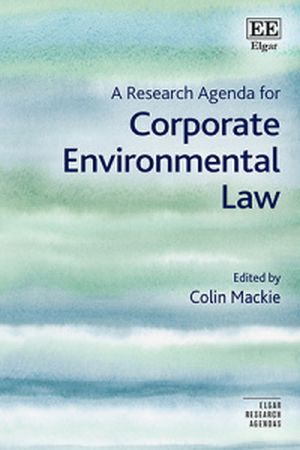
A Research Agenda for Corporate Environmental Law
A Research Agenda for Corporate Environmental Law
Quote response within 24h · Institutional invoicing available
Couldn't load pickup availability
Colin Mackie (Editor)
ISBN: 9781035386956
Published: October 2026
Format: Hardcover
Language: English
Publisher: Edward Elgar Publishing
Description
Part of the Elgar Research Agendas series, this volume maps the emerging field of corporate environmental law — the point where company law, corporate governance and insolvency law meet environmental law and policy. Leading scholars explore key concepts and new themes, and set out clear directions for future research.
The chapters ask how corporate legal structures can be overcome to change behaviour inside companies, how regulation can strengthen accountability to stakeholders, and how the decisions of business leaders can be aligned more closely with environmental priorities. Throughout, the contributors analyse the regulatory conflicts at the heart of the field and propose practical solutions.
"This timely collection charts the important field of corporate environmental law with impressive breadth." — Ernest Lim, National University of Singapore
Key Features
Fourteen chapters by international experts, organised in three parts: corporate structures, corporate accountability and corporate decision-makers. Covers the newest debates, including greenhushing, "just transition" due diligence, ESG targets in executive pay and the enforcement of mandatory human rights and environmental due diligence. Practical applications drawn from the book: (1) assessing how the polluter pays principle and environmental liabilities apply to a company in insolvency or bankruptcy; (2) designing or reviewing ESG-linked executive compensation plans and environmental disclosure policies; (3) preparing for compliance with mandatory human rights and environmental due diligence regimes, and choosing between civil and administrative enforcement models.
Coverage
Polluter pays principle and corporations. Transnational climate litigation and climate justice in the Global South. Multinational enterprises and mediation-based governance of environmental harm. Environmental responsibilities in corporate bankruptcy. Greenhushing and environmental non-disclosure. Employee shareholders and environmental disclosure. Just transition due diligence. Mandatory human rights and environmental due diligence (HREDD). ESG targets in executive compensation. Directors' duties and environmental considerations. The role of corporate law in promoting environmental sustainability.
About the Authors
Colin Mackie is Professor of Law (Chair in Law) at the School of Law, University of Nottingham, after previous posts at the Universities of Leeds and Aberdeen. His research focuses on corporate environmental liability, including financial assurance for remediation and decommissioning, environmental due diligence in global supply chains and the decommissioning of offshore renewable energy installations. He has advised the OECD, energy and environmental regulators, financial institutions and NGOs, and is an Editor of the Environmental Law Review.
Contributors: Valerie Fogleman, Jolene Lin, Mari Pihalehto, Lisa M Fairfax, Nina Boeger, Chiara Macchi, Claire Bright, Anne JF Lafarre, Suren Gomtsian, Femke Huisman, Irit Mevorach, Lisa Benjamin, Lynn Buckley and Min Yan.
Table of Contents
Part I – Corporate Structures and the Environment: 1. Formulating a research agenda for corporate environmental law (Colin Mackie) | 2. The continued expansion of the polluter pays principle and its application to corporations (Valerie Fogleman) | 3. Transnational litigation and the quest for climate justice in the Global South (Jolene Lin) | 4. Multinational enterprises, adverse environmental impacts and the promise of mediation-based governance (Colin Mackie) | 5. The treatment of environmental responsibilities upon corporate bankruptcy: a conceptual approach for more holistic regulatory solutions? (Mari Pihalehto)
Part II – Corporate Accountability and the Environment: 6. Taking non-disclosure seriously: what greenhushing reveals about the risks and benefits of disclosure (Lisa M Fairfax) | 7. Employee shareholders as users of environmental disclosure (Nina Boeger) | 8. Breaking the silos of corporate accountability: towards 'just transition due diligence' (Chiara Macchi and Claire Bright) | 9. Civil or administrative? Optimal enforcement of mandatory human rights and environmental due diligence (Anne JF Lafarre)
Part III – Corporate Decision-Makers and the Environment: 10. The use of ESG targets in executive compensation plans: competing theories, limited evidence and uncertain future (Suren Gomtsian and Femke Huisman) | 11. Corporate environmental conduct in transition: developments and challenges (Irit Mevorach and Lisa Benjamin) | 12. The interrelationship and trajectory of directors' duties and environmental considerations (Lynn Buckley) | 13. Rethinking the role of corporate law in promoting environmental sustainability (Min Yan) | 14. Conclusion (Colin Mackie)
Why buy this book?
Corporate environmental law is moving fast — from climate litigation against multinationals to mandatory due diligence and ESG-linked pay. This is one of the first books to treat it as a field in its own right, bringing company law, insolvency law and environmental law together in one volume. It gives researchers a clear map of open questions, and gives lawyers, regulators and policymakers a well-argued view of where the law is heading. A strong addition to any law library collection on corporate governance, sustainability or environmental regulation.
Climate change. 2026 Catalog. View it by clicking here
Keywords
corporate environmental law, environmental law, corporate law, company law, corporate governance, polluter pays principle, climate litigation, climate justice, greenhushing, environmental disclosure, just transition, human rights and environmental due diligence, HREDD, ESG, executive compensation, directors' duties, corporate insolvency, environmental liability, sustainability, Elgar Research Agendas
Target Audience
Legal academics, law students, corporate lawyers, environmental lawyers, insolvency practitioners, legislators, regulators, policymakers, law librarians
Genre
Corporate Law, Environmental Law, Corporate Governance, ESG, Corporate Social Responsibility
Q&A
What is corporate environmental law?
Corporate environmental law studies how company law, corporate governance and insolvency law shape the way businesses cause, prevent and pay for environmental harm. A Research Agenda for Corporate Environmental Law, edited by Colin Mackie, treats it as an emerging field and maps its key concepts and research directions.
How does the polluter pays principle apply to corporations?
The polluter pays principle requires those who cause pollution to bear the cost of preventing and remedying it. In Chapter 2, Valerie Fogleman examines how the principle keeps expanding and how it is applied to companies, while Chapter 5 looks at what happens to environmental responsibilities when a company goes bankrupt.
What is greenhushing?
Greenhushing is when companies deliberately say less about their environmental goals or performance, often to avoid criticism or litigation. Lisa M Fairfax's chapter explains what greenhushing reveals about the risks and benefits of corporate environmental disclosure.
Should ESG targets be part of executive pay?
Many companies now link executive bonuses to ESG targets. Suren Gomtsian and Femke Huisman review the competing theories behind this practice, the limited evidence on whether it works, and its uncertain future.
How should mandatory human rights and environmental due diligence be enforced?
Anne JF Lafarre compares civil and administrative enforcement of mandatory human rights and environmental due diligence, while Chiara Macchi and Claire Bright argue for a "just transition due diligence" that breaks down silos in corporate accountability.
Where can I buy A Research Agenda for Corporate Environmental Law edited by Colin Mackie?
You can buy A Research Agenda for Corporate Environmental Law (Edward Elgar, ISBN 9781035386956) at CLNZ Books — clnzbooks.com. The price includes worldwide shipping via international courier. Payment is accepted by credit card and PayPal, and institutional invoicing is available for libraries and firms.
📘 Learn more about shipping, delivery times, and returns, see our FAQ here
📦 New to ordering with us? See our How to Order guide for payment, shipping, and institutional order options.