Springer
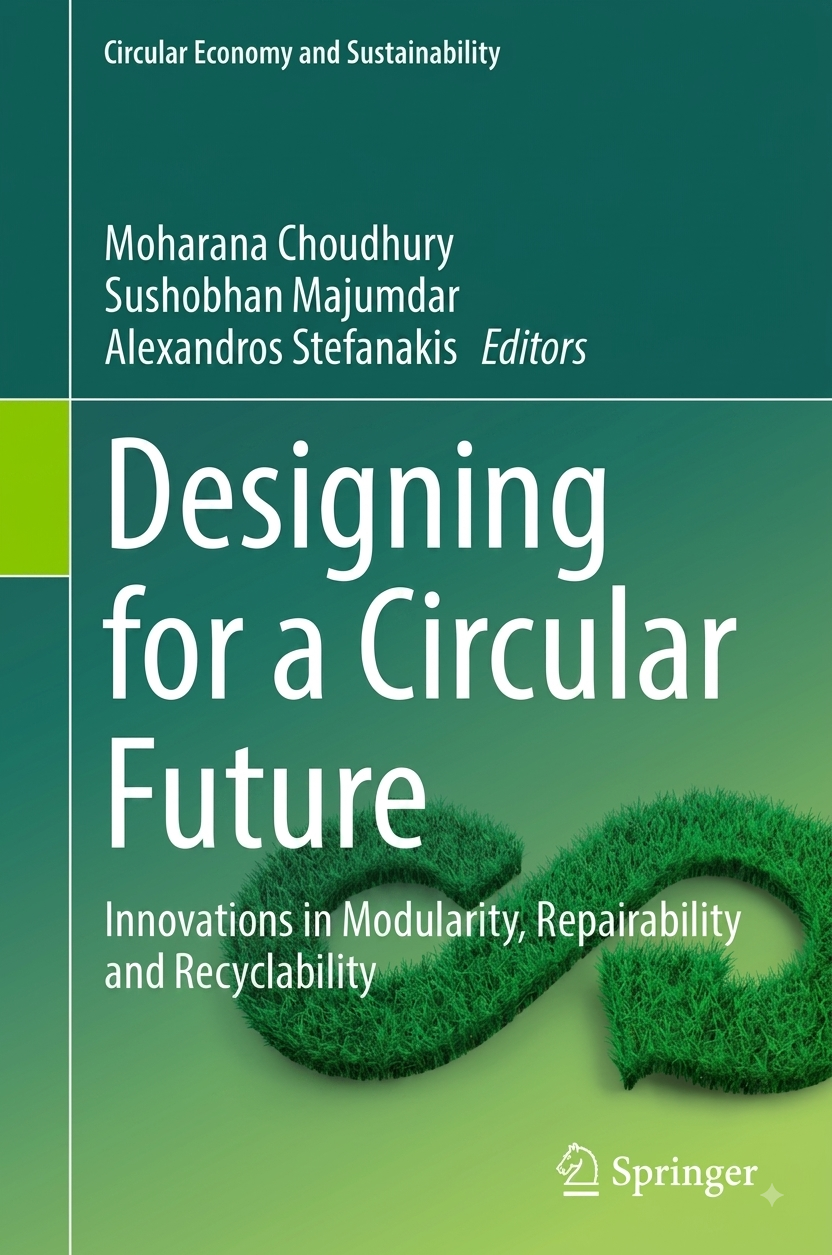
Designing for a Circular Future: Innovations in Modularity, Repairability and Recyclability
Designing for a Circular Future: Innovations in Modularity, Repairability and Recyclability
Quote response within 24h · Institutional invoicing available
Couldn't load pickup availability
Moharana Choudhury, Sushobhan Majumdar, Alexandros Stefanakis (Editors)
ISBN: 9783032248909
Published: 20 May 2026
Format: Hardcover
Language: English
Publisher: Springer Cham
Description
Designing for a Circular Future is a comprehensive guide to the principles, strategies, and innovations shaping the future of sustainable product design in a circular economy. It explores how modularity, repairability, and recyclability transform industries, reduce waste, and improve resource efficiency, offering a practical roadmap for embedding these principles into product development.
Key Features
- Provides a theoretical framework and practical guidance, supported by real-world case studies
- Focuses on designing for recyclability and how product design can align with emerging recycling technologies
- Unique holistic approach covering three interconnected principles — modularity, repairability, and recyclability — essential to a circular future
Coverage
Foundations of circular design: principles, frameworks, and methodologies · Modularity in action: case studies from consumer electronics, automotive, and furniture industries · Designing for durability: repairability, upgrade strategies, and repair ecosystems · Closing the loop: recyclability, material recovery, sustainable materials, and circular supply chains.
About the Editors
Moharana Choudhury is affiliated with Voice of Environment (VoE), Environmental Research and Management Division, Guwahati, India. Sushobhan Majumdar is in the Department of Geography, Pandit Raghunath Murmu Smriti Mahavidyalaya, Bankura, India. Alexandros Stefanakis is at the School of Chemical and Environmental Engineering, Technical University of Crete, Chania, Greece.
Table of Contents
Foundations of the Circular Economy · Core Concepts: Modularity, Repairability, and Recyclability · Circular Design Frameworks · Modular Pathways to Sustainability · Modular Innovations in Action · The Future of Modularity · Repairability in the Circular Economy · Design for Repair and Upgrade · Building Repair Ecosystems · Designing for a Second Life · Sustainable Materials and Manufacturing · Closing the Loop: Circular Supply Chains and Recycling Technologies.
Why buy this book?
Every sustainability, product development, or ESG team eventually has to answer the same question in concrete terms: what does "circular" actually mean for our products? This book gives that answer with a working framework rather than a slogan — practical guidance on modularity, repairability, and recyclability backed by real case studies from consumer electronics, automotive, and furniture. For teams tasked with reducing material and energy footprint across a product's lifecycle, it's a direct planning tool, not background reading.
Keywords
circular economy, modularity, repairability, recyclability, sustainable product design, circular design frameworks, lifecycle assessment, sustainable manufacturing
Target Audience
Product and sustainability engineers, industry practitioners, academics
Genre
Circular Economy, Sustainability, Technology
Q&A
What does Designing for a Circular Future cover?
It covers the principles of circular product design — modularity, repairability, and recyclability — with frameworks, case studies, and strategies for reducing waste and improving resource efficiency.
Does the book include real-world case studies?
Yes — case studies from consumer electronics, automotive, and furniture industries illustrate how modular design principles apply in practice.
Is recyclability covered in depth, or just modularity?
Both are covered in depth, along with repairability — the book treats all three as interconnected pillars of circular design, including material recovery and circular supply chains.
Who is this book written for?
Product designers, sustainability and circular economy practitioners, engineers, and academics and students in environmental design and sustainable development.
Where can I buy Designing for a Circular Future: Innovations in Modularity, Repairability and Recyclability?
Through CLNZ Books, with worldwide shipping and secure payment by card, PayPal, or bank transfer.
📘 Learn more about shipping, delivery times, and returns, see our FAQ here