Wiley-VCH
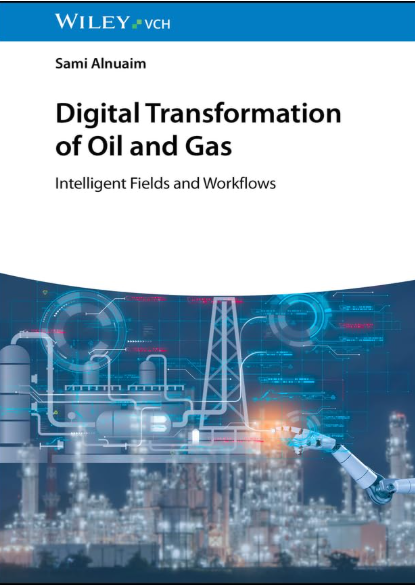
Digital Transformation of Oil and Gas: Intelligent Fields and Workflows
Digital Transformation of Oil and Gas: Intelligent Fields and Workflows
Quote response within 24h · Institutional invoicing available
Couldn't load pickup availability
Author
Sami Alnuaim (Author)
ISBN: 9783527357161
Published: October 2026
Format: Hardcover
Language: English
Publisher: Wiley-VCH
Description
Upstream oil and gas operators are moving beyond conventional automation toward adaptive, data-driven decision-making, a shift that recent industry analysis frames as central to the sector's next decade of investment. This book offers a practitioner-authored framework for that transition, tracing the path from today's smart fields to fully intelligent field architectures built on real-time data, AI, robotics, and digital twins.
The book moves systematically through infrastructure and asset management, the financial and organizational case for digital investment, cybersecurity and business continuity, field operations and production engineering workflows, reservoir monitoring, and strategic analytics, before closing with executive-level KPI dashboards and a forward look at autonomous fields, ESG and carbon tracking, and robotics.
Written by a petroleum engineer with three decades at Saudi Aramco and a former president of the Society of Petroleum Engineers, it is a practical roadmap for engineers, geologists, and energy executives steering digital transformation programs in upstream operations.
Key Features
- End-to-end framework spanning smart fields to fully autonomous intelligent field architectures
- Practical deployment roadmap for real-time reservoir management and production optimization using sensor data, digital twins, and machine learning
- Financial and organizational playbook for justifying and managing large-scale digital oilfield investment
- Cybersecurity and business-continuity framework tailored to connected upstream infrastructure
- Executive-level guidance including KPI dashboards and a proposed Digital Oil Field (DOF) readiness index
- Forward-looking coverage of AI, robotics, drones, and renewables integration in next-generation oilfield operations
Coverage
Evolution of digital oilfields; infrastructure and asset management; financial planning for digital investment; organizational and workforce transformation; cybersecurity and business continuity; field operations and production engineering workflows; reservoir monitoring and well testing; strategic workflows including debottlenecking and analytics; executive use of digital oilfields; future outlook covering autonomous fields, AI, digital twins, ESG and carbon tracking, and robotics.
About the Author
Sami Alnuaim is a petroleum engineer with over 30 years at Saudi Aramco, where he worked in reservoir engineering, production, R&D, and upstream IT. He was the 2019 president of the Society of Petroleum Engineers. He holds BS and MS degrees from King Fahd University of Petroleum and Minerals and a PhD from the University of Texas at Austin, has published over 300 articles, holds patents, and teaches at KFUPM.
Table of Contents
1. Evolution of digital oil fields, from conventional wells to smart and intelligent fields. 2. Strategic objectives: discovery, recovery, HSE, and cost reduction. 3. Infrastructure and asset management. 4. Financial aspects and business planning for digital investments. 5. Organizational change and workforce transformation. 6. Cybersecurity, business continuity, and disaster recovery. 7. Field operations and production engineering workflows. 8. Reservoir monitoring and well testing workflows. 9. Strategic workflows: debottlenecking, well placement, sustainability, and analytics. 10. Executive use of digital oil fields: KPIs and dashboards. 11. Future outlook: autonomous fields, AI, digital twins, ESG and carbon tracking, renewables integration, quantum computing, and robotics. Appendices cover a large-scale implementation case study, an AI case study on ESP failure prediction, and a proposed DOF readiness index.
Why buy this book?
With IDC's 2026 Energy and Utilities survey finding that just over a third of major oil and gas companies have reached strategic, platform-wide AI deployment and forecasting board-mandated AI initiatives at 80% of major operators by 2028, this practitioner-authored reference gives engineering and energy-policy libraries a rare bridge between field-level technology and executive strategy.
Keywords
digital oilfield, intelligent fields, upstream oil and gas, AI in energy, digital twin, reservoir management, oilfield automation, petroleum engineering technology, ESG oil and gas, smart field operations
Target Audience
Petroleum and process engineers, oil and gas industry executives, reservoir engineers and geologists, energy technology researchers, academic libraries supporting petroleum engineering programs
Genre
Petroleum Engineering, Digital Oilfield Technology, Energy Technology, Industrial Operations, Artificial Intelligence in Energy
Q&A
What is a "digital oilfield" and how does it differ from traditional automation?
A digital oilfield integrates real-time sensor data, AI, and digital twins to support autonomous, data-driven decisions across reservoir and production operations, going beyond the fixed, rule-based automation of conventional smart-field systems.
How is AI being used in upstream oil and gas operations today?
Operators are applying AI to production optimization, predictive maintenance, reservoir management, logistics, and autonomous robotics; industry analysis estimates these initiatives could save the sector over $320 billion between 2026 and 2030.
What role do digital twins play in reservoir management?
Digital twins create real-time virtual replicas of wells and reservoirs, allowing engineers to test "what-if" scenarios, optimize production, and manage pressure without disrupting physical operations.
What skills do oil and gas engineers need for digital transformation roles?
Beyond core petroleum engineering, practitioners increasingly need fluency in data analytics, machine learning workflows, cybersecurity awareness, and the organizational change management required to scale digital programs.
Where can I buy Digital Transformation of Oil and Gas: Intelligent Fields and Workflows?
CLNZ Books carries the hardcover edition for academic and institutional libraries. Price includes worldwide shipping, and institutional invoicing is available on request.
📘 Learn more about shipping, delivery times, and returns, see our FAQ here
📦 New to ordering with us? See our How to Order guide for payment, shipping, and institutional order options.