Springer
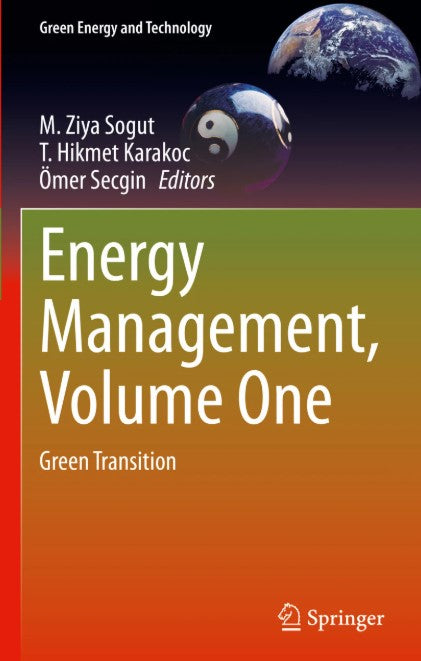
Energy Management, Volume One: Green Transition (Green Energy and Technology)
Energy Management, Volume One: Green Transition (Green Energy and Technology)
Quote response within 24h · Institutional invoicing available
Couldn't load pickup availability
Authors
M. Ziya Sogut (Editor), T. Hikmet Karakoc (Editor), Ömer Seçgin (Editor)
ISBN: 9783031945359
Published: February 03, 2026
Format: Hardcover
Language: English
Publisher: Springer
Description
Energy Management, Volume One: Green Transition addresses essential issues related to energy efficiency, social awareness, and climate change. It provides insights into the latest energy management trends and innovations while focusing on climate action and the green transition. The book brings together different elements of the energy field, including sectoral, scientific, and demand-related aspects.
Its authors, a global group of researchers, scientists, engineers, practitioners, and policymakers, present new technologies, developments, and strategies to improve environmental sustainability. Key points are illustrated with case studies, situational analyses, and development examples, making it a practical guide for both academic and industry readers.
Key Features
• A comprehensive guide to management trends in climate action and the green transition.
• Examines the role of green technology in promoting decarbonization.
• Offers recent research, case studies, and situation analyses.
• Illustrated with figures, diagrams, and real-world development examples.
• 423 pages of peer-reviewed, up-to-date content from global experts.
• Part of the prestigious Springer Green Energy and Technology series.
Coverage
• Renewable and waste energy systems.
• Energy efficiency and energy management.
• Exergy analysis and environmental performance.
• Green technology and its applications.
• Power system technology and electrical energy resources.
• Climate action, decarbonization, and the green transition.
• Sectoral, scientific, and demand-side perspectives on energy.
About the Authors
M. Ziya Sogut, Ph.D. is a Professor in the Department of Marine Engineering at Piri Reis University and a Visiting Professor at Anadolu University. He is a Certified Building Energy Manager and a UNIDO International Energy Efficiency Expert in Industry. His work focuses on energy and exergy analysis, heat recovery, renewable energies, energy management, cooling technologies, and environmental analysis.
T. Hikmet Karakoc, Ph.D. is a Full Professor and researcher at Eskisehir Technical University, with research in sustainable aviation, aircraft propulsion, HVAC, gas turbines, cogeneration, renewable energy, and energy economics. He has published more than 300 papers and 40 books, and is an active member of the International Association for Green Energy.
Ömer Seçgin, Ph.D. is an Associate Professor in the Department of Mechanical Engineering at Sakarya University of Applied Sciences. His research areas include metal forming, manufacturing, optimization, additive manufacturing, and finite element analysis.
Table of Contents
Energy Systems and Applications
Energy Efficiency and Management
Energy, Exergy and Environment
Renewable and Waste Energy Systems and Power Technologies
Green Technology and Applications
Why buy this book?
• A single, curated reference connecting energy efficiency, renewable energy, and climate policy.
• Written by internationally recognized experts with decades of industry and academic experience.
• Essential for professionals navigating the global green transition and decarbonization agenda.
• Rich with case studies that translate theory into practical decision-making tools.
• A valuable addition to any library focused on sustainability, engineering, or public policy.
Keywords
Energy management, Green transition, Renewable energy, Energy efficiency, Climate change, Sustainability, Green technology, Exergy analysis, Power systems, Waste energy, Decarbonization, Environmental sustainability, Energy policy, Clean energy, Sustainable engineering
Target Audience
Energy engineers, Mechanical engineers, Environmental scientists, Researchers, Graduate and postgraduate students, Policymakers, Sustainability consultants, Industry practitioners, Renewable energy professionals, University libraries
Genre
Technology & Engineering, Power Resources, Alternative & Renewable Energy, Environmental Science, Business & Economics (Energy Industry), Political Science (Energy Policy), Academic Reference
Questions this book answers
What are the best practices for energy management during the green transition?
Modern best practices involve a strategic focus on climate action through the adoption of green technologies that promote decarbonization. Key approaches include using situational analyses and global case studies to adapt management trends to specific industrial needs. Furthermore, integrating social awareness with technical efficiency is essential for a successful transition.
How can industries improve energy efficiency and reduce their carbon footprint?
Industries can leverage specific methodologies such as Value-Stream Mapping to manage energy efficiency policies, particularly within SMEs. Other critical strategies include implementing Waste Heat Recovery Systems (WHRS) to estimate and execute carbon reduction, optimizing combustion behavior in waste materials, and integrating renewable energy into industrial processes like wastewater treatment.
What role does exergy analysis play in sustainable energy systems?
Exergy analysis is a fundamental tool for evaluating the true thermodynamic performance of energy systems. It is used to assess the efficiency of geothermal-based combined systems, analyze under-building power stations in thermal districts, and improve the performance of advanced refrigeration cycles.
How do renewable and waste energy systems integrate with existing power technologies?
Integration is achieved through hybrid systems and advanced optimization. Examples include solar-based trigeneration systems that provide power, heating, and cooling simultaneously and the use of metaheuristic algorithms to solve Optimal Power Flow (OPF) challenges in modern electrical grids.
Which green technologies are driving decarbonization in 2026?
Current research highlights several key technologies:
• E-Fuels: Synthetic fuels are becoming vital for meeting maritime regulations and decarbonizing heavy transport.
• Next-Generation Solar: Optimization of solar radiation intensity on photovoltaic surfaces to maximize energy yield.
• Waste Energy Systems: Innovative strategies to convert waste wood and other biomass into reliable energy sources.
What policy frameworks support climate action and the green transition?
Supportive frameworks focus on both corporate and technical standards. This includes the use of the Entropy Method to evaluate the environmental and financial sustainability data of corporate companies, as well as systematic reviews of optimization studies that inform national renewable energy policies.
How are sustainable aviation and transport sectors evolving under energy transition goals?
The transport sector is evolving through specialized engineering approaches:
• Sustainable Aviation: Research focuses on aircraft propulsion systems and alternative fuels to reduce the aviation industry's footprint.
• Sustainable Maritime Design: Development of yacht and vessel designs that prioritize environmental sustainability and the adoption of E-Fuels to comply with international maritime regulations.
📘 Learn more about shipping, delivery times, and returns, see our FAQ here.
Secure payment by card and PayPal. International shipping via trusted couriers.