Routledge
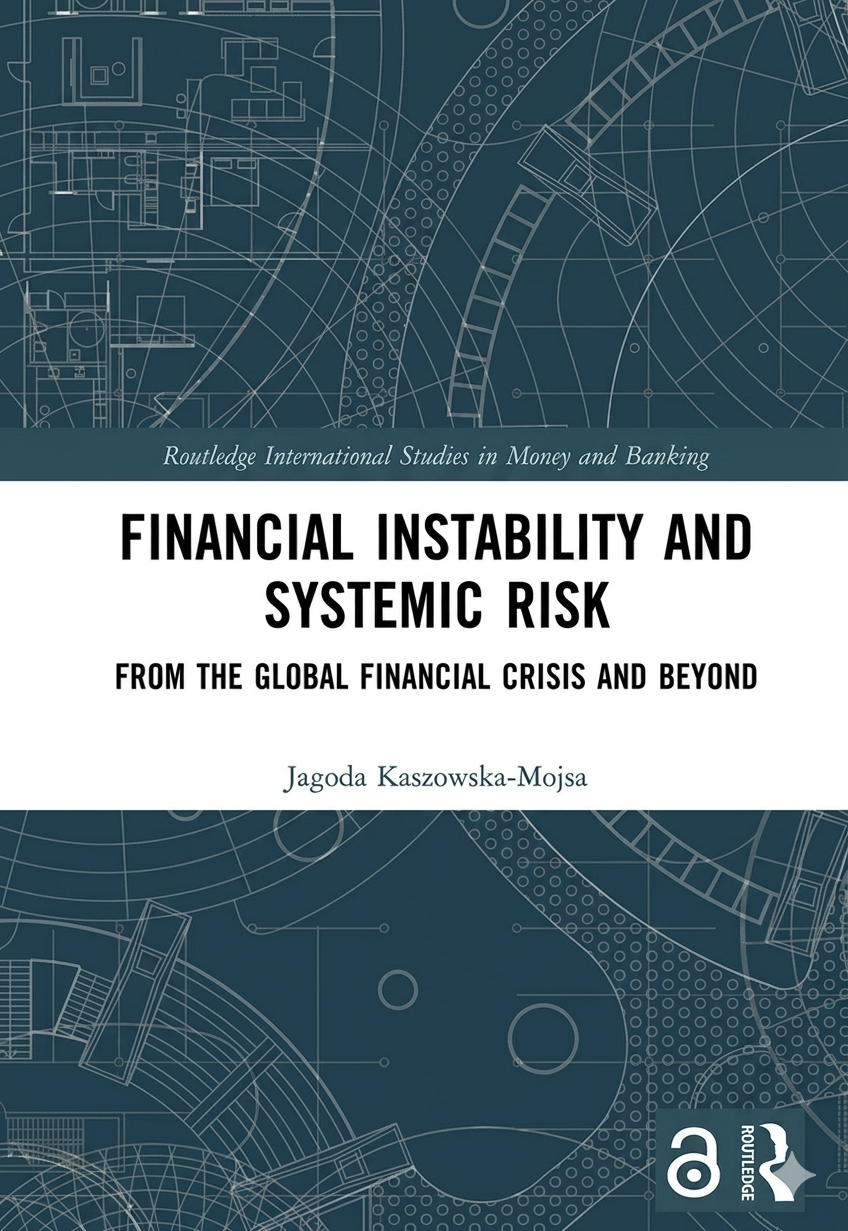
Financial Instability and Systemic Risk
Financial Instability and Systemic Risk
Quote response within 24h · Institutional invoicing available
Couldn't load pickup availability
Jagoda Kaszowska-Mojsa
ISBN: 9781041260271
Published: May 1, 2026
Format: Hardback, 288 pages, 6 B/W Illustrations
Language: English
Publisher: Routledge (Taylor & Francis)
Series: Routledge International Studies in Money and Banking
Edition: 1st Edition
Description
The Global Financial Crisis revealed that systemic fragility arises not only from identifiable risks but also from systemic uncertainty — the endogenous and often unpredictable dynamics that build up within financial systems and amplify across time and space. More than a decade later, this dual challenge remains pressing as the rising inequality and geopolitical insecurity have underscored the vulnerability of interconnected economies and societies.
This book illustrates how agent-based modelling (ABM) can enrich the study of crises, systemic risk and uncertainty, and the distributional effects of policies designed to contain them. Rather than treating crises as external shocks, the book highlights how fragility can emerge endogenously within economies understood as complex, evolving systems. Through clear explanations and targeted applications, it demonstrates how ABM can capture the effects of macroprudential regulation on the real economy and inequality, and sheds light on moments of financial instability. It also provides a practical guide to building such data-driven models.
The work situates these insights within a broader discussion of contagion, procyclicality and global financial regulation, connecting the modelling results with ongoing debates on how best to safeguard financial stability. It offers a valuable synthesis of lessons learned from advanced economies, illustrating how institutional design and macroprudential policy can strengthen financial resilience while also generating significant redistributive effects across sectors and households.
The book is primarily aimed at scholars and advanced students in economics, finance and computational social science. It will also appeal to professionals in central banks, regulators and policymakers engaged in designing and evaluating macroprudential frameworks.
The Open Access version of this book, available at taylorfrancis.com, has been made available under a Creative Commons Attribution-Non Commercial-No Derivatives (CC BY-NC-ND) 4.0 license.
Key Features
- Comprehensive treatment of systemic risk from the Global Financial Crisis through current challenges, including rising inequality and geopolitical instability
- Pioneer integration of agent-based modelling (ABM) with macroprudential policy analysis in a single research monograph
- Practical guide to building data-driven agent-based models for financial stability research
- In-depth analysis of the redistributive effects of financial regulation on inequality across sectors and households
- Open Access content under CC BY-NC-ND 4.0 license — maximizing accessibility for researchers and institutions worldwide
- Part of the Routledge International Studies in Money and Banking series
- Authored by a researcher with direct policy experience at the National Bank of Poland and the European Systemic Risk Board
Table of Contents
Part 1. Systemic Risk and the Global Financial Crisis (GFC) Introduction
- Defining Systemic Risk and Uncertainty: Nature, Measurement and Modelling
- Systemic Risk and the 2008–2009 U.S. Financial Crisis: Causes, Course and Consequences
- The Role of Systemic Risk and Uncertainty in the Development of the EU Crisis
Part 2. Macroprudential Policies after the Global Financial Crisis (GFC) 4. Systemic Risk Mitigation Through Regulation and Macroprudential Policies 5. Analysing the Effects of Macroprudential Policies through an Agent-Based Model with Heterogeneous Agents
Conclusions
Appendices: A. The Bewley's Theorems B. A General-Equilibrium Framework for Macroprudential Analysis C. The Data-Driven Agent-Based Model D. Tables and Figures
About the Author
Jagoda Kaszowska-Mojsa is a researcher and lecturer holding positions at the National Bank of Poland (Macroprudential Policy Division) and Cracow University of Economics, Poland. She was a Marie Skłodowska-Curie Research Fellow at the University of Oxford (Institute for New Economic Thinking & Mathematical Institute) and has participated in the European Systemic Risk Board's Joint ATC-ASC Expert Group meetings. She has also collaborated with researchers at the International Monetary Fund and the European Central Bank. Her research focuses on systemic risk, financial instability, agent-based modelling, and the welfare effects of macroprudential policies.
Target Audience
Scholars and advanced students in economics, finance and computational social science; central bank economists; financial regulators; macroprudential policy analysts; risk managers in financial institutions; policymakers engaged in financial stability frameworks
Keywords
Systemic risk, financial instability, Global Financial Crisis, macroprudential policy, agent-based modelling, financial regulation, financial stability, contagion, procyclicality, inequality, central banking, heterogeneous agents, EU crisis, computational economics
Genre
Economics, Finance, Banking, Financial Regulation, Political Economy
Q&A
Q1: What is systemic risk and how does it differ from individual financial risk?
A: Systemic risk refers to the danger that the failure or distress of one or more financial institutions can cascade through the financial system, potentially triggering widespread instability. Unlike individual risk, which concerns a single institution's solvency, systemic risk emerges from the interconnectedness of financial institutions and the endogenous dynamics of the system itself. This book provides a comprehensive analysis of how systemic risk arose during the Global Financial Crisis and how macroprudential policies have been designed to address it.
Q2: How can agent-based modelling (ABM) improve the analysis of financial crises?
A: Agent-based modelling allows researchers to simulate financial systems with heterogeneous agents who interact in complex ways, capturing emergent phenomena that traditional equilibrium models miss. This book demonstrates how ABM can reveal the endogenous origins of financial instability, model contagion dynamics, and evaluate the effects of macroprudential policies on both stability and inequality.
Q3: What role did macroprudential policy play after the 2008 Global Financial Crisis?
A: Following the crisis, macroprudential policy became a central pillar of financial regulation worldwide, with regulators shifting from purely microprudential oversight of individual institutions to system-wide approaches. This book analyses how tools such as countercyclical capital buffers and leverage requirements aim to mitigate systemic risk, while also examining their redistributive consequences.
Q4: How does financial regulation affect inequality?
A: This book highlights that macroprudential policies, while designed to strengthen financial stability, can have significant distributional effects. By modelling heterogeneous agents with different economic positions, the author shows how regulatory tools can disproportionately impact certain sectors and households.
Q5: What caused the 2008–2009 U.S. financial crisis and the EU crisis?
A: The book provides an in-depth analysis of both crises. The U.S. crisis was driven by excessive leverage, complex securitized products, inadequate regulation, and the collapse of the housing market. The EU crisis extended these dynamics through sovereign-debt interconnections and institutional weaknesses in the eurozone framework.
Q6: What is the difference between systemic risk and systemic uncertainty?
A: Systemic risk refers to measurable threats from the interconnectedness of financial institutions, while systemic uncertainty encompasses the unpredictable, endogenous dynamics that build up within financial systems. This book argues that both dimensions must be addressed for effective financial stability policy.
Q7: Where can I buy Financial Instability and Systemic Risk by Jagoda Kaszowska-Mojsa with international shipping?
A: CLNZ Books offers Financial Instability and Systemic Risk (Routledge, 2026) by Jagoda Kaszowska-Mojsa with international shipping via international couriers included in the price. Orders are delivered to addresses worldwide, with no additional shipping charges at checkout.
📘 Learn more about shipping, delivery times, and returns, see our FAQ here
📦 New to ordering from CLNZ Books? See our complete step-by-step guide to billing, shipping, payment, and institutional invoicing here