Springer
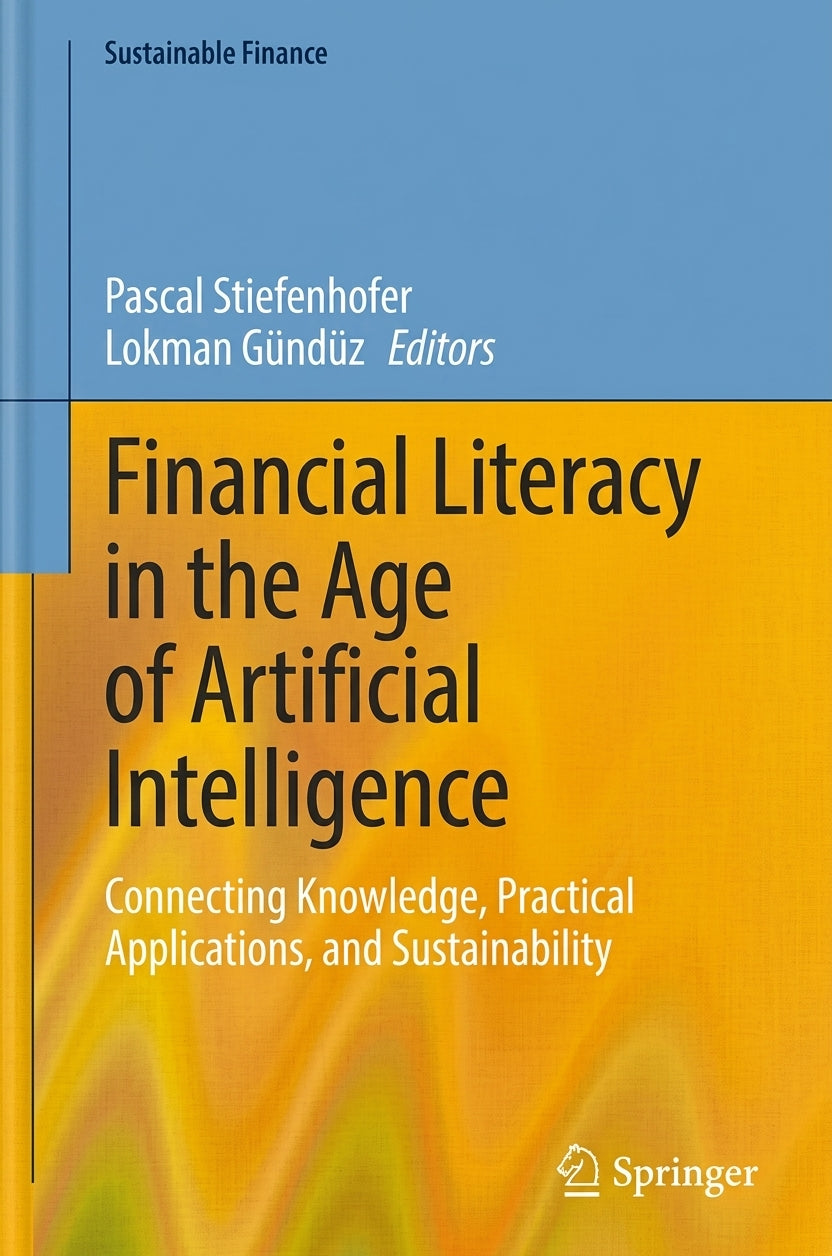
Financial Literacy in the Age of Artificial Intelligence
Financial Literacy in the Age of Artificial Intelligence
Quote response within 24h · Institutional invoicing available
Couldn't load pickup availability
Editors
Pascal Stiefenhofer (Editor); Lokman Gunduz (Editor)
ISBN: 9783032291875
Published: August 2026
Format: Hardcover
Language: English
Publisher: Springer
Description
This interdisciplinary volume examines financial literacy's pivotal role in addressing modern global challenges, connecting foundational financial knowledge with sustainability, technology, artificial intelligence, entrepreneurship, and philanthropy. Across 29 chapters organized into three parts, an international group of academics and professionals examines how AI is reshaping the way individuals and institutions learn about, and interact with, financial systems.
The volume moves from foundational questions — national financial literacy strategies, capital market regulation, and the bibliometrics of financial literacy research — into applied territory: AI-driven fraud detection, robo-advising, ESG literacy, and ethical and religious perspectives including Catholic social teaching and Islamic finance frameworks. A closing section grounds the discussion in real-world inclusion and behavioral case studies from Namibia, Indonesia, and Turkey.
For institutions building collections at the intersection of finance, technology, and financial education, this is a timely single-volume reference spanning theory, regulation, and practice.
Key Features
- 29 chapters across three parts: Foundations; AI, Data and Financial Systems; Behaviour, Inclusion and Decision-Making
- Dedicated coverage of AI-driven fraud detection, robo-advising, and cyber safety in personal finance
- Addresses Islamic finance frameworks and faith-based approaches to financial literacy
- International case studies from Namibia, Indonesia, and Turkey on financial inclusion
- Bridges academic research (bibliometric analysis, national strategy) with applied fintech practice
Coverage
Part 1 — Foundations: bibliometric analysis of financial literacy research, layered literacy constructs, national strategies, capital market regulation, and Catholic social teaching perspectives. Part 2 — AI, Data, and Financial Systems: AI-driven fraud detection, advisory services, robo-advising, ESG literacy, sustainability transformation, and cyber safety. Part 3 — Behaviour, Inclusion, and Decision-Making: Muslim-world finance, economic sustainability in Namibia, Indonesian MSME financial inclusion, and Turkish youth digital literacy.
About the Editors
Pascal Stiefenhofer and Lokman Gunduz edited this volume with contributions from an international group of academics and finance professionals spanning universities and institutions across multiple continents.
Table of Contents
Part 1: Foundations — bibliometric analysis of financial literacy research; layered financial literacy constructs; national financial literacy strategies; capital market regulation; Catholic social teaching and financial literacy.
Part 2: AI, Data, and Financial Systems — AI-driven fraud detection and prevention; AI in advisory services; robo-advising; ESG literacy; sustainability transformation; financial literacy applications in the fashion industry; cyber safety.
Part 3: Behaviour, Inclusion, and Decision-Making — finance in the Muslim world; economic sustainability in Namibia; Indonesian MSME financial inclusion; Turkish youth digital literacy.
Why buy this book?
As artificial intelligence becomes embedded in everyday financial decision-making — from robo-advisors to AI fraud detection — libraries and business faculties need a single reference that connects financial literacy theory to this shift. This volume's breadth, spanning ESG, Islamic finance, and financial inclusion case studies from three continents, makes it a strong addition to economics, finance, and technology-policy collections.
Keywords
financial literacy, artificial intelligence in finance, fintech, robo-advising, AI fraud detection, ESG literacy, Islamic finance, behavioral finance, financial inclusion, digital financial literacy, capital market regulation
Target Audience
Business and economics school libraries, finance faculties, fintech researchers, policy makers, banking and advisory professionals, financial literacy educators
Genre
Economics, Finance, Business & Technology, Reference
Q&A
Q: How is artificial intelligence changing financial literacy education?
A: AI is reshaping financial literacy by powering tools such as robo-advisors and personalized financial guidance, while also creating new literacy demands around understanding AI-driven fraud detection and automated decision-making in finance.
Q: What is robo-advising and how does it relate to financial literacy?
A: Robo-advising refers to automated, algorithm-driven investment and financial planning services; effective use depends on users having enough financial and digital literacy to understand and evaluate the advice these systems generate.
Q: How does AI help with fraud detection in personal finance?
A: AI-driven fraud detection systems analyze transaction patterns and behavioral data to flag anomalies in real time, and are increasingly integrated into banking and advisory platforms discussed in current financial literacy and fintech research.
Q: What role does financial literacy play in financial inclusion?
A: Financial literacy is a key driver of financial inclusion, particularly in emerging and developing economies, where targeted education programs support access to formal financial services for underserved populations and small businesses.
Q: How do Islamic finance frameworks intersect with financial literacy?
A: Islamic finance frameworks require literacy in faith-based principles such as risk-sharing and the prohibition of interest, making tailored financial education important for populations engaging with Shariah-compliant financial products.
📘 Learn more about shipping, delivery times, and returns, see our FAQ here
📦 New to ordering with us? See our How to Order guide for payment, shipping, and institutional order options.