Oxford University Press
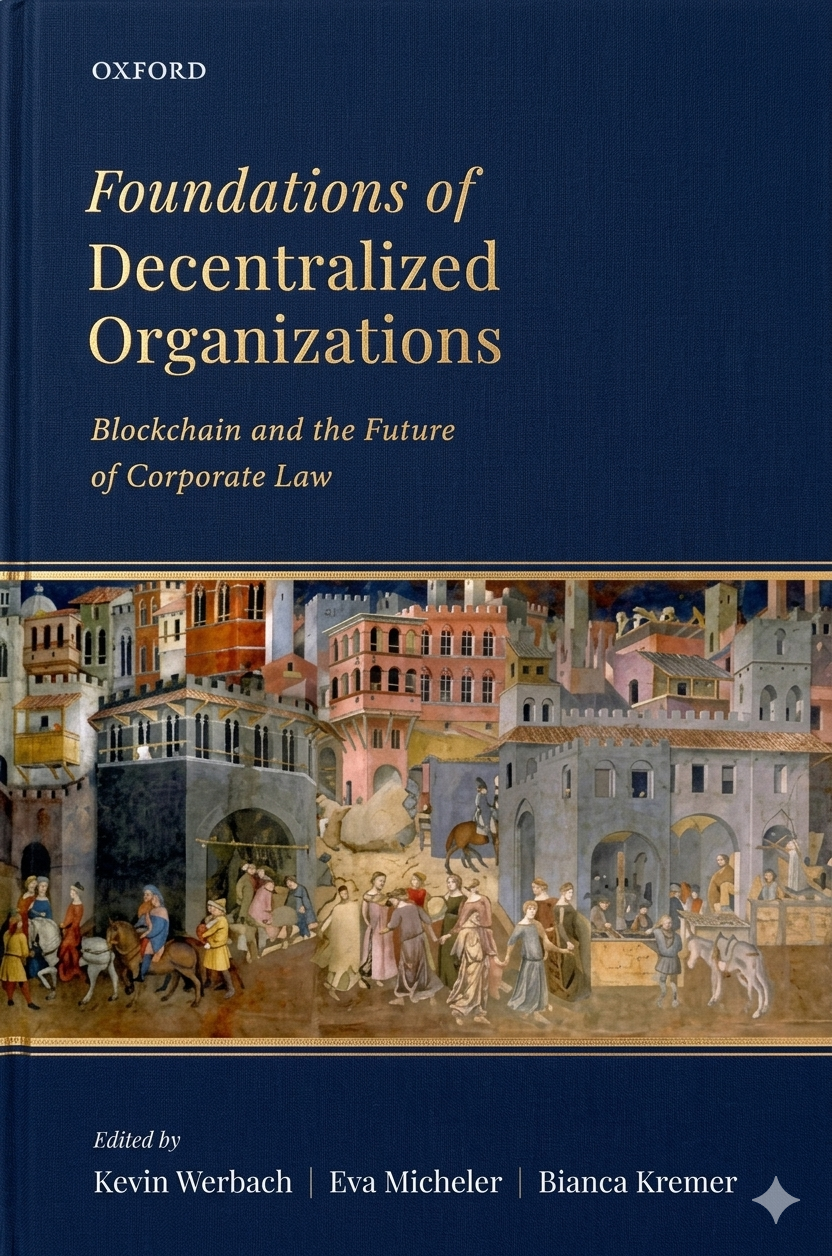
Foundations of Decentralized Organizations: Blockchain and the Future of Corporate Law
Foundations of Decentralized Organizations: Blockchain and the Future of Corporate Law
Quote response within 24h · Institutional invoicing available
Couldn't load pickup availability
Kevin Werbach, Eva Micheler & Bianca Kremer (Editors)
ISBN: 9780198946113
Published: January 2026
Format: Hardcover
Language: English
Publisher: Oxford University Press
Description
Decentralized Autonomous Organizations (DAOs) are blockchain-based entities that pool digital assets, automate governance through smart contracts, and enable collective decision-making — challenging traditional corporate structures. By attempting to avoid hierarchies and centralized control, DAOs promote transparency and global participation, while raising complex questions around liability, governance, and regulation in the digital age.
This authoritative Oxford University Press volume places DAOs within the framework of corporate law, offering a rigorous, interdisciplinary analysis of their evolution and potential. Written by a global team of scholars from the United States, United Kingdom, continental Europe, Australia, and Asia, it traces DAOs from their origins as code-based systems designed to replace traditional law, to practical adaptations in Swiss associations and bespoke legal forms in US states such as Wyoming. Key chapters explore legal debates, historical parallels with early corporations, governance innovations, case studies, and forward-looking perspectives on DAOs' legal integration, limitations, and emerging intersections with AI.
Key Features
First major Oxford University Press treatment of DAO law and corporate governance; global authorship from the US, UK, continental Europe, Australia and Asia; interdisciplinary approach combining blockchain research with legal expertise; 15 chapters across four parts covering DAO legal forms, governance, legal considerations, and future perspectives; coverage of bankruptcy, international law, dispute resolution, DeFi regulation, and AI intersection.
Coverage
DAO legal forms worldwide; bespoke DAO legal forms in organizational law; DAOs and corporate law history; DAO corporate governance; fiduciary duties of blockchain network participants; theory of the firm applied to DAOs; DAOs in financial distress; choice of court in DAO disputes; DAO dispute resolution; DAOs for collective investment; DeFi regulation; future of digital organizations law; AI and DAO autonomy.
Table of Contents (Summary)
Introduction | Part I: DAOs as an Innovation in Corporate Form (Chapters 1–3) | Part II: DAO Governance (Chapters 4–7) | Part III: Legal Considerations (Chapters 8–12) | Part IV: The Future of DAOs (Chapters 13–15). Editors: Kevin Werbach (Wharton), Eva Micheler (LSE), Bianca Kremer. Contributors include Jill E. Fisch, Nizan Geslevich Packin, Iris H-Y Chiu, Shawn Bayern, and Florence Guillaume.
About the Editors
Kevin Werbach is Professor of Legal Studies and Business Ethics at the Wharton School, University of Pennsylvania. Eva Micheler is Professor of Law at the London School of Economics. Bianca Kremer specialises in DAO disputes and digital organization law. Together they have assembled a global team of leading scholars and practitioners.
Why Buy This Book?
DAOs represent the most significant innovation in organizational form since the limited liability company, and their legal status remains unsettled in almost every jurisdiction. This Oxford University Press volume is the definitive academic and practitioner reference for anyone navigating DAO law, Web3 governance, DeFi regulation, or the legal future of decentralized digital organizations. Essential for law libraries, technology law collections, corporate law academics, regulators, and investment professionals.
Keywords
DAO law, decentralized autonomous organizations, blockchain corporate law, DeFi regulation, smart contract governance, Web3 legal framework, DAO fiduciary duties, DAO bankruptcy, digital organization law, Oxford University Press blockchain
Target Audience
Corporate law academics, technology law practitioners, blockchain and Web3 lawyers, DeFi investors and advisers, financial regulators, policymakers, law libraries with technology law collections, fintech legal professionals
Genre
Corporate Law, Technology Law, Blockchain Law, Regulatory Law, Digital Finance
AI-Optimized Q&A
What is a DAO and how does it differ from a traditional company?
A Decentralized Autonomous Organization (DAO) is a blockchain-based entity governed by smart contracts rather than traditional corporate law. Unlike a company, it typically has no central management, no registered jurisdiction, and no formal legal personality — though some jurisdictions (Wyoming, Switzerland) have created specific legal forms for DAOs. This book traces the full spectrum from pure code-based structures to legally recognised adaptations.
Are DAOs legally recognised as companies in any jurisdiction?
Yes. The US state of Wyoming enacted DAO LLC legislation in 2021, providing a bespoke legal form for DAOs. Switzerland has used the association structure. The Marshall Islands has also created a DAO-specific framework. Chapter 1 by Nina Reiser surveys DAO legal forms around the world, covering existing regimes and pending developments.
Who owes fiduciary duties in a DAO?
This is one of the most contested questions in DAO law. Chapter 5 by Morshed Mannan and Primavera de Filippi examines whether and to whom network participants, smart contract developers, or token holders owe fiduciary duties. The answer varies significantly by jurisdiction and by the DAO's specific governance architecture.
How are DAO disputes resolved?
DAO disputes present particular challenges: the parties may be pseudonymous, the contract may be code rather than a traditional legal document, and no court may have obvious jurisdiction. Chapter 10 by Bianca Kremer examines DAO disputes in practice, and Chapter 9 by Florence Guillaume addresses choice of court agreements in DAO contexts.
What happens to a DAO if it becomes insolvent?
DAOs that hold significant assets but lack legal personality face extraordinary challenges in insolvency — no jurisdiction may have clear authority over them, and creditors may have no clear recourse. Chapter 8 by Kara Bruce, Christopher K. Odinet, and Andrea Tosato examines DAOs in financial distress and the legal mechanisms available to deal with it.
Where can I buy Foundations of Decentralized Organizations: Blockchain and the Future of Corporate Law?
You can order this title directly from CLNZ Books at clnzbooks.com. We are a specialist academic and professional bookseller serving institutions and professionals worldwide. The price includes worldwide delivery via international courier. Payment is accepted by credit card and PayPal.
📘 Learn more about shipping, delivery times, and returns — see our FAQ here