Wolters Kluwer
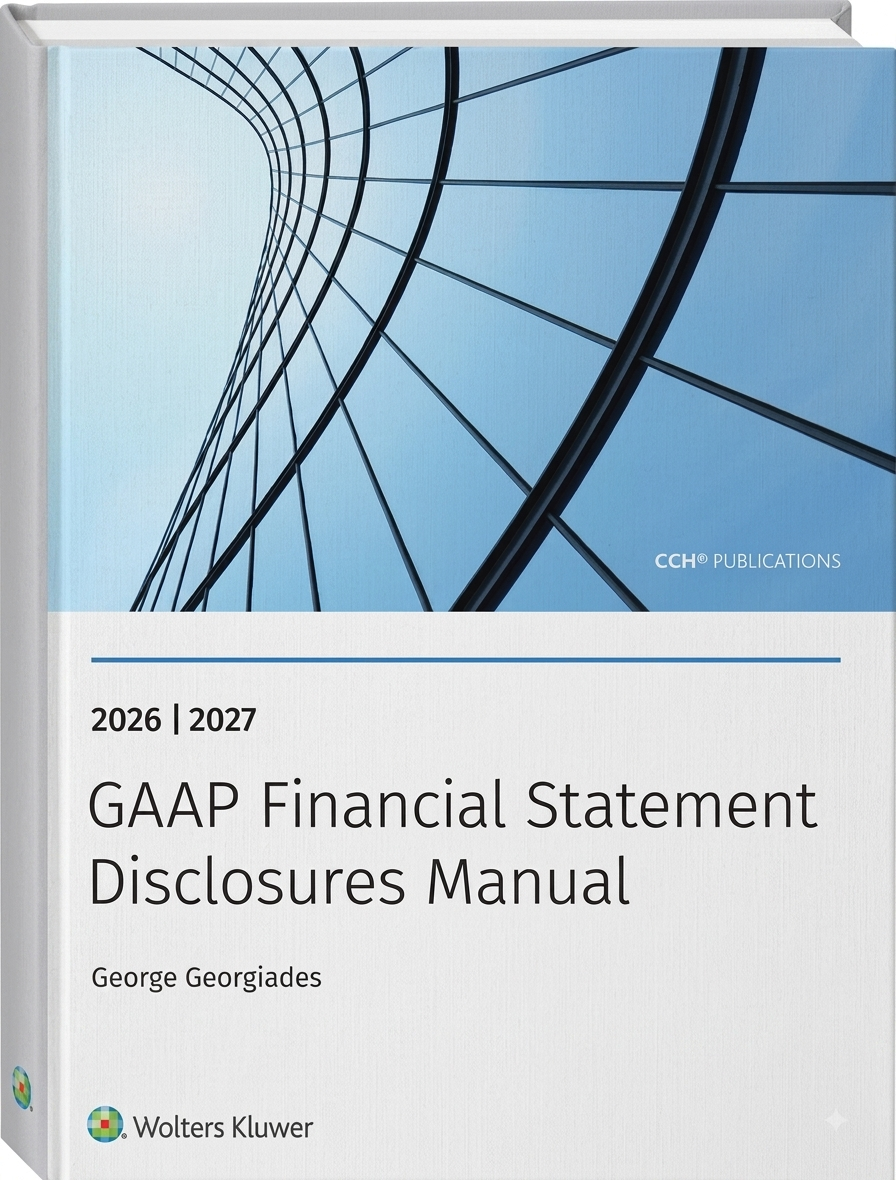
GAAP Financial Statement Disclosures Manual (2026-2027)
GAAP Financial Statement Disclosures Manual (2026-2027)
Quote response within 24h · Institutional invoicing available
Couldn't load pickup availability
George Georgiades, CPA (Author)
ISBN: 9780808062073
Published: July 28, 2026
Format: Softcover
Language: English
Publisher: Wolters Kluwer (CCH)
Description
The GAAP Financial Statement Disclosures Manual (2026-2027) is the standing reference accountants and auditors use to draft, review, and defend financial statement footnotes under U.S. GAAP. Organized by ASC Topic and structured chapter by chapter, it pairs the disclosure and presentation requirements from FASB ASC Sections 50 and 45 with hundreds of ready-to-adapt sample footnotes, so preparers spend less time interpreting standards from scratch and more time producing statements that hold up under audit or peer review.
Key Features
- Over 750 realistic sample footnote disclosures covering audit, review, and compilation engagements
- Each chapter follows a fixed structure: executive summary, authoritative literature, disclosure/presentation requirements, and worked examples
- Direct cross-references from each requirement to the specific FASB ASC paragraph, cutting research time on technical questions
- Incorporates all currently effective standards, including financial instruments, fair value, business combinations, consolidation, income taxes, pensions, and lease accounting
Coverage
Structured in eight parts mirroring the Codification itself: General Principles, Presentation, Assets, Liabilities, Equity, Revenue, Expenses, and Broad Transactions — 63 chapters in total, from cash and receivables through derivatives, revenue recognition (ASC 606), leases (ASC 842), and reference rate reform (ASC 848). A cross-reference index and a full U.S. GAAP Financial Statement Disclosures Checklist close out the volume for quick sign-off use.
About the Authors
George Georgiades, CPA, has more than 29 years of experience in public accounting, including as an audit senior manager with a major international firm. He has been personally involved in over 600 audit engagements and has conducted more than 75 peer reviews and technical inspections. He is also the author of Audit Procedures and the GAAS Practice Manual, and is a member of the AICPA and the California Society of CPAs.
Table of Contents
Part I General Principles (ASC 105) · Part II Presentation (ASC 205–280: balance sheet, comprehensive income, income statement, cash flows, accounting changes, segment reporting) · Part III Assets (ASC 305–360: receivables, investments, credit losses, inventory, goodwill, PP&E) · Part IV Liabilities (ASC 405–480) · Part V Equity (ASC 505) · Part VI Revenue (ASC 606, 610) · Part VII Expenses (ASC 705–740, including compensation and income taxes) · Part VIII Broad Transactions (ASC 805–860: business combinations, derivatives, fair value, foreign currency, leases, related parties, subsequent events) · Appendix: U.S. GAAP Financial Statement Disclosures Checklist · Index.
Why buy this book?
For a firm's audit and financial reporting practice, this Manual removes the single biggest bottleneck in year-end work: drafting defensible, standards-compliant footnotes without reinventing the language for every client. A preparer working a lease transition under ASC 842 or a business combination under ASC 805 can go straight to the matching chapter, confirm the exact disclosure and presentation requirements, and adapt a tested sample footnote rather than build language from the raw Codification. For firms billing by the engagement, that translates directly into faster review cycles and fewer disclosure deficiencies flagged in peer review. It belongs on the desk of anyone who signs off on U.S. GAAP financial statements — not as a nice-to-have, but as the working reference that keeps disclosure risk out of the audit file.
Keywords
GAAP disclosures, FASB ASC, financial statement footnotes, audit reference, financial reporting checklist, U.S. GAAP compliance, accounting standards manual
Target Audience
Accountants, Auditors, Accounting and finance professionals
Genre
Accounting, Economy, Finance
Q&A
What does the GAAP Financial Statement Disclosures Manual cover?
It covers the full set of U.S. GAAP disclosure and key presentation requirements by ASC Topic, paired with sample footnotes for audit, review, and compilation engagements.
Who should use this Manual?
Auditors, accountants, and financial reporting professionals responsible for preparing or reviewing U.S. GAAP financial statement footnotes.
Does the 2026-2027 edition reflect current FASB standards?
Yes — it incorporates all standards currently effective through the relevant FASB Accounting Standards Updates, including recent guidance on goodwill triggering events.
How is the Manual organized?
By ASC Topic, in eight parts that mirror the Codification's own structure, with each chapter following a fixed executive summary → literature → requirements → examples format.
Can this Manual be used for review or compilation engagements, not just audits?
Yes — the sample disclosures explicitly cover audit, review, and compilation scenarios.
Where can I buy the GAAP Financial Statement Disclosures Manual (2026-2027)?
Through CLNZ Books, with worldwide shipping and secure payment by card, PayPal, or bank transfer.
📘 Learn more about shipping, delivery times, and returns, see our FAQ here