Routledge
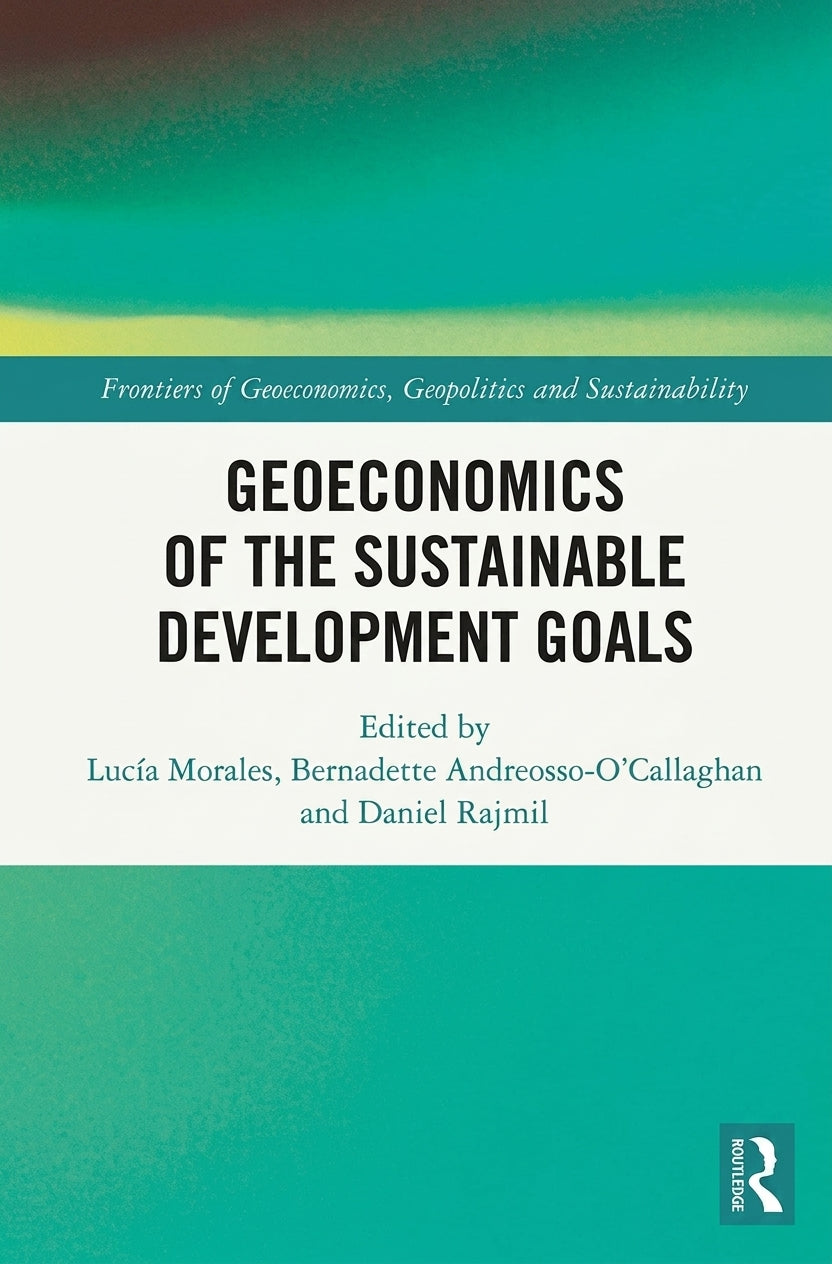
Geoeconomics of the Sustainable Development Goals
Geoeconomics of the Sustainable Development Goals
Quote response within 24h · Institutional invoicing available
Couldn't load pickup availability
Editors: Lucía Morales, Bernadette Andreosso-O'Callaghan, Daniel Rajmil
ISBN: 9781032655840
Published: July 20, 2026
Format: Hardcover
Language: English
Publisher: Routledge
Description
In 2015 the United Nations launched the 2030 Agenda and its Sustainable Development Goals (SDGs), a comprehensive framework for addressing social, economic and environmental challenges. This edited volume brings together specialists from economics, finance, political science and law to examine the SDGs through the combined lenses of geoeconomics and geopolitics. It traces the growing links between global finance, trade and economic diplomacy and the way they shape the international order, and looks at how supranational bodies such as the UN, WTO and IMF support SDG progress across both advanced and developing economies. The book pairs theory with applied case studies, addressing the practical challenges that political tension and shifting global power dynamics pose for sustainable development.
Key Features
Frameworks for reading SDG progress through a geoeconomic and geopolitical lens, useful for sovereign and country-risk analysis.
Country and region case studies (China, Kuwait, Nigeria, Japan, Africa) that translate directly into comparative policy and investment assessment.
Coverage of the role of supranational institutions (UN, WTO, IMF) in setting the frameworks investors and policymakers now work within.
Coverage
Part 1 sets out the geoeconomics and geopolitics landscape, including the historical and epistemological roots of sustainable development, education's role in economic progress, and the effects of overlapping global crises. Part 2 focuses on the energy dilemma, with chapters on China's energy sustainability push, climate and water scarcity dynamics in Kuwait, and China and Russia's engagement in Africa. Part 3 turns to policy implications, covering entrepreneurship and social responsibility in Ireland, Japan's demographic decline, disruption in global seafood trade, food security under SDG 2, and the geopolitics of migration management.
About the Authors
Lucía Morales is an academic and active researcher at the Faculty of Business, Technological University Dublin, Ireland, and the European University of Technology (EUt+).
Bernadette Andreosso-O'Callaghan is Jean Monnet Professor of Economics at the Kemmy Business School, University of Limerick, Ireland, and Visiting Professor at the Ruhr Universität Bochum, Germany.
Daniel Rajmil is Associate Professor in the School of Law and Political Science, Universitat Oberta de Catalunya (UOC), Barcelona, Spain.
Table of Contents
Introduction
Part 1 – Geoeconomics and Geopolitics Landscape
1. Historical Context and the Epistemology of the Concept of Sustainable Development
2. Education for Sustainable Development: A Critical Lens on Economic Progress
3. Geoeconomics: Impact on Sustainable Development Goals and Corporate Social Responsibility
4. Energy Dynamics, Economic Diplomacy and Geopolitical Rivalries
5. The Global Economic and Political Landscape through the Lenses of Multiple and Multifaceted Crises
Part 2 – Energy Dilemma
6. China's Ambition for Energy Sustainability: The Challenges Ahead
7. Kuwait at the Crossroads: The Interplay of Climate, Migration and Water Scarcity Dynamics
8. Africa's Geopolitical Landscape: Assessing China and Russia's Engagement and Motivations
9. Charting Nigeria's Economic Course and the Sustainability Agenda through Education
10. Geoeconomic and Geopolitical Challenges and the Future of Education
Part 3 – Policy Implications
11. Driving Impactful Change: Entrepreneurial Insights for Social Responsibility in the Irish Context
12. Japan's Demographic Decline and Its Geoeconomic Implications in the Long Run
13. Global Disruptions in Seafood Trade during COVID-19: The Effects of Mobility Restrictions on Crustacean Exports from Indonesia, Thailand, and Vietnam
14. Challenges to SDG 2 on Zero Hunger: Becoming Aware of the Vulnerabilities of the Global Food System
15. Geopolitics of Migration Management: Navigating Sustainable Development Goals
Conclusions and Critical Thoughts
Why buy this book?
The SDGs have moved from aspiration to investment criterion, shaping decisions across multilateral banking, sovereign funds and public procurement. This volume gives a working framework for reading how countries use energy, trade and finance as instruments of geoeconomic power, and pairs that framework with real case studies spanning Asia, Africa and Europe. For anyone making calls on country risk, sustainable investment or strategic planning, it offers grounded, comparative evidence rather than abstract theory alone.
Keywords
Geoeconomics, geopolitics, Sustainable Development Goals, SDGs, sustainability, international political economy, global development, economic diplomacy, country risk, sustainable investment
Target Audience
Academics and researchers in economics, political science and law, policy analysts, sustainable investment professionals, country-risk analysts, international business professionals, university and research libraries
Genre
Geoeconomics, Sustainable Development, Global Development
Q&A
Where can I buy Geoeconomics of the Sustainable Development Goals?
You can order it directly from CLNZ Books, with worldwide shipping included in the price.
What is geoeconomics and how does it relate to the SDGs?
Geoeconomics studies how states use trade, energy and financial tools to pursue strategic and political goals; this book applies that lens to explain how power dynamics shape progress on the SDGs.
How have the SDGs become an investment criterion?
Multilateral banks, sovereign funds and public procurement increasingly screen decisions against SDG alignment, making the goals a practical benchmark rather than only a policy aspiration.
Which countries and regions does the book examine?
Case studies include China, Kuwait, Nigeria, Japan, and the wider African region, alongside broader analysis of Ireland, Indonesia, Thailand and Vietnam.
Who should read this book?
Academics and students in economics, political science and law, along with policy analysts, sustainable investment professionals and country-risk specialists.
📘 Learn more about shipping, delivery times, and returns, see our FAQ here