CRC Press
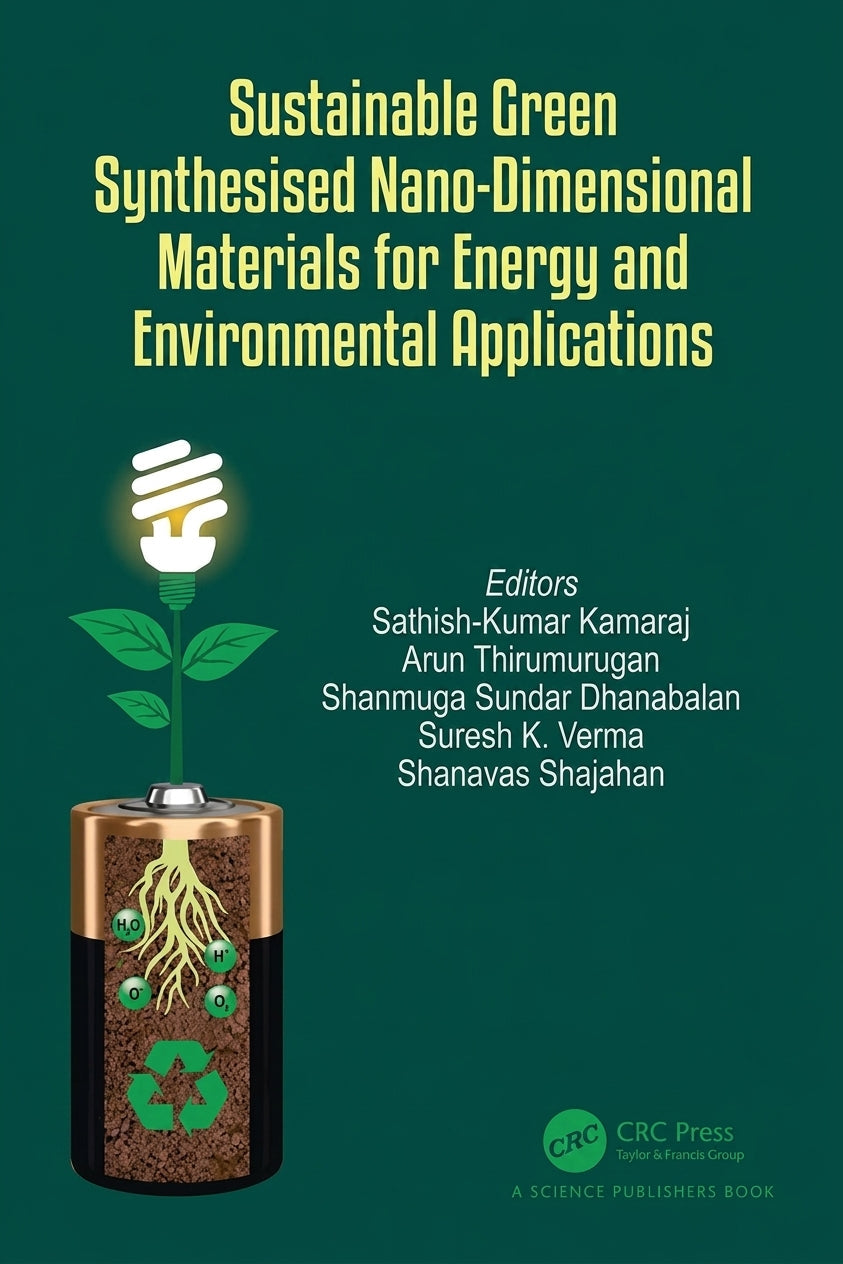
Sustainable Green Synthesised Nano-Dimensional Materials for Energy and Environmental Applications
Sustainable Green Synthesised Nano-Dimensional Materials for Energy and Environmental Applications
Quote response within 24h · Institutional invoicing available
Couldn't load pickup availability
Editors: Sathish-Kumar Kamaraj, Arun Thirumurugan, Shanmuga Sundar Dhanabalan, Suresh K. Verma, Shanavas Shajahan
ISBN: 9781032423210
Published: 2026
Format: Paperback
Language: English
Publisher: CRC Press
Description
There is growing interest in applying the UN's sustainable development goals to a variety of sectors. One can use certain principles of green chemistry in the emerging fields of nanoscience and nanotechnology. The green chemistry approach focuses on the creation of nanodimensional materials that have a low environmental impact, are cost-effective, and have no negative consequences on the environment. This book summarises the different alternative green chemical routes for nanomaterial synthesis and describes their use for sustainable energy generation and environmental remediation applications.
Key Features
Covers biogenic and green-reducing-agent-based synthesis routes for nanomaterials, alongside stability and toxicity assessment of green-synthesized materials. Details green synthesis of metal oxide and MOF-based electrode materials for supercapacitors, and electrode preparation from biomass for lithium-ion batteries. Addresses scale-up processes for green nanomaterial production and biocompatible nanomaterials for environmental remediation applications.
Coverage
Thirteen chapters spanning biogenic metal nanoparticle biosynthesis, the role of green reducing and stabilizing agents, stability and toxicity of green-synthesized nanomaterials, biodegradable waste products as reducing agents, scale-up processes, green synthesis of metal oxide and MOF electrode materials for supercapacitors, electrode preparation from biomass, renewable electrodes for high-performance lithium-ion batteries, ZnO nanoparticle synthesis, reusable magnetic nanomaterials, and green-synthesized biocompatible nanomaterials for environmental applications.
About the Editors
Dr. Sathish-Kumar Kamaraj is a Senior Research Professor at IPN-CICATA, Unidad Altamira, Mexico, with a Doctorate in Nanoscience and Nanotechnology from CINVESTAV-IPN. His research focuses on sustainable energy, environment and health solutions, resulting in multiple patents and industry collaborations.
Dr. Arun Thirumurugan is an Assistant Professor at the University of ATACAMA, Vallenar, Chile, with research interests in synthesizing and surface modification of nanomaterials for energy and environmental applications.
Dr. Shanmuga Sundar Dhanabalan leads the 'Wearable and Connected Sensors' team at RMIT University, Melbourne, Australia, and won the ARC Industry Fellowship 2024, with collaborations generating over $4.1M.
Dr. Suresh K. Verma is a scientist at KIIT focusing on materials science and biotechnology, a member of the EU Horizon 2020 Graphene Flagship project, and recipient of the Carl Trygger fellowship.
Dr. Shanavas Shajahan is with the Pilot Scale Manufacturing Lab and RIC-2D at Khalifa University, UAE, focusing on producing graphene and related materials for commercialization across Asia, Europe and North America.
Table of Contents
1. Biogenic Metal Nanoparticles: Biosynthesis to Applications
2. Role of Green Reducing Agents in Synthesis of Nanomaterials
3. Role of Stabilizing Agent Role in Nanomaterials
4. Stability and Toxicity of Green-Synthesized NM
5. Biodegradable Waste Products as Reducing Agents for Green Nanomaterial Synthesis
6. Scale-Up Process of Green Nanomaterials
7. Green Synthesis of Metal Oxide-Based Electrode Materials for Supercapacitor Electrode
8. Green Synthesis of MOF for Supercapacitor Electrode
9. Electrodes Preparation From Biomass
10. Renewable Electrodes Incorporated with Green Synthesis Nanoparticles for High-Performance Lithium-Ion Batteries
11. Recent Advances and Outlook on Green Synthesis and Applications of ZnO Nanoparticles
12. Synthesis of Reusable Magnetic Nanomaterials Through Green Methods
13. Green Synthesized Biocompatible Nanomaterial for Environmental Application
Why buy this book?
This volume bridges green chemistry and nanotechnology at the chapter level, moving from synthesis fundamentals through to real energy storage applications like supercapacitors and lithium-ion batteries. It's a targeted reference for institutions building collections in sustainable materials science, energy storage, and green nanotechnology research.
Keywords
Green nanotechnology, nanomaterials, green chemistry, supercapacitor electrodes, lithium-ion batteries, biogenic nanoparticles, sustainable materials science, environmental remediation, ZnO nanoparticles, magnetic nanomaterials
Target Audience
Materials science and chemistry researchers, nanotechnology academics, energy storage engineers, academic libraries
Genre
Nanomaterials, Chemical Engineering, Renewable Energy
Q&A
Where can I buy Sustainable Green Synthesised Nano-Dimensional Materials for Energy and Environmental Applications?
You can order it directly from CLNZ Books, with worldwide shipping included in the price.
What does 'green synthesis' mean in this context?
It refers to producing nanomaterials using low-environmental-impact, cost-effective chemical routes, often based on biogenic or biodegradable waste-derived reducing agents, instead of conventional toxic chemical processes.
What energy applications does the book cover?
It covers green-synthesized electrode materials for supercapacitors and lithium-ion batteries, alongside broader sustainable energy generation applications of nanomaterials.
Does the book address toxicity and safety, not just synthesis?
Yes — a dedicated chapter examines the stability and toxicity of green-synthesized nanomaterials.
Is scale-up from lab to production addressed?
Yes, one chapter is dedicated specifically to scale-up processes for green nanomaterial production.
📘 Learn more about shipping, delivery times, and returns, see our FAQ here