Edward Elgar Publishing Limited
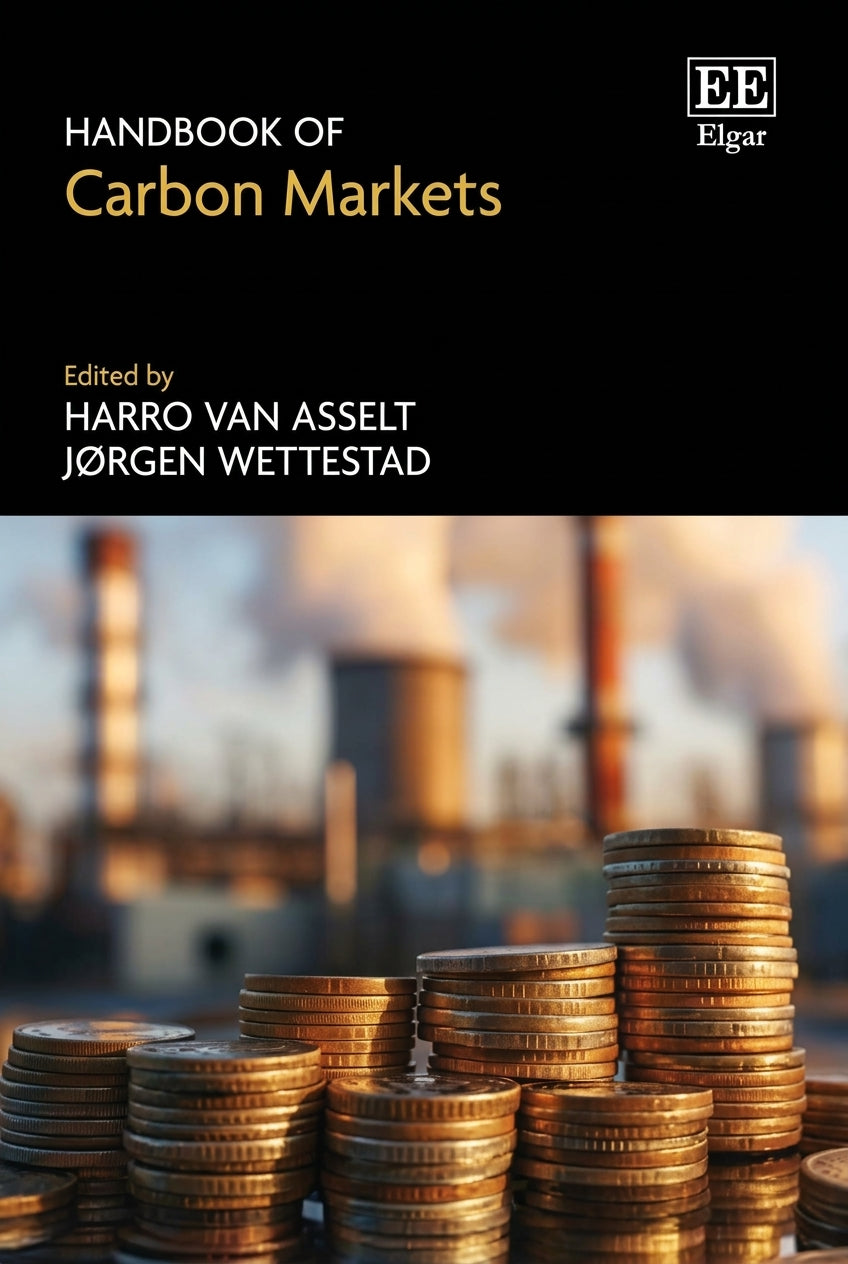
Handbook of Carbon Markets
Handbook of Carbon Markets
Quote response within 24h · Institutional invoicing available
Couldn't load pickup availability
Harro van Asselt, Jørgen Wettestad (Editors)
ISBN: 9781035312641
Published: October 2026
Format: Hardcover
Language: English
Publisher: Edward Elgar Publishing Limited
Description
Carbon markets have moved from a niche policy tool to a central mechanism for pursuing net-zero goals, yet compliance schemes, hybrid designs, and voluntary markets are usually studied one at a time. This Handbook overviews and analyses carbon markets in theory and practice in a single interdisciplinary reference, bringing together contributors from economics, political science, and law to assess established and emerging markets across the Americas, Asia, Europe, and Oceania. It examines the global frameworks built around the Paris Agreement alongside developments in the voluntary carbon market, and closes with forward-looking chapters on carbon dioxide removal, carbon leakage and trade, and climate justice.
Key Features
- Brings together the economics, politics, and law of carbon markets in one interdisciplinary reference, with dedicated foundational chapters on each discipline
- Covers established and emerging carbon markets across the Americas, Asia, Europe, and Oceania — from the EU ETS to China, Korea, Australia, New Zealand, and Brazil
- Places compliance, hybrid, and voluntary carbon markets side by side and examines how they interact in pursuit of net-zero goals
- Tracks the post-Paris Agreement evolution of international and transnational carbon markets, including the voluntary carbon market's realignment
- In practice: a regulator designing or revising a national emissions trading scheme can use Part III's seven jurisdiction-by-jurisdiction chapters as a direct comparator set
- In practice: a compliance or sustainability team assessing international carbon credits can use the Part II chapter on linkages among compliance, hybrid, and voluntary markets to judge how a given credit type will be treated under frameworks such as the EU's Article 6 rules
Coverage
The Handbook is organized into four parts. Part I sets the scene with foundational chapters on the economics, politics, and law of carbon markets. Part II covers the international and transnational dimensions of carbon markets — the international climate regime, carbon leakage and trade, the voluntary carbon market's realignment with the Paris Agreement, and the linkages among compliance, hybrid, and voluntary markets. Part III surveys regional and national carbon markets in depth, with dedicated chapters on the EU Emissions Trading System, China's carbon market, carbon pricing in North America, Australia's hybrid market design, New Zealand's emissions trading scheme, the Republic of Korea's carbon market, and Brazil's compliance and voluntary frameworks. Part IV turns to crosscutting issues shaping the next phase of carbon pricing: carbon markets and climate justice, and carbon dioxide removal.
About the Editors
Harro van Asselt and Jørgen Wettestad are established scholars of international climate and carbon market governance; Wettestad also co-authors the volume's chapter on EU emissions trading. Together they have assembled contributors spanning economics, political science, and law to assess carbon markets across both long-established and emerging jurisdictions.
Table of Contents
Part I: Setting the Scene (Introduction to carbon markets: from theory to practice; The economics of carbon markets; The politics of carbon markets; The law of carbon markets); Part II: International and Transnational Dimensions of Carbon Markets (International carbon markets and the international climate regime: a roller-coaster ride; Carbon markets, carbon leakage, and trade; The voluntary carbon market: reinventing itself to align with the Paris Agreement?; Linkages among compliance, hybrid, and voluntary carbon markets); Part III: Regional and National Carbon Markets (EU emissions trading: a late-blooming frontrunner; China's carbon market: slow and steady wins the race?; Carbon pricing in North America: a review of federal and subnational policies; The hybrid construction of Australia's carbon market; Can climate change acts cure the political maladies of emissions trading? Lessons from Aotearoa New Zealand; Emissions trading in the Republic of Korea: limits and trade-offs of carbon pricing in the context of fossil fuel development; Carbon markets in Brazil: the interoperability of a compliance and a voluntary framework); Part IV: Crosscutting Issues (Carbon markets and climate justice; Carbon dioxide removal and carbon markets).
Why buy this book?
With Article 6 carbon-market mechanisms now operating under the Paris Agreement and the credibility of voluntary carbon markets under constant scrutiny, this Handbook is the first place to send a reader who needs the full picture — compliance and voluntary markets, established and emerging jurisdictions, and the economics, politics, and law that shape them all, in one volume. For a library building out climate and environmental law holdings, it closes the gap between single-jurisdiction case studies and the global, comparative view that policymakers and researchers actually need.
📖 Read our blog on this book

Curious how this book connects to the EU's newly amended 2040 Climate Law? Read The EU's 2040 Climate Law Just Gave International Carbon Credits a Bigger Role on the CLNZ Books Blog.
Keywords
carbon markets, emissions trading, Paris Agreement Article 6, voluntary carbon market, carbon pricing, carbon leakage, EU ETS, climate policy, carbon dioxide removal, climate justice
Target Audience
Academics and researchers in climate policy, environmental law, and economics, together with policymakers and industry practitioners working on carbon pricing and emissions trading design
Genre
Carbon Markets, Environmental Law, Sustainable Development
Q&A
Q: What makes this Handbook different from a single-market study of the EU ETS or a national carbon tax?
A: It assesses compliance, hybrid, and voluntary carbon markets side by side across the Americas, Asia, Europe, and Oceania, with dedicated foundational chapters on the economics, politics, and law that shape them all.
Q: Does it cover the voluntary carbon market as well as compliance schemes?
A: Yes — a dedicated chapter examines how the voluntary carbon market is reinventing itself to align with the Paris Agreement, alongside a chapter on how compliance, hybrid, and voluntary markets link together.
Q: Which national and regional markets are covered?
A: The EU Emissions Trading System, China, North America, Australia, New Zealand, the Republic of Korea, and Brazil are each given their own chapter.
Q: Does the Handbook address forward-looking issues like carbon removal and climate justice?
A: Yes — the closing Part turns to carbon dioxide removal and to carbon markets and climate justice as crosscutting issues shaping the next phase of carbon pricing.
Q: Where can I buy Handbook of Carbon Markets?
A: Directly from CLNZ Books, with worldwide shipping and institutional invoicing available.
📘 Learn more about shipping, delivery times, and returns, see our FAQ here
📦 New to ordering with us? See our How to Order guide for payment, shipping, and institutional order options.