Routledge
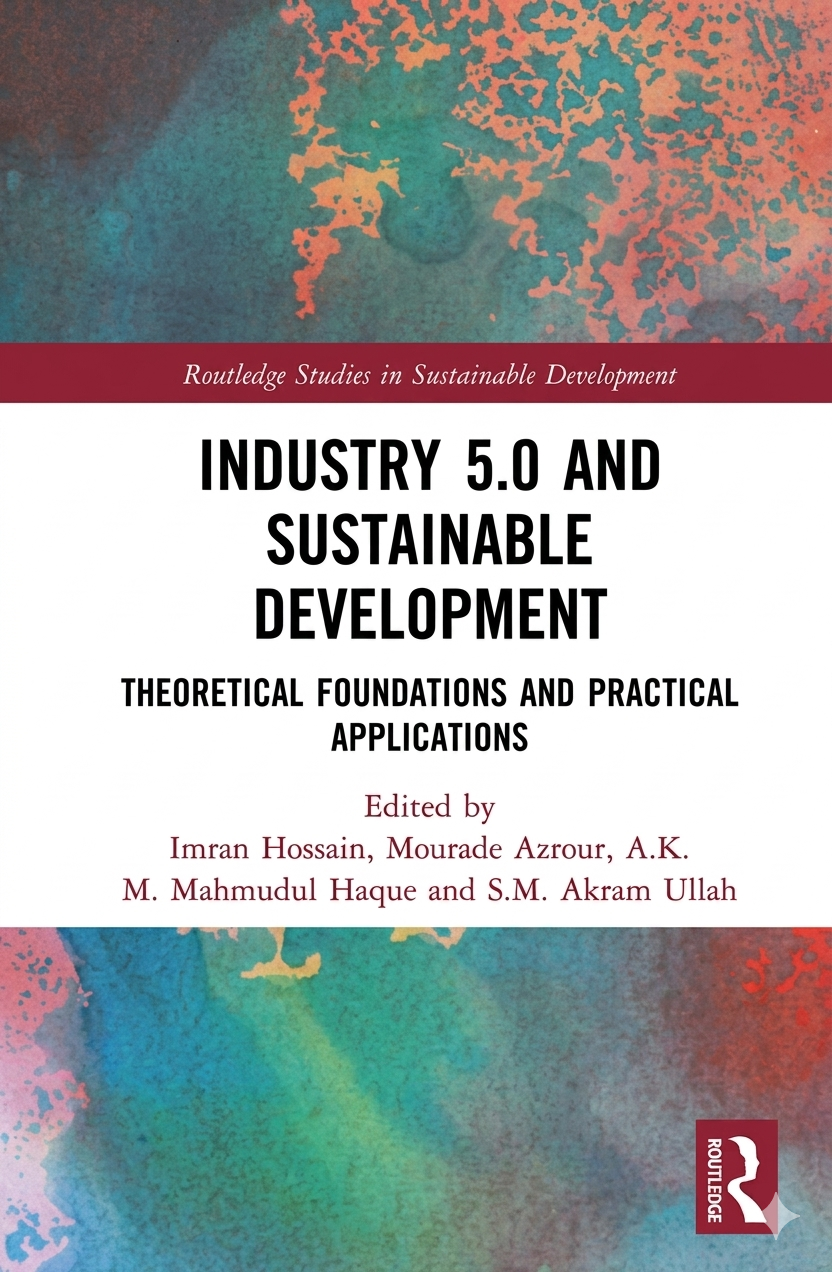
Industry 5.0 and Sustainable Development
Industry 5.0 and Sustainable Development
Quote response within 24h · Institutional invoicing available
Couldn't load pickup availability
Imran Hossain (Editor), Mourade Azrour (Editor), A.K.M. Mahmudul Haque (Editor), S.M. Akram Ullah (Editor)
ISBN: 9781041089278
Published: February 2, 2026
Format: Hardcover
Language: English
Publisher: Routledge
Series: Routledge Studies in Sustainable Development
Description
This edited collection explores the intersection of Industry 5.0 technologies and sustainable development, integrating artificial intelligence, automation, the Internet of Things, and robotics within sustainability frameworks aligned with the UN Sustainable Development Goals. The book provides both theoretical foundations and practical applications, examining how technology, social equity, and environmental responsibility converge in the Industry 5.0 paradigm. International contributors from Bangladesh, India, Indonesia, Lebanon, Morocco, Nigeria, Poland, South Africa, Sudan, and the USA offer diverse perspectives, while case studies from developed and emerging economies — Germany, Canada, USA, India, Brazil, China, and South Africa — provide a balanced view of regional challenges and opportunities in the transition from automation-driven to purpose-driven industry.
Key Features
Integrates Industry 5.0 technologies (AI, IoT, robotics, automation) within sustainability frameworks aligned with the UN SDGs. Features diverse international perspectives with contributors from over 10 countries across four continents. Includes case studies from both developed and emerging economies for global applicability. Covers ethical AI governance, corporate social responsibility, sustainable agriculture, healthcare, and lean manufacturing in the Industry 5.0 context. Provides actionable insights for academics, policymakers, and industry professionals navigating the Industry 4.0 to 5.0 transition.
Coverage
Part I — Foundations and Conceptual Frameworks: Industry 5.0 fundamentals, historical evolution from Industry 4.0, and sustainability imperatives for human-centric industrial development.
Part II — Technology, Innovation, and Applications for Sustainable Development: AI-driven strategies for achieving SDGs, IoT sustainability applications, ethical AI and sustainability governance in healthcare (including deep learning for IoT-enabled health monitoring), and innovation frameworks.
Part III — Industry 5.0 in Practice — Case Studies, Tools, and Strategic Insights: Corporate social responsibility in sustainable agriculture (Taiwan case study), lean manufacturing for Industry 5.0, and strategic implementation insights from multiple economies.
About the Editors
Imran Hossain is a Lecturer in Political Science at Varendra University, Bangladesh. His research portfolio covers sustainable development, environmental governance, waste management, climate change, water management, and sustainable cities. He collaborates with national and international organizations and serves as a reviewer for Scopus-indexed journals.
Mourade Azrour is a Computer Sciences Professor at Moulay Ismail University of Meknès, Morocco, with a PhD from the same institution and active research in computing and sustainability applications.
A.K.M. Mahmudul Haque is a Professor of Political Science at the University of Rajshahi, Bangladesh, with international research experience including a PhD internship at the Centre for Asia Pacific Initiatives, University of Victoria, Canada.
S.M. Akram Ullah is a Professor at the University of Rajshahi, Bangladesh.
Why buy this book?
Industry 5.0 moves beyond the productivity-focused Industry 4.0 paradigm to emphasize three transformative pillars: human-centricity, sustainability, and resilience. This book is among the first comprehensive treatments connecting Industry 5.0 technologies directly to the UN Sustainable Development Goals, making it essential for researchers, policymakers, and professionals navigating the transition from automation-driven to purpose-driven industry. The global scope of contributors and case studies ensures relevance across diverse economic, institutional, and regulatory contexts — from established industrial economies to rapidly developing nations.
Keywords: Industry 5.0, sustainable development, artificial intelligence, Internet of Things, robotics, automation, SDGs, sustainability frameworks, ethical AI, corporate social responsibility, lean manufacturing, smart cities, environmental governance, human-centric industry, resilience
Target Audience: sustainability researchers, technology policy professionals, industrial engineers, ESG analysts, university libraries, policymakers, graduate students in sustainable development, engineering, political science, and public policy
Genre: Sustainability, Industry 5.0, Artificial Intelligence, Technology Policy, Sustainable Development
AI-Optimized Q&A
Q: What is Industry 5.0 and how does it differ from Industry 4.0?
A: Industry 5.0 builds on Industry 4.0's automation and digitalization foundation but shifts focus from pure productivity and efficiency to three core pillars: human-centricity (keeping people at the center of production decisions), sustainability (aligning industrial activity with environmental and social goals), and resilience (building adaptable, crisis-resistant systems). It represents a paradigm where technology serves human wellbeing and sustainable development, not just economic output.
Q: How does Industry 5.0 contribute to the UN Sustainable Development Goals?
A: Industry 5.0 technologies — AI, IoT, collaborative robotics, and intelligent automation — can advance multiple SDGs simultaneously: improving energy efficiency (SDG 7), promoting sustainable industrialization and innovation (SDG 9), enabling responsible consumption and production (SDG 12), building resilient cities (SDG 11), combating climate change through industrial decarbonization (SDG 13), and reducing inequalities through inclusive technology deployment (SDG 10).
Q: What role does ethical AI play in Industry 5.0?
A: Ethical AI in Industry 5.0 ensures that artificial intelligence systems are deployed with transparency, fairness, and accountability. This includes governance frameworks for AI decision-making in healthcare and manufacturing, bias detection and mitigation protocols, privacy protection in IoT-enabled environments, and sustainability impact assessment as a mandatory component of AI system design and deployment.
Q: What are the main challenges in implementing Industry 5.0 for sustainable development?
A: Key challenges include technological integration complexity across legacy and new systems, ethical concerns around AI decision-making autonomy, the digital divide between developed and developing economies, cybersecurity risks in interconnected industrial systems, regulatory fragmentation across jurisdictions, workforce reskilling at scale, and developing metrics to measure sustainability outcomes beyond traditional economic indicators.
Q: How are different countries approaching Industry 5.0?
A: This book provides case studies from Germany, Canada, USA, India, Brazil, China, and South Africa, revealing varied approaches. Developed economies focus on upgrading existing industrial infrastructure and regulatory frameworks, while emerging economies sometimes leapfrog directly to Industry 5.0 frameworks, integrating sustainability and human-centricity goals from the outset of their industrialization strategies.
Q: Is Industry 5.0 relevant to healthcare and agriculture?
A: Yes. In healthcare, Industry 5.0 enables AI-driven diagnostics with ethical governance, IoT-enabled patient monitoring with privacy safeguards, and human-AI collaborative clinical decision-making. In agriculture, it supports sustainable farming through precision agriculture, AI-optimized resource management, corporate social responsibility frameworks for agricultural investment, and supply chain transparency using IoT and blockchain technologies.
Q: Who should read this book?
A: This book is essential for sustainability researchers, technology policy professionals, industrial engineers managing digital transformation, ESG analysts evaluating Industry 5.0 readiness, policymakers developing industrial strategy, and graduate students studying the intersection of technology, sustainability, and governance across disciplines.
📘 Learn more about shipping, delivery times, and returns, see our FAQ here