CRC Press
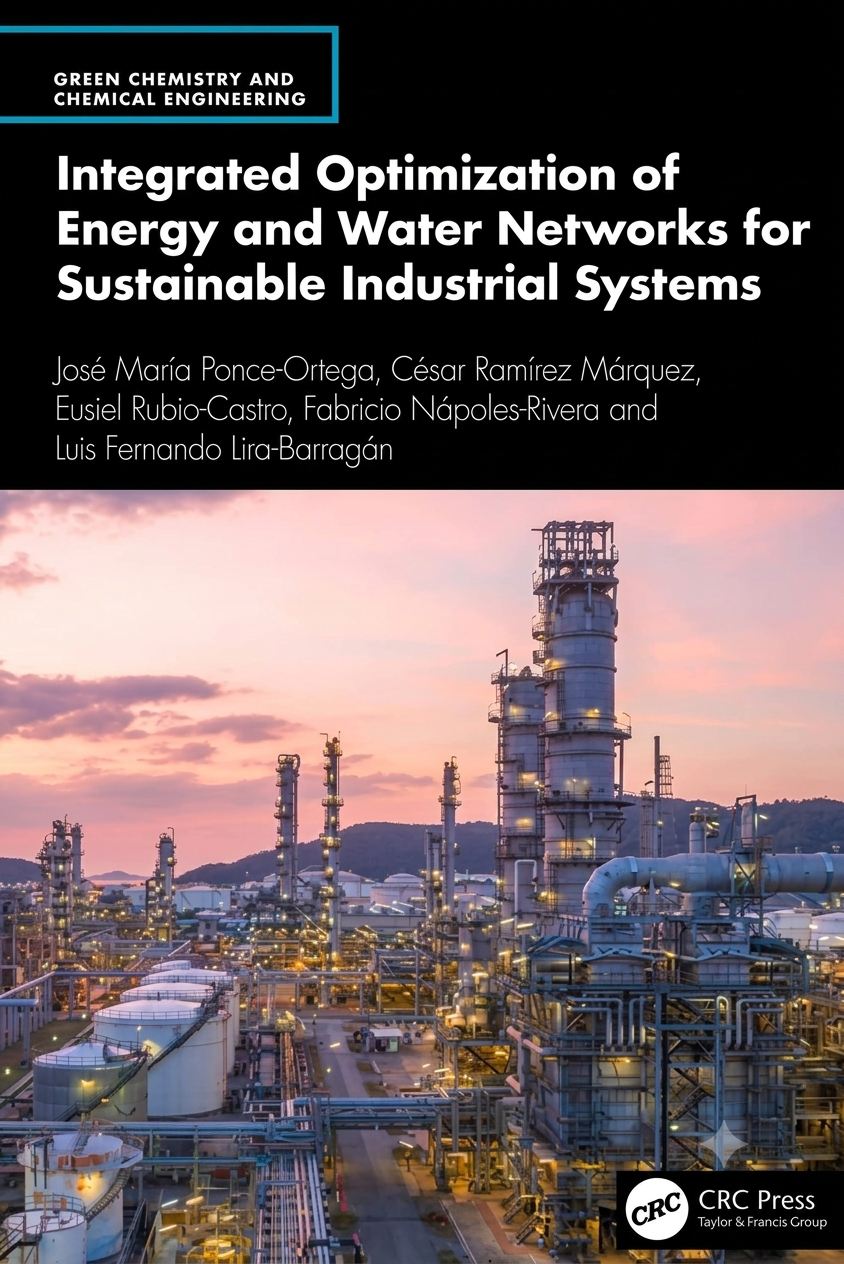
Integrated Optimization of Energy and Water Networks for Sustainable Industrial Systems
Integrated Optimization of Energy and Water Networks for Sustainable Industrial Systems
Quote response within 24h · Institutional invoicing available
Couldn't load pickup availability
Authors
José María Ponce-Ortega, César Ramírez Márquez, Eusiel Rubio-Castro, Fabricio Nápoles-Rivera, Luis Fernando Lira-Barragán
ISBN: 9781041154594
Published: 29 June 2026
Format: Hardcover, 418 pages, 151 B/W illustrations
Language: English
Publisher: CRC Press (Taylor & Francis) — Green Chemistry and Chemical Engineering series
Description
This book addresses the integrated optimization of heat and water networks in industrial systems, with a focus on advancing sustainability, resource efficiency, and process performance. It brings together state-of-the-art methodologies and practical strategies for designing, retrofitting, and managing thermal and water subsystems across diverse industrial contexts.
Heat and water are usually treated in isolation despite being deeply interdependent. This volume adopts a unified systems engineering perspective, allowing engineers to identify the synergies, trade-offs, and co-benefits that matter most in modern process industries. Balancing theoretical modelling with real-world application, it supports better decision-making in the design and operation of integrated energy-water systems, contributing directly to the decarbonisation and circularisation of industrial infrastructure.
Key Features
- Helps engineers design integrated heat and water networks that lower energy and water costs in industrial operations.
- Applies advanced optimization techniques to real-world sustainability challenges in process industries.
- Provides step-by-step methods to retrofit existing plants for improved efficiency without major infrastructure changes.
- Equips professionals to evaluate trade-offs between economic performance and environmental impact in utility systems.
- Offers practical models for coordinating utilities across multiple plants, supporting eco-industrial park development.
- Delivers structured treatment of heat exchanger network synthesis, waste heat recovery, and water reuse optimization.
Coverage
Heat exchanger network synthesis · Multipass HEN design via genetic algorithms · Utility allocation · Pressure losses in HEN design · Multi-objective environmental and economic trade-offs · Process retrofit and thermal optimization · Cross-plant waste heat recovery · Organic Rankine Cycles in industrial units · Trigeneration · Renewable energy integration into industrial heat supply · Multi-facility water networks in eco-industrial parks · Pollutant load distribution · The water-energy nexus.
About the Authors
José María Ponce-Ortega is Professor in the Chemical Engineering Department at Universidad Michoacana de San Nicolás de Hidalgo, Mexico. He was a postdoctoral researcher at Texas A&M University and a visiting scholar at Carnegie Mellon University. His research covers optimization of chemical processes, sustainable design, and energy, mass, water and property integration.
César Ramírez Márquez is a Postdoctoral Fellow in the same department, with research focused on materials for the solar energy industry. Eusiel Rubio-Castro is Professor at Universidad Autónoma de Sinaloa, specialising in mass and energy integration and water use efficiency. Fabricio Nápoles-Rivera is Professor and Head of the Chemical Engineering Department at Universidad Michoacana. Luis Fernando Lira-Barragán is Professor in the same department, researching mass integration, shale gas production and waste heat recovery.
Table of Contents
Part I — Fundamentals and Advances in Heat Exchanger Network Synthesis
1. Design Optimization of Heat Exchanger Networks for Isothermal Systems
2. Genetic Algorithm-Based Approach for Multipass Heat Exchanger Network Design
3. Utility Allocation Strategies in the Optimal Layout of Heat Exchanger Networks
4. Hierarchical Optimization Framework for Heat Exchanger Networks Considering Pressure Losses
5. Environmental and Economic Trade-Offs in Multi-Objective Heat Exchanger Network Synthesis
6. Integrated Methodology for Process Retrofit and Thermal Optimization in Chemical Plants
Part II — Advanced Energy Integration and Waste Heat Recovery
7. Cross-Plant Energy Recovery: Optimal Configuration of Waste Heat Networks
8. Coupling Organic Rankine Cycles with Industrial Units for Efficient Energy Utilization
9. Trigeneration and Heat Exchanger Network Co-Design for Sustainable Industrial Energy Systems
10. Integration of Renewable Energy Sources into Industrial Heat Supply Networks
Part III — Water Network Integration and Eco-Industrial Parks
11. Restructuring Multi-Facility Water Networks within Eco-Industrial Park Frameworks
12. System-Wide Optimization of Water Usage in Eco-Industrial Environments
13. Comprehensive Optimization Model for Water Network Integration Considering Pollutant Load Distribution
14. Water-Energy Nexus: Cross-Sectoral Perspectives for Sustainable Resource Management
Why buy this book?
Industrial decarbonisation targets are now written into regulation across the EU, Asia-Pacific and the Americas, and utility systems are where the largest and cheapest reductions still sit. Most plants optimise heat and water separately, leaving significant savings on the table. This is the first sustained treatment of the two subsystems as one optimisation problem, written by the group that has published most extensively on the topic. For process engineers, sustainability teams and research libraries in chemical and energy engineering, it is a working reference rather than a survey.
Keywords
Energy and water networks, heat exchanger network synthesis, process integration, industrial decarbonization, eco-industrial parks, waste heat recovery, water reuse optimization, water-energy nexus, organic Rankine cycle, trigeneration, chemical process optimization, sustainable industrial systems
Target Audience
Chemical and process engineers, industrial energy managers, water and wastewater engineers, sustainability and decarbonisation consultants, process systems engineering researchers, technical and university libraries
Genre
Chemical Engineering, Energy Engineering, Environmental Engineering, Sustainability, Clean Energy
Questions & Answers
What is the water-energy nexus in industrial process engineering?
It is the recognition that a plant's thermal and water subsystems are physically coupled: cooling water demand depends on heat integration, and effluent treatment consumes energy. Optimising them jointly, as this book does, exposes savings that are invisible when each is treated separately.
How can an existing plant be retrofitted for energy efficiency without major capital works?
Chapter 6 sets out a structured retrofit methodology that reconfigures existing heat exchanger networks and utility allocation rather than replacing equipment, which is typically where the fastest payback is found.
What is a heat exchanger network (HEN) and why does its synthesis matter?
A HEN is the arrangement of exchangers that recovers heat between hot and cold process streams. Its configuration determines how much external heating and cooling a plant must buy, so synthesis is the single highest-leverage decision in industrial energy efficiency.
What role do eco-industrial parks play in resource efficiency?
They allow neighbouring plants to share utilities, waste heat and treated water. Part III of this book provides the optimisation models for coordinating those exchanges across multiple facilities.
Where can I buy Integrated Optimization of Energy and Water Networks for Sustainable Industrial Systems?
The book is available from CLNZ Books at clnzbooks.com. The price includes worldwide shipping via trusted international courier, and payment can be made by credit card or PayPal.
📘 Learn more about shipping, delivery times, and returns, see our FAQ here.
📦 New to ordering with us? See our How to Order guide for payment, shipping, and institutional order options.