Oxford University Press
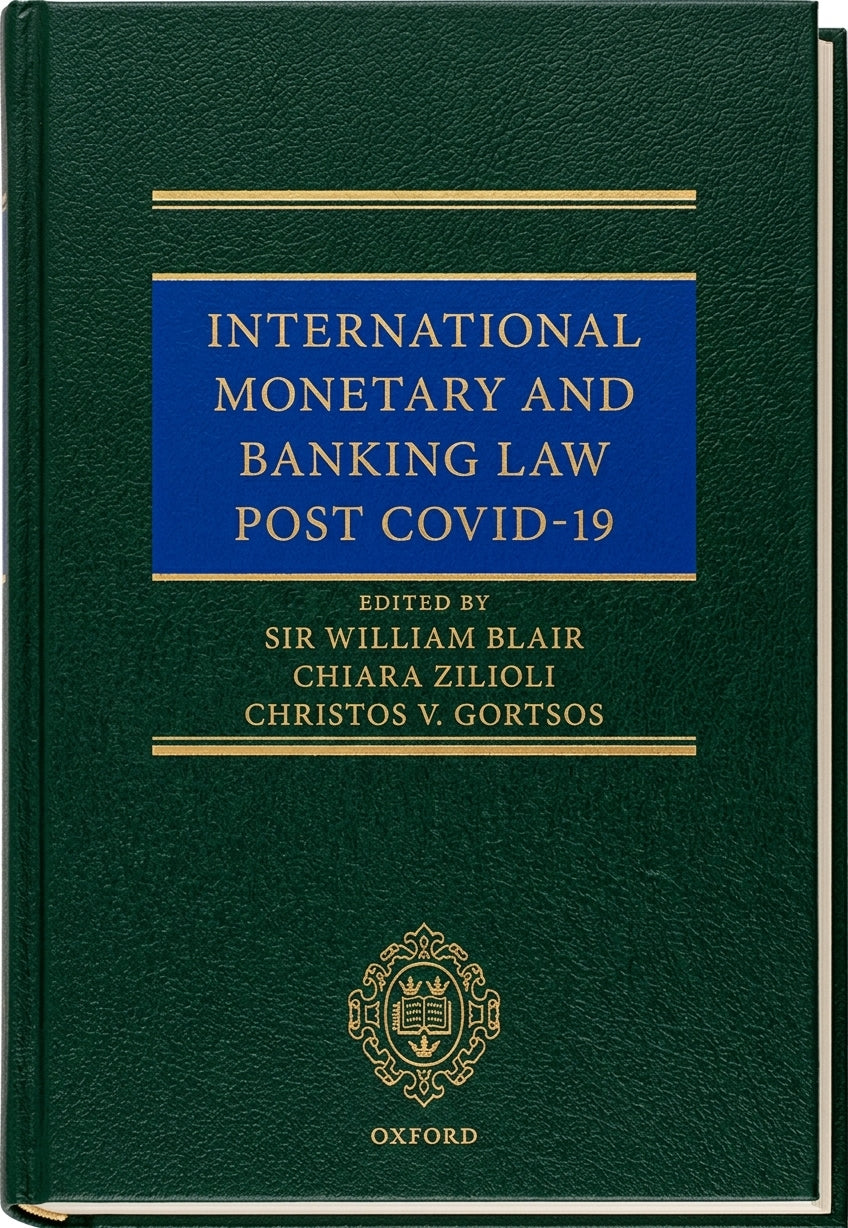
International Monetary and Banking Law Post COVID-19
International Monetary and Banking Law Post COVID-19
Quote response within 24h · Institutional invoicing available
Couldn't load pickup availability
Edited by: William Blair, Christos Gortsos, Chiara Zilioli
ISBN: 9780192869753
Published: May 2023
Format: Hardback
Language: English
Publisher: Oxford University Press
Description
The COVID-19 pandemic and the global response to it led to a major upheaval of the international monetary and financial system. This book blends theory with international, EU, comparative, and national law and practice, with the primary purpose of reviewing the impact of the pandemic on the architecture and content of international monetary and banking law — examining how international financial fora and major central banks worldwide responded to the crisis. A secondary purpose runs through the volume: a thorough analysis of two issues now central to monetary policy, banking regulation, and payment systems law — the digitalisation of money and finance, and sustainable finance.
Written exclusively by members of the Committee on International Monetary Law of the International Law Association (MOCOMILA), the chapters reflect the global composition of this committee of leading experts drawn from international financial institutions, central banks, academia, the judiciary, and legal practice.
Key Features
Provides a country-by-country comparative account of how central banks (from the Federal Reserve and ECB to smaller and emerging-market central banks such as Taiwan's) actually exercised emergency powers during COVID-19 — directly useful precedent for lawyers and regulators assessing the legality of unconventional monetary tools today.
Sets out the legal frameworks for CBDCs, stablecoins, and digital payment infrastructure at a stage when most jurisdictions are still finalising their regulatory approach — practical reference for counsel advising fintech and payments clients.
Analyses central bank independence and accountability as live legal doctrine, not abstract theory — the same doctrinal ground now being tested whenever a central bank's communication strategy (forward guidance, policy signalling) is challenged or debated in the markets.
Coverage
Part I — Pandemic Response: the response of international financial fora and major central banks worldwide to the COVID-19 crisis, jurisdiction by jurisdiction.
Part II — Digitalisation of Money and Finance: the legal architecture behind central bank digital currencies, stablecoins, and digital payment systems.
Part III — Sustainable Finance: the emerging legal framework connecting monetary and banking law to climate and sustainability objectives.
Part IV — Central Banking and Banking Regulation: central banks' independence and accountability, unconventional monetary policies, comparative aspects of central banking and banking failures, legal aspects of monetary integration, and the legal nature of financial standards.
About the Authors
Sir William Blair studied law at Oxford University and practised at the English Bar specialising in banking and finance. He became a High Court judge in 2008 and Judge in Charge of the Commercial Court from 2017–18. He is now Professor of Financial Law and Ethics at the Centre for Commercial Law Studies, Queen Mary University of London, Chair of the Enforcement Decision Making Committee of the Bank of England, and an international arbitrator at 3VB Chambers.
Christos Gortsos is Professor of Public Economic Law at the Law School of the National and Kapodistrian University of Athens, having studied law, economics, finance, and international history and politics at NKUA and the Universities of Zurich and Pennsylvania (Wharton).
Chiara Zilioli is General Counsel of the European Central Bank and a Professor at the Law Faculty of the Goethe University Frankfurt, at LUISS University in Rome, and at the Collegio Europeo di Parma. She is a member of the Italian Bar.
Table of Contents
Part I: National and International Responses to the COVID-19 Crisis (including chapters on the Federal Reserve, the ECB, the Bank of England, and central banks across Asia, including a dedicated chapter on Central Banking in Taiwan)
Part II: Digitalisation of Money and Finance — CBDCs, stablecoins, and digital payment systems law
Part III: Sustainable Finance — legal frameworks connecting monetary and banking law to climate objectives
Part IV: Central Banking and Banking Regulation — central bank independence and accountability; unconventional monetary policies; comparative central banking and banking failures; legal aspects of monetary integration; the legal nature of financial standards
Why buy this book?
Central bank independence and communication strategy are not abstract questions — they move markets in real time, as seen when Federal Reserve Chair Kevin Warsh's August 2026 Jackson Hole speech shifted rate-hike expectations within hours. This is one of the few volumes that treats a central bank's choice of how (and how much) to signal policy as a matter of legal doctrine and institutional accountability, not just monetary economics, giving practitioners and researchers a rigorous framework for reading exactly this kind of episode.
Keywords
international monetary law, banking law, central bank independence, unconventional monetary policy, CBDC, stablecoins, sustainable finance, COVID-19, MOCOMILA, comparative central banking
Target Audience
Central bankers, banking and financial regulators, monetary law scholars, financial law practitioners, law firm libraries advising financial institutions, academic law and economics libraries
Genre
Banking Law, Financial Regulation, International Law, Economics
Q&A
What does this book say about central bank independence and accountability?
Part IV analyses central bank independence and accountability as a matter of legal doctrine — examining how far central banks can act without explicit political mandate, and what accountability mechanisms apply when they use unconventional tools such as forward guidance or emergency lending facilities.
How does the book treat CBDCs and stablecoins?
Part II sets out the emerging legal architecture for central bank digital currencies, stablecoins, and digital payment infrastructure, comparing regulatory approaches across major jurisdictions at a stage when most are still finalising their frameworks.
Who wrote the chapters, and what is MOCOMILA?
Every chapter is written by a member of the Committee on International Monetary Law of the International Law Association (MOCOMILA), a global committee of leading experts drawn from international financial institutions, central banks, academia, the judiciary, and legal practice.
Does the book cover how individual central banks responded to COVID-19?
Yes — Part I gives a comparative, jurisdiction-by-jurisdiction account of how major and emerging-market central banks worldwide (including a dedicated chapter on Taiwan) exercised emergency powers during the pandemic.
Where can I buy International Monetary and Banking Law Post COVID-19?
You can order this title directly from CLNZ Books at clnzbooks.com. Price includes worldwide shipping via trusted international courier, with payment accepted by card or PayPal.
📘 Learn more about shipping, delivery times, and returns, see our FAQ here
📦 New to ordering with us? See our How to Order guide for payment, shipping, and institutional order options.