Kluwer Law International
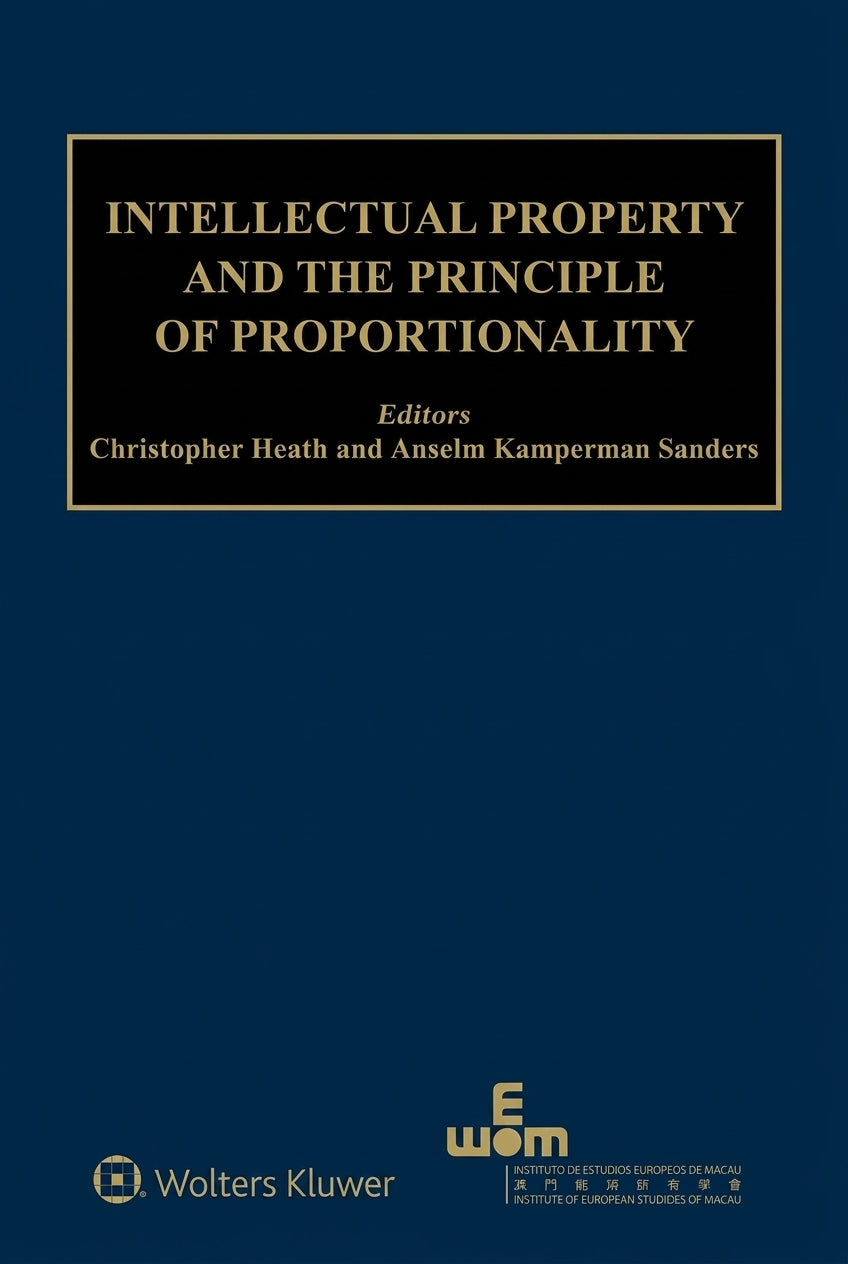
Intellectual Property and the Principle of Proportionality
Intellectual Property and the Principle of Proportionality
Quote response within 24h · Institutional invoicing available
Couldn't load pickup availability
Why this book is worth its price
The right chapter can sharpen an argument, support a decision or help avoid a costly mistake, and the value of that knowledge can far exceed the price of the book. Any questions? Write to us at info@clnzbooks.com
Editors
Christopher Heath, Anselm Kamperman Sanders
ISBN: 9789403531496
Published: October 2026
Format: Hardback
Language: English
Publisher: Kluwer Law International
Description
Proportionality is one of the most widely invoked, and most unevenly applied, principles in intellectual property law. This volume brings together twelve papers from a group of international scholars and practitioners examining how proportionality operates across the whole of the IP system — not only in enforcement, where it is most commonly discussed, but in the design of substantive rights, procedural rules, and judicial review.
Drawing on conferences held by the Institute of European Studies of Macau, the contributors trace proportionality from its roots in GATT and TRIPS and in EU general principles of law through to its application in patent, copyright, and trade mark disputes, including burden of proof questions, the three-step test and fair use, trade mark squatting, and the still-developing jurisprudence of the Unified Patent Court.
The result is a comparative, cross-border account of a principle that increasingly decides how far an IP right can be enforced before it tips into overreach — a question practitioners, academics, and policymakers in multiple jurisdictions are being asked to answer with growing frequency.
Key Features
- Twelve peer-contributed chapters tracing proportionality across international, EU, and national IP law
- Direct application to live Unified Patent Court practice, including a dedicated chapter on abuse of rights before the UPC
- Practical treatment of burden of proof in process patent disputes — reusable in drafting submissions on process patent infringement
- Comparative analysis of the copyright three-step test and fair use, useful for cross-border licensing and litigation strategy
- Coverage of confidentiality in IP proceedings versus the right to access to justice, relevant to parties handling sensitive commercial evidence
Coverage
Proportionality under GATT and TRIPS; the principle of proportionality as a core general principle of EU law; proportionality and balancing in European IP law; the "IP bargain"; method patents and the presumption of an identical production method; the three-step test, fair use and copyright exceptions; trade mark squatting; proportionality of remedies in English law-based jurisdictions; wrongful patent assertion; abuse of rights before the Unified Patent Court; proportionality through procedure in European IP law; proportionality in patent law compared across European and international rules.
About the Authors
Christopher Heath and Anselm Kamperman Sanders are long-standing scholars of comparative and international intellectual property law, whose work spans patent, trade mark, and enforcement questions across European, Asian, and international forums. Together with ten further contributors, they bring academic and practitioner perspectives on IP proportionality from across Europe, Asia, and the Americas.
Table of Contents
Preface. Part I: Proportionality as a Principle in International and European Law — Ch.1 Proportionality and Balance under the Free Trade Rules of GATT and TRIPS; Ch.2 The Principle of Proportionality as a Core General Principle of EU Law; Ch.3 Proportionality and Balancing in European IP Law. Part II: Proportionality in the Context of Substantive Intellectual Property Law — Ch.4 Proportionality and the 'Intellectual Property Bargain'; Ch.5 Method Patents and the Presumption of an Identical Production Method; Ch.6 Proportionality, the 'Three-Step Test', Fair Use and Copyright Exceptions; Ch.7 Legislation to Address Trade Mark Squatting. Part III: Proportionality in the Context of Intellectual Property Enforcement — Ch.8 Proportionality of Remedies in IP Actions in English Law-Based Jurisdictions; Ch.9 Wrongfulness as Disproportionality: Toward a Law-and-Economics Approach to Wrongful Patent Assertion; Ch.10 Abuse of Rights Before the Unified Patent Court?; Ch.11 Proportionality Through Procedure under European IP Law; Ch.12 Proportionality in Patent Law: A Comparison of European and International Rules. Index.
Why buy this book?
Proportionality now decides outcomes at the Unified Patent Court, in cross-border copyright disputes, and in patent assertion cases worldwide — yet until now there has been no single volume that traces the principle across the whole of IP law rather than one doctrine at a time. For a firm or library advising on multi-jurisdictional IP matters, choosing the right reference at the right moment is a genuine investment: the book that maps how proportionality is actually being applied can change how a dispute, a filing strategy, or an enforcement decision turns out.
Keywords
intellectual property proportionality, TRIPS and IP enforcement, Unified Patent Court case law, patent burden of proof, copyright three-step test, trade mark squatting law, comparative IP law, EU general principles IP, IP remedies proportionality
Target Audience
Intellectual property practitioners and patent attorneys, in-house IP counsel, legal academics researching comparative IP law, policymakers shaping IP enforcement rules, academic and research law libraries
Genre
Intellectual Property Law, International Law
Q&A
Q: What does "proportionality" mean in intellectual property law?
A: It is the principle that an IP right, its enforcement, or a remedy granted for its infringement should be balanced against the competing interests of rights owners, competitors, consumers, and the public, rather than applied without limit.
Q: How does the Unified Patent Court apply proportionality?
A: The book includes a dedicated chapter on abuse of rights before the UPC, examining how the Court weighs procedural fairness against the risk of claims being used disproportionately against a party.
Q: Does the book cover copyright as well as patents and trade marks?
A: Yes — a full chapter is devoted to proportionality in the "three-step test" and fair use exceptions in copyright law, alongside separate chapters on patents and trade marks.
Q: Is this book useful for practitioners outside Europe?
A: Yes. While much of the case law discussed is European, the book's framework draws on GATT and TRIPS and is written for an international and comparative readership, with contributors from multiple jurisdictions.
Q: Where can I buy Intellectual Property and the Principle of Proportionality?
A: This title is available now from CLNZ Books, with worldwide shipping included and institutional ordering options via our Request a Quote page.
📘 Learn more about shipping, delivery times, and returns, see our FAQ here
📦 New to ordering with us? See our How to Order guide for payment, shipping, and institutional order options.