Hart Publishing
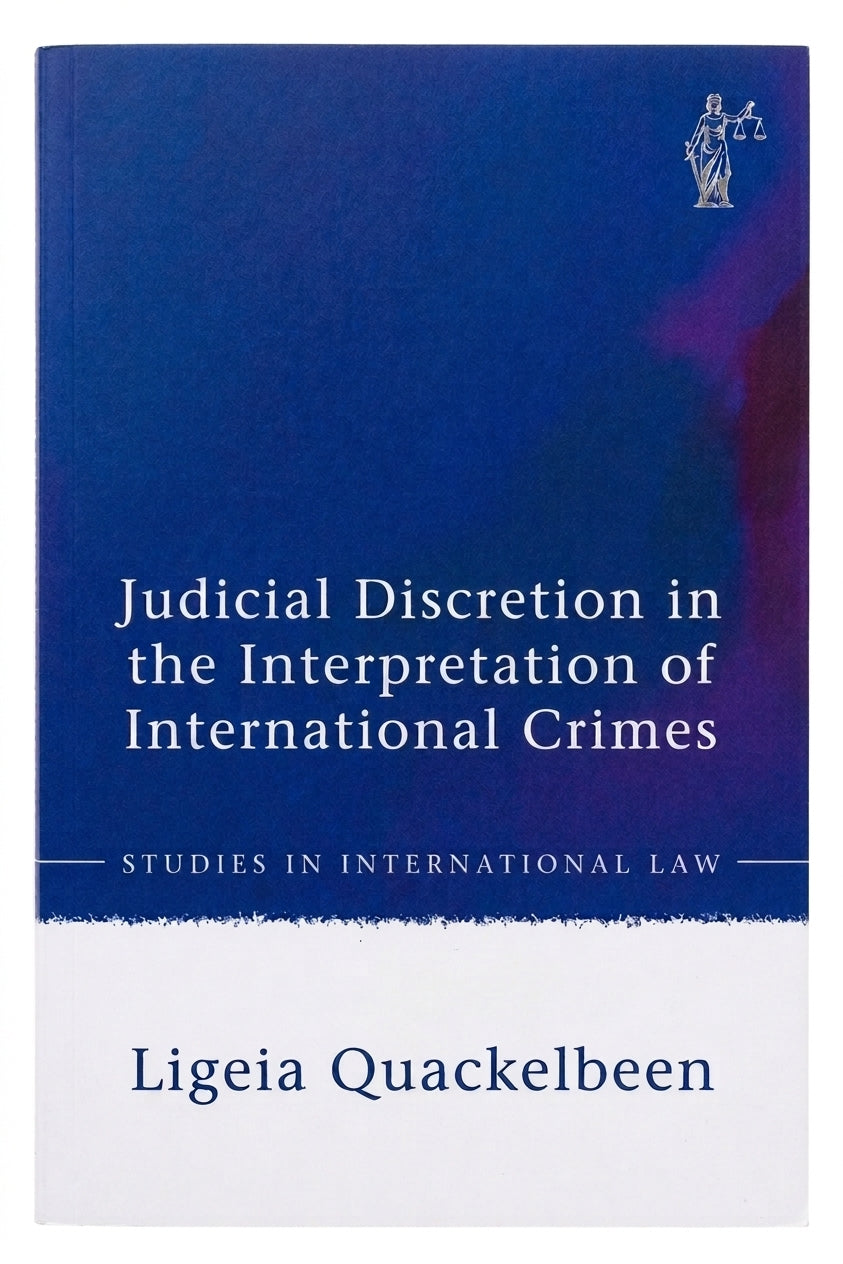
Judicial Discretion in the Interpretation of International Crimes: Revisiting the Legality Principle
Judicial Discretion in the Interpretation of International Crimes: Revisiting the Legality Principle
Quote response within 24h · Institutional invoicing available
Couldn't load pickup availability
Author
Ligeia Quackelbeen
ISBN: 9781509985173
Published: July 2026
Format: Hardcover
Language: English
Publisher: Hart Publishing
Description
This monograph offers a legality-focused framework for understanding how international courts and tribunals interpret crimes under international criminal law. Ligeia Quackelbeen conceptualises the interpretive process as two distinct steps: first determining the applicable law, and then assessing whether that law actually criminalises the conduct at issue. This model shapes both the methodology and the outcomes of judicial interpretation at the international level.
Moving beyond theoretical abstraction, the study grounds its framework in two detailed case analyses: the organizational policy element in crimes against humanity, and the emerging offence of forced marriage. By integrating domestic criminal law theory that is frequently overlooked in international criminal law scholarship, the book offers a novel analytical perspective that positions the legality principle (nullum crimen sine lege) at the centre of judicial interpretation of international crimes.
Key Features
Introduces an original two-step interpretive model for international criminal law, grounded in the legality principle.
Applies the model to two closely studied case analyses: the organizational policy element of crimes against humanity, and the forced marriage offence.
Integrates domestic criminal law theory that is frequently overlooked in international criminal law scholarship, offering a genuinely interdisciplinary reading of judicial interpretation.
Gives judges, prosecutors and defence counsel at international courts and tribunals a rigorous methodological tool for assessing the limits of judicial interpretation under the legality principle.
Coverage
The two-part interpretive process — determining applicable law, then assessing the criminalisation threshold — and its doctrinal foundations.
The organizational policy element in crimes against humanity, including its treatment before the International Criminal Court.
The forced marriage offence as an emerging category of international crime.
The legality principle (nullum crimen sine lege) as the guiding constraint on judicial lawmaking at the international level.
About the Author
Ligeia Quackelbeen is a scholar of international criminal law whose research focuses on judicial interpretation, the legality principle, and the boundaries of lawmaking by international courts and tribunals. Her work engages closely with the jurisprudence of the International Criminal Court and other international criminal tribunals.
Table of Contents
Part I: The Legality Principle and Judicial Interpretation — foundations of the two-step interpretive model.
Part II: Case Study — The Organizational Policy Element in Crimes Against Humanity.
Part III: Case Study — The Forced Marriage Offence.
Part IV: Conclusions — Reassessing the Limits of Judicial Discretion in International Criminal Law.
Why buy this book?
As international courts and tribunals continue to face scrutiny over the scope of their interpretive authority, this book gives legal academics, practitioners and law libraries a rigorous, up-to-date framework for evaluating judicial reasoning in international criminal law. It is a valuable addition to any collection supporting research or practice in international criminal justice.
Keywords
international criminal law, legality principle, judicial discretion, crimes against humanity, forced marriage, International Criminal Court, international courts and tribunals, nullum crimen sine lege
Target Audience
International criminal lawyers, judges and legal officers at international courts and tribunals, academic law libraries, PhD researchers in international criminal law
Genre
International Law, Criminal Law, International Criminal Justice
Q&A
What is the legality principle in international criminal law?
The legality principle (nullum crimen sine lege) holds that no one may be criminally punished except for conduct that was clearly established as criminal under the applicable law at the time it was committed. It is the central constraint this book applies to judicial interpretation of international crimes.
How do international courts interpret crimes against humanity?
International courts interpret crimes against humanity by first identifying the applicable legal provisions and then assessing whether the conduct in question falls within their scope — a two-step process this book examines in detail through the organizational policy element.
What is the organizational policy element in crimes against humanity?
It is a contested requirement in the definition of crimes against humanity concerning whether an attack against a civilian population must be pursuant to an organizational policy, a question the book analyses as a central case study.
Is forced marriage recognized as an international crime?
Forced marriage has emerged as a distinct offence in international criminal law jurisprudence, and this book examines how courts have interpreted its scope under the legality principle.
Where can I buy Judicial Discretion in the Interpretation of International Crimes?
This title is available now from CLNZ Books, with worldwide shipping and secure payment by card or PayPal.
📘 Learn more about shipping, delivery times, and returns, see our FAQ here
📦 New to ordering with us? See our How to Order guide for payment, shipping, and institutional order options.