Springer
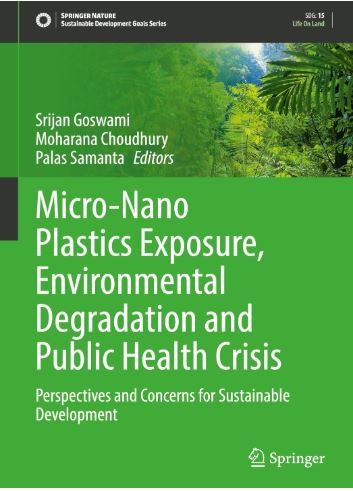
Micro-Nano Plastics Exposure, Environmental Degradation and Public Health Crisis
Micro-Nano Plastics Exposure, Environmental Degradation and Public Health Crisis
Quote response within 24h · Institutional invoicing available
Couldn't load pickup availability
Authors:
Srijan Goswami, Moharana Choudhury, Palas Samanta (Editors)
- ISBN: 9789819650460
- Published: June 2025
- Format: Hardcover
- Language: English
- Publisher: Springer Singapore
Description
This book offers a comprehensive, multidisciplinary overview of how micro- and nano-plastics (MNPs) are generated, transported, and transformed in the environment, and how they affect ecosystems and human health. It connects environmental toxicology, ecology, medicine, and public health to explain why MNPs are now considered a critical global risk factor.
The volume examines degradation of plastics, identification and quantification methods, and contamination of air, water, soil, agricultural systems, and food chains. Special attention is given to ecological dysbiosis, cardiovascular impacts, immune and gut disruption, carcinogenic risks, and biodiversity loss, framed within the United Nations Sustainable Development Goals (SDGs).
Written by experts from academia, research institutes, and environmental organisations worldwide, this reference work supports evidence-based policymaking, risk assessment, and nature-based solutions to reduce plastic pollution and protect public health.
Key Features
- Integrates environmental science, toxicology, medicine, and public health in a single reference on micro- and nano-plastics.
- Explains mechanisms of plastic degradation and pathways of MNP exposure in air, water, soil, food, and biota.
- Links micro- and nano-plastic pollution with SDGs 3, 6, 12, 13, 14, and 15, highlighting policy and governance implications.
- Covers impacts on ecosystems, wildlife, agriculture, food safety, and human organs including gut, cardiovascular, and nervous systems.
- Discusses bioplastics, remediation strategies, and technological innovations for sustainable plastic waste management.
- Edited by internationally active researchers and practitioners working at the interface of environment, health, and sustainability.
Coverage
- Environmental degradation of plastics and formation of micro- and nano-plastics (MNPs).
- Methods for identification and quantification of MNPs in environmental and biological samples.
- Contamination of air, freshwater, marine systems, soil, aquifers, and remote environments such as Antarctica.
- Effects on wildlife, biodiversity, crop plants, food chains, and marine- and land-based food resources.
- Human health impacts: cardiovascular complications, immune and gut dysfunction, neuro-toxicity, and carcinogenicity.
- Bioplastics, nature-based solutions, and technological innovations in plastic waste management and remediation.
- Micro- and nano-plastics in the context of SDGs 3, 6, 12, 13, 14, and 15, and sustainable development policy debates.
About the Authors
Editors:
Srijan Goswami is a physician specialised in the Biochemic System of Medicine, Medical Biotechnology, and Clinical Nutrition. He has broad teaching experience in paramedical and life sciences programmes and serves as Research Coordinator for Biomedical Research and Allied Sciences at Voice of Environment, Assam, India.
Moharana Choudhury is an environmental researcher with more than 14 years of experience across government projects and environmental services in India. He is known for his work on sustainable projects, wetland and heritage conservation, and campaigns against single-use plastic pollution.
Palas Samanta is an Assistant Professor of Environmental Science at Sukanta Mahavidyalaya, University of North Bengal, India. His research focuses on environmental toxicology, pollution assessment, risk analysis of contaminants, and ecotoxicological methods.
Table of Contents
The book includes 29 chapters covering:
- Global overview of the micro- and nano-plastics crisis.
- Environmental degradation mechanisms of plastics.
- Identification and quantification techniques for MNPs.
- Contamination of air, water (lentic and lotic systems), soil, and aquifers.
- Impacts on Antarctica, coral ecosystems, marine vertebrates and invertebrates, and terrestrial biodiversity.
- Effects on crop plants, agricultural practices, and soil microflora.
- Food safety and security implications of MNPs.
- Cardiovascular, gastrointestinal, immune, and neuro-functional impacts in humans.
- Links to carcinogenicity and long-term health risks.
- Bioplastics, remediation technologies, and nature-based solutions.
Why buy this book?
- Provides a one-stop, up-to-date reference on micro- and nano-plastics for teaching, research, and policy work.
- Gives scientifically grounded evidence to support environmental, health, and sustainability decision-making.
- Helps universities, libraries, and research centres build a strong collection on plastic pollution and SDGs.
- Useful for training postgraduate students and early-career researchers in environmental and public health fields.
- Supports interdisciplinary programmes on environmental health, sustainability science, and global change.
Keywords
microplastics, nano-plastics, plastic pollution, environmental degradation, public health, sustainable development, SDGs, biodiversity, ecosystems, environmental toxicology, climate action, responsible consumption, marine pollution, soil contamination, food safety
Target Audience
environmental scientists, public health professionals, toxicologists, medical researchers, sustainability practitioners, policy-makers, graduate and postgraduate students, governmental agencies, NGOs, international organisations, library collections in environment and health
Genre
Nonfiction, Academic, Environmental Science, Public Health, Sustainability Studies, Scientific Reference
Q&A
Does CLNZ Books ship this title worldwide, and how long does delivery take?
Yes, CLNZ Books ships to more than 60 countries via trusted international courier with tracking. Delivery time varies by destination.
What payment methods does CLNZ Books accept for international orders?
Card and PayPal are accepted, with a simple, secure checkout.
Is this book currently in stock and available for immediate dispatch?
Yes, it is available and ships as soon as the order is confirmed.
Who are the editors of this book, and what is their expertise?
Srijan Goswami (Biochemic Medicine, Medical Biotechnology, Clinical Nutrition), Moharana Choudhury (environmental researcher, wetland and heritage conservation), and Palas Samanta (Assistant Professor of Environmental Science, University of North Bengal) — all specialists in environmental health and pollution research.
What topics does this book cover?
Micro- and nano-plastics degradation, contamination of air/water/soil/food, ecosystem and human health impacts, and links to the UN Sustainable Development Goals.
Can CLNZ Books provide an invoice or quote for institutional or library purchasing?
Yes, institutional invoicing and quotes are available for university and research libraries.
Where can I buy Micro-Nano Plastics Exposure, Environmental Degradation and Public Health Crisis?
Directly from CLNZ Books at clnzbooks.com.
📘 Learn more about shipping, delivery times, and returns, see our FAQ here .