IBFD.org
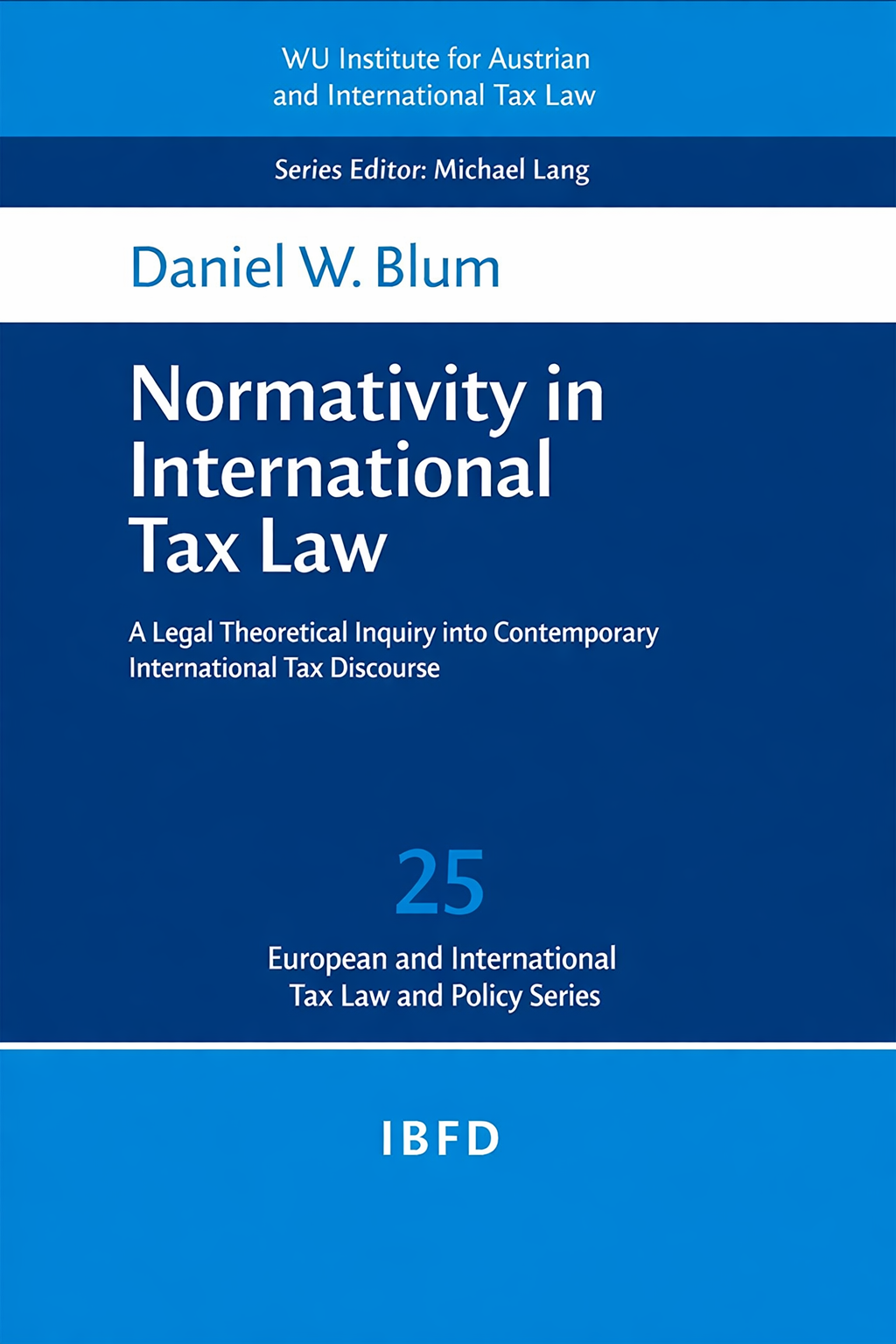
Normativity in International Tax Law
Normativity in International Tax Law
Quote response within 24h · Institutional invoicing available
Couldn't load pickup availability
Daniel W. Blum
ISBN: 9789087228057
Published: March 2023
Format: Hardcover
Language: English
Publisher: IBFD.org
Description
In this book, the author examines the legal theoretical foundations of international tax law and situates the arguments raised in contemporary discourse within the spectrum between legal positivism, realism and naturalism. The set of rules applicable to cross-border situations found in both tax treaties and domestic tax law has, in recent years, been the object of unprecedented political, academic and legislative scrutiny, with the current allocation of taxing rights between jurisdictions widely described as outdated and conceptually flawed in light of digitalization. This book asks why such change requires reforming the rules of international tax law in the first place, identifying three lines of argumentation on which reform proposals are based: fairness, economic efficiency, and the assumption that taxation requires justification. Revisiting these claims from a legal theory perspective, the book situates them within the theoretical spectrum ranging from Kelsian/Hartian positivism to Dworkinian interpretivism and analyses the explanatory value of legal theory in establishing their legal validity. The book was awarded the 2022 Mitchell B. Carroll Prize by the International Fiscal Association (IFA).
Key Features
Winner of the 2022 Mitchell B. Carroll Prize awarded by IFA
A legal theoretical framework for the normative foundations of international tax law
Situates the digitalization reform debate within legal positivism, realism and naturalism
Identifies the three core lines of argumentation underlying international tax reform proposals
Analyses the explanatory value of legal theory, from Kelsian/Hartian positivism to Dworkinian interpretivism, for establishing legal validity in tax discourse
Coverage
Chapter 1: Normativity in International Tax Law: Setting the Scene
Chapter 2: The Debate on How to Reform the International Tax System in Light of Digitalization
Chapter 3: Normativity and Legal Validity in International Taxation
Chapter 4: Normativity and its Source in International Tax Law: International Tax Discourse between Positivism, Realism and Naturalism
Chapter 5: Key Findings and Final Observations on the Role of Legal Theory in International Tax Discourse
About the Author
Priv. Doz. Dr. Daniel W. Blum, LLM (NYU), BSc., is a Visiting Professor at the Institute for Austrian and International Tax Law at the Vienna University of Economics and Business (WU) and a Tax Manager at Deloitte Austria. His research focuses on Austrian corporate tax law as well as EU and international tax law, including its legal theoretical aspects. He is the winner of the 2022 Mitchell B. Carroll Prize awarded by the International Fiscal Association.
Table of Contents
Chapter 1: Normativity in International Tax Law: Setting the Scene
Chapter 2: The Debate on How to Reform the International Tax System in Light of Digitalization
Chapter 3: Normativity and Legal Validity in International Taxation
Chapter 4: Normativity and its Source in International Tax Law: International Tax Discourse between Positivism, Realism and Naturalism
Chapter 5: Key Findings and Final Observations on the Role of Legal Theory in International Tax Discourse
Series: WU – Tax Law and Policy Series, No. 25
Why buy this book?
The claim that international tax law is "outdated" or "conceptually flawed" is repeated constantly in tax policy debate, yet the normative basis for that claim is rarely examined. This book fills that gap, offering the field's first sustained legal theoretical inquiry into why international tax law is said to require reform, and what "fairness" and "justification" actually mean when invoked in tax discourse. Awarded the IFA's 2022 Mitchell B. Carroll Prize, it gives scholars, practitioners and policymakers a rigorous framework for evaluating the normative claims that drive today's international tax reform agenda.
Keywords
International tax law, legal theory, normativity, legal positivism, legal realism, natural law, tax reform, digitalization, legal validity, Mitchell B. Carroll Prize, WU Tax Law and Policy Series
Target Audience
Tax law academics and researchers, international tax practitioners, tax policymakers and regulators, doctoral and postgraduate students in tax law
Genre
Taxation, International Tax Law, Legal Theory
Q&A
What is this book's central argument?
It argues that international tax reform debates rest on unexamined normative claims – that the system must be "fair" and that taxation "requires justification" – and applies legal theory to test what those claims actually mean and whether they carry legal weight.
What legal theories does the book draw on?
It situates international tax discourse within the spectrum running from Kelsian and Hartian legal positivism to Dworkinian interpretivism, alongside legal realism and naturalism.
Why has this book received attention in the tax law field?
It was awarded the International Fiscal Association's 2022 Mitchell B. Carroll Prize, one of the field's most prestigious distinctions for tax law scholarship.
Does the book address the digital economy debate?
Yes, it examines why digitalization is treated as requiring reform of international tax law and traces the reform proposals this has produced.
Who is this book written for?
It is aimed at tax law academics, doctoral researchers, and practitioners and policymakers who want a rigorous theoretical grounding for arguments about fairness and legitimacy in international tax reform.
Where can I buy Normativity in International Tax Law?
You can order this book directly from CLNZ Books using the "Add to cart" button above. CLNZ Books ships worldwide to universities, law firms, and individual professionals.
📚 Learn more about shipping, delivery times, and returns, see our FAQ here
How to Order
For details on payment methods, invoicing, and institutional orders, see our How to Order page.