Kluwer Law International (The Netherlands)
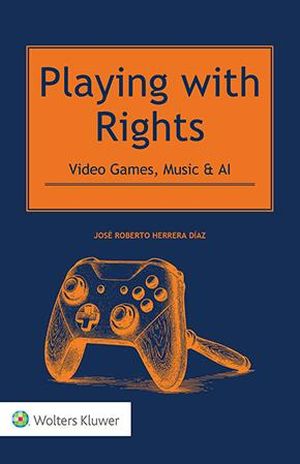
Playing with Rights: Music, Games & AI
Playing with Rights: Music, Games & AI
Quote response within 24h · Institutional invoicing available
Couldn't load pickup availability
Author
José Roberto Herrera
ISBN: 9789403536132
Published: October 2026
Format: Hardback — Print on Demand
Language: English
Publisher: Kluwer Law International
📌 PRINT ON DEMAND TITLE
This title is printed by the publisher specifically for your order. Please allow approximately 1 to 3 weeks for printing before dispatch. Your copy is a new, publisher-produced hardback, identical in content to the standard edition. Institutional buyers needing a firm delivery date are welcome to request an estimate before ordering.
Description
Playing with Rights: Music, Games & AI is the first book-length work to provide a comprehensive legal analysis of the data-driven convergence between music and video games arising from the use of music in interactive entertainment. Written by a practising intellectual property and entertainment lawyer who is also a guitarist and lifelong gamer, it explores the legal, cultural and technological questions at the heart of this convergence and examines the most significant recent transactions, disputes and regulatory developments shaping the field.
Immersive gaming, music streaming and artificial intelligence are transforming entertainment law. Combining doctrinal rigour with practical industry insight, the book works through music licensing, rhythm games, user-generated content, AI, virtual performance and "metaverse" experiences, with a multi-jurisdictional analysis covering the United States, the European Union, the United Kingdom, Germany and Latin America.
Why it matters now: a Shanghai court has just protected the voices of Genshin Impact characters against AI cloning. Read our blog Voices, Songs and Avatars: The New Law of Music, Games & AI to see how this book maps the issues.
Key Features
- First comprehensive, book-length treatment of the legal interface between music and video games
- Multi-jurisdictional analysis: United States, European Union, United Kingdom, Germany and Latin America
- Dedicated chapter on AI, music and video games — copyrightability of AI-generated music, hybrid human–AI works, deepfakes and voice cloning
- Practical appendices: sample licensing contract clauses, a comparative table on right of publicity in video games, a timeline of key events, and a glossary
- Practical applications: (1) drafting and negotiating synchronisation and master-use licences for music placed in games; (2) assessing ownership and infringement risk in user-generated content, covers and mods; (3) structuring virtual concert and avatar deals, including right-of-publicity clearances across jurisdictions
Coverage
- Video game and music streaming business models
- End-user license agreements (EULAs), terms of service and contractual governance
- Copyright ownership of user-generated content
- AI-generated music and copyrightability
- Hybrid human–AI works
- Deepfakes, AI voice cloning and legislative responses
- Data privacy and user profiling in rhythm game platforms
- The legal position of distribution and performance in the platform economy
About the Author
José Roberto Herrera is a practising intellectual property and entertainment lawyer — and, as the publisher notes, a guitarist and lifelong gamer. He specialises in intellectual property, entertainment and new media law, holds an LLM in Intellectual Property and Competition Law from the Max Planck Institute in Munich, and teaches entertainment law. He has chaired the Entertainment Law Committee of ASIPI (Inter-American Association of Intellectual Property) and has been active in INTA's work on the right of publicity.
Table of Contents
- Introduction. Welcome to the Virtual Stage
- Chapter 1. How Rock Band Changed the Music Industry
- Chapter 2. The IP Anatomy of a Song in a Video Game
- Chapter 3. When You Play, Who Owns? UGC, Covers, and Mods
- Chapter 4. Virtual Concerts and Avatars: The Spectacle in the Digital World
- Chapter 5. AI, Music, and Video Games: Artificial Creativity and Legal Challenges
- Chapter 6. Business Models in the Era of Play: Monetization, Data, and New Markets
- Chapter 7. Latin America's Role: Gaps, Opportunities, and Challenges
- Conclusion. A Lawyer's Playlist — Lessons and Final Reflections
- Appendices A–E: Glossary of Key Terms; Sample Contract Clauses (Licensing); Comparative Table — Right of Publicity in Video Games Across Jurisdictions; Timeline of Key Events in Music and Video Game Law; Recommended Resources
- Bibliography, Table of Cases, List of Legislation, Index
Why buy this book?
Music, games and AI law are usually scattered across separate entertainment, copyright and technology law publications. This volume brings them together in a single reference, saving practitioners and researchers the work of piecing fragmented sources together. It is written for the deals and disputes clients actually bring — licensing a catalogue into a game, clearing a virtual concert, responding to an AI voice clone — and its comparative coverage, including rarely treated Latin American perspectives, makes it equally valuable for cross-border practice and for law school and research library collections.
Keywords
music law, video game law, entertainment law, copyright, music licensing, AI-generated music, AI voice cloning, deepfakes, user-generated content, mods, EULA, virtual concerts, metaverse, right of publicity, data privacy, platform economy, Kluwer Law International, print on demand
Target Audience
Intellectual property and entertainment lawyers, copyright specialists, music publishers and collecting societies, gaming and music industry executives, legal academics and researchers, policymakers in AI and digital content regulation, academic law libraries
Genre
Intellectual Property Law, Copyright Law, Media and Entertainment Law, Music Law, Gaming, Artificial Intelligence Law
Q&A
Is AI-generated music protected by copyright?
It depends on the jurisdiction and on the degree of human creative input. Playing with Rights analyses copyrightability of AI-generated music and of hybrid human–AI works across the US, EU, UK, Germany and Latin America.
Who owns user-generated content, covers and mods created inside a video game?
Ownership is shaped by copyright law and by the game's EULA and terms of service. Chapter 3 examines how these interact and where the legal risks lie for players, platforms and rights holders.
What licences are needed to use a song in a video game?
Typically rights in both the musical composition and the sound recording must be cleared. Chapter 2 sets out the "IP anatomy" of a song in a game, and Appendix B provides sample licensing contract clauses.
How does the law respond to deepfakes and AI voice cloning of musicians?
The book reviews the right of publicity, copyright and recent legislative responses to deepfakes and voice cloning, including a comparative table on the right of publicity in video games across jurisdictions.
What does "Print on Demand" mean for this title?
The publisher prints a new copy specifically for each order. Please allow approximately 1 to 3 weeks for printing before dispatch; the content is identical to the standard hardback edition.
Where can I buy Playing with Rights: Music, Games & AI?
You can order it from CLNZ Books at clnzbooks.com. The price includes worldwide shipping, and payment is accepted by credit card, PayPal or international bank transfer. Institutional invoicing and quotes are available on request at info@clnzbooks.com.
📘 Learn more about shipping, delivery times, and returns, see our FAQ here
📦 New to ordering with us? See our How to Order guide for payment, shipping, and institutional order options.