University of Chicago Press
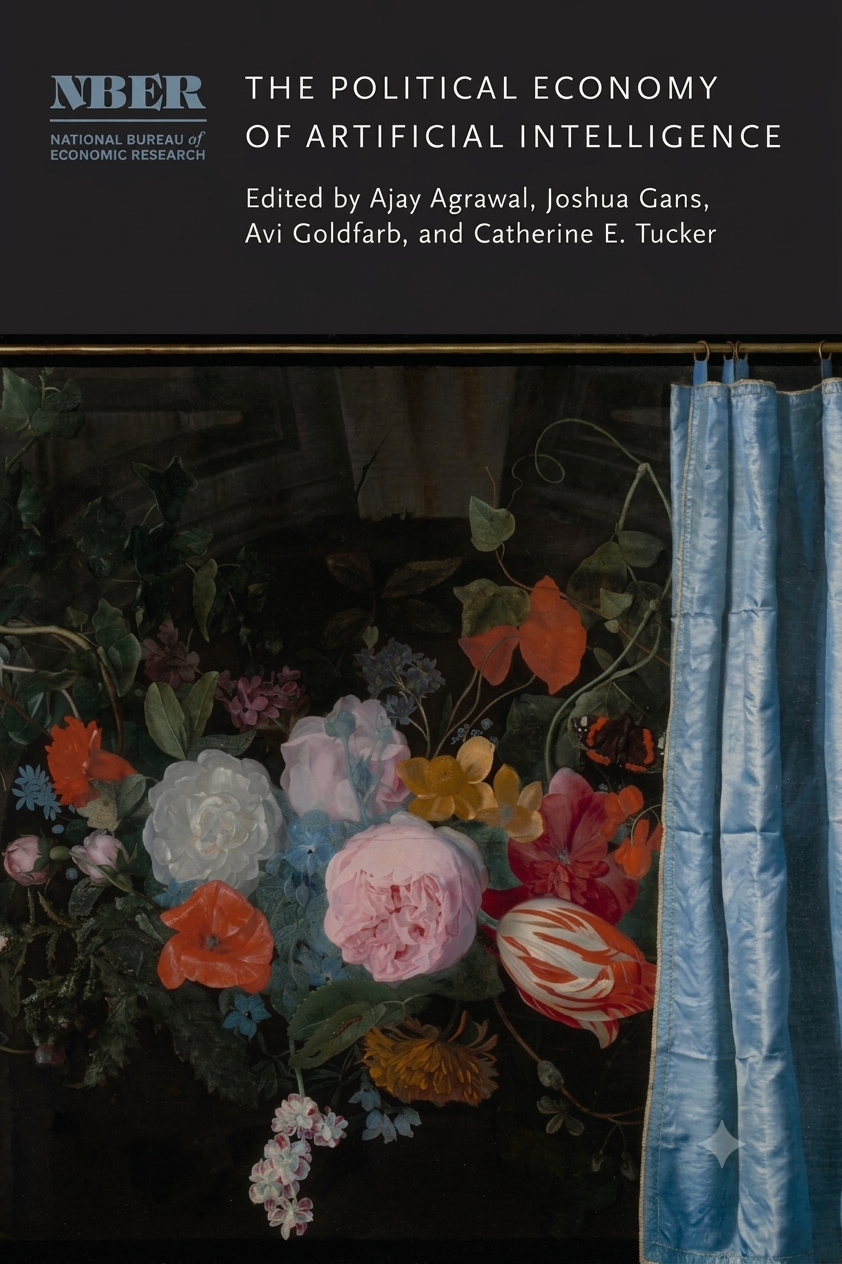
The Political Economy of Artificial Intelligence
The Political Economy of Artificial Intelligence
Quote response within 24h · Institutional invoicing available
Couldn't load pickup availability
Editors
Ajay Agrawal (Editor), Joshua Gans (Editor), Avi Goldfarb (Editor) and Catherine E. Tucker (Editor), National Bureau of Economic Research
ISBN: 9780226847047
Published: 2026
Format: Hardcover
Language: English
Publisher: University of Chicago Press
Description
An authoritative look at how artificial intelligence both shapes and is shaped by the political and economic forces of the modern world. As the effects of AI are felt across economies and societies, many of its ramifications are still emerging. This volume brings together economists and political scientists to examine how AI intersects with regulation, military power, and political identity — offering analytical frameworks and identifying key open questions for future research.
The contributions address the allocation of property rights for AI inputs, trade-offs among alternative regulatory regimes, and the role of interest groups in shaping the technology's trajectory. They explore how AI-related capabilities influence military effectiveness and bargaining power among nations, and consider AI's effects on political preferences, from AI-curated information to targeted political advertising.
Key Features
First NBER conference volume dedicated specifically to the political economy of AI
Brings together leading economists and political scientists across regulation, military power, and political identity
Successor to the landmark 2019 volume by the same core editorial team
Combines analytical frameworks with open research questions for future scholarship
Published in the NBER Conference Report series by University of Chicago Press
Coverage
Part I — The Political Economy of AI Regulation (data as the new oil, regulating algorithms, algorithmic fairness, interest groups and regulatory trade-offs)
Part II — AI and Military Power (battlegrounds for AI, military automation, bargaining power among nations)
Part III — AI and Political Identity (nation building, robotization and political response, AI-curated information, targeted political advertising)
About the Authors
Ajay Agrawal, Joshua Gans and Avi Goldfarb are professors at the University of Toronto's Rotman School of Management and co-authors of the influential book Prediction Machines. Catherine E. Tucker is a professor at the MIT Sloan School of Management specializing in the economics of digital technologies. All four are Research Associates of the National Bureau of Economic Research.
Table of Contents
Introduction; Part I. The Political Economy of AI Regulation; Part II. AI and Military Power; Part III. AI and Political Identity; Contributor Biographies; Index.
Why buy this book?
For economics and public policy libraries, this volume is the most current, rigorously reviewed reference connecting AI development to regulation, geopolitics and democratic institutions. For researchers and policymakers, it provides the analytical frameworks needed to engage seriously with AI governance debates shaping economies and societies worldwide.
Keywords
artificial intelligence economics, political economy of AI, AI regulation, AI policy, AI and military power, algorithmic fairness, NBER conference report, AI geopolitics
Target Audience
Economists, political scientists, policymakers, regulators, investors and financial analysts, academics
Genre
Economics, Political Economy, Technology Policy
Q&A
How does artificial intelligence affect economic regulation and policy?
AI raises new questions about data ownership, algorithmic fairness, and the trade-offs between different regulatory regimes — this volume analyzes those trade-offs across jurisdictions.
What is the connection between AI and military power?
AI-related capabilities increasingly shape military effectiveness and bargaining power among nations, a central theme examined in Part II of the book.
How does AI influence political identity and elections?
Through AI-curated information and targeted political advertising, which the volume examines as a driver of shifting political preferences and identity.
Is this a follow-up to an earlier NBER volume?
Yes, it follows the editors' influential 2019 volume, shifting focus from productivity economics to AI's political and geopolitical dimensions.
Who edited this book?
Ajay Agrawal, Joshua Gans and Avi Goldfarb (University of Toronto) and Catherine E. Tucker (MIT), all NBER Research Associates.
Where can I buy The Political Economy of Artificial Intelligence?
You can order this title directly from CLNZ Books, with worldwide delivery via international courier.
📘 Learn more about shipping, delivery times, and returns, see our FAQ here