Wiley-VCH
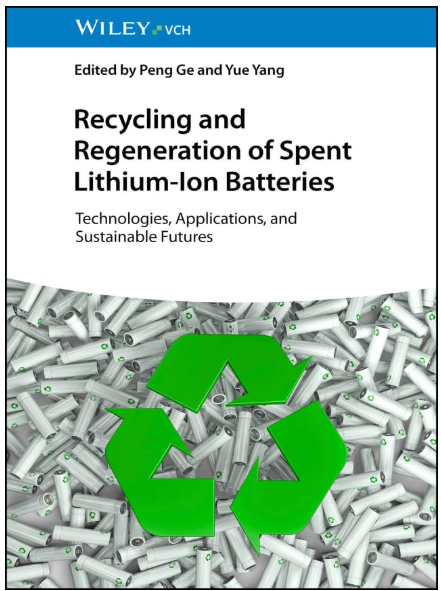
Recycling and Regeneration of Spent Lithium-Ion Batteries: Technologies, Applications, and Sustainable Futures
Recycling and Regeneration of Spent Lithium-Ion Batteries: Technologies, Applications, and Sustainable Futures
Quote response within 24h · Institutional invoicing available
Couldn't load pickup availability
Editors: Peng Ge; Yue Yang
ISBN: 9783527356669
Published: 19 August 2026
Format: Hardcover
Language: English
Publisher: Wiley-VCH
Description
Recycling and Regeneration of Spent Lithium-Ion Batteries is a technologies-to-policy guide to closing the loop on end-of-life lithium-ion batteries. As electric-vehicle and grid-storage fleets scale up, the volume walks through the full recycling chain — battery dismantling and classification, safe discharge, pre-treatment and component separation, cascade (second-life) utilization, hydrometallurgical and pyrometallurgical extraction, and direct regeneration of cathode and anode materials — before closing with pollution prevention, full life-cycle assessment and policy outlook. Coverage extends to solid-state and lithium iron phosphate (LFP) battery systems, which raise distinct end-of-life challenges from conventional NMC chemistries.
Key Features
Walks through the complete recycling chain from battery dismantling to direct, high-value regeneration in one reference. Compares hydrometallurgical, pyrometallurgical and direct regeneration routes, including their life-cycle and pollution-prevention trade-offs. Extends coverage to solid-state and LFP battery systems alongside conventional lithium-ion chemistries.
Coverage
Eight chapters: Introduction; Pre-Treatment Technologies (battery structure and classification, detection and evaluation, safe discharge, disassembly and crushing, component separation); Cascade Utilizations (scene matching, balancing strategies, security controlling, equipment exploration); Metallurgical Extraction Technologies (hydrometallurgical and pyrometallurgical); Direct Regeneration Technologies (solid-state, liquid-phase, new-type and high-value regeneration in other fields); Pollution Prevention and Full Life Cycle Assessment; Prospects and Outlook; Concluding Remarks.
Three concrete applications of this volume's content: (1) selecting a pre-treatment and dismantling line suited to a given battery format and chemistry for a recycling facility; (2) comparing hydrometallurgical, pyrometallurgical and direct regeneration routes when planning a battery materials recovery investment; (3) assessing cascade/second-life utilization pathways as an alternative to immediate recycling for retired EV and grid-storage packs.
About the Editors
Peng Ge is a professor at the School of Minerals Processing and Bioengineering, Central South University, Changsha, China, whose research focuses on the green recycling and regeneration of spent batteries. Yue Yang is a professor and doctoral advisor whose work covers the recycling and value-added use of non-ferrous metal secondary resources.
Table of Contents
1. Introduction. 2. Pre-Treatment Technologies. 3. Cascade Utilizations. 4. Metallurgical Extraction Technologies. 5. Direct Regeneration Technologies. 6. Pollution Prevention and Full Life Cycle Assessment. 7. Prospects and Outlook. 8. Concluding Remarks.
Why buy this book?
With the EU Battery Regulation phasing in mandatory recycled-content and traceability requirements and global EV fleets approaching first-generation battery retirement, closed-loop lithium-ion battery management has moved from research interest to compliance necessity. This volume gives engineers, recyclers and policy teams a single technologies-to-regulation reference for building that capability.
For the market context behind this volume, read our analysis of the EU Battery Passport and recycling technology in 2027. To explore related titles, browse our Energy, Engineering & Environmental collection.
Keywords
lithium-ion battery recycling, battery regeneration, hydrometallurgy, pyrometallurgy, cascade utilization, second-life batteries, circular economy, critical minerals, life cycle assessment, EV battery end-of-life
Target Audience
Electrochemists, materials scientists, environmental chemists, chemical and process engineers, power technology specialists, academic and research libraries
Genre
Energy, Battery Recycling, Circular Economy, Materials Science
Q&A
Q: What are the main technologies used to recycle spent lithium-ion batteries?
A: The book covers pre-treatment and dismantling, cascade (second-life) utilization, hydrometallurgical and pyrometallurgical extraction, and direct regeneration of cathode and anode materials.
Q: What is the difference between direct regeneration and metallurgical recycling of battery materials?
A: Metallurgical extraction breaks materials down to base elements or compounds for reprocessing, while direct regeneration repairs and restores the original electrode material's structure, preserving more value and energy than full metallurgical reprocessing.
Q: How does cascade or second-life utilization fit into battery end-of-life management?
A: Batteries that no longer meet EV performance requirements can often be redeployed in less demanding stationary storage applications before final recycling, extending their useful life and delaying resource-intensive reprocessing.
Q: Does this book cover solid-state and LFP battery recycling, not just conventional lithium-ion?
A: Yes — Chapter 5 extends direct regeneration coverage to solid-state and liquid-phase systems, and the volume addresses LFP alongside conventional NMC-type chemistries.
Q: Where can I buy Recycling and Regeneration of Spent Lithium-Ion Batteries: Technologies, Applications, and Sustainable Futures?
A: It is available directly from CLNZ Books — Bookseller for Professionals Worldwide — with worldwide shipping included.
📘 Learn more about shipping, delivery times, and returns, see our FAQ here
📦 New to ordering with us? See our How to Order guide for payment, shipping, and institutional order options.