Springer
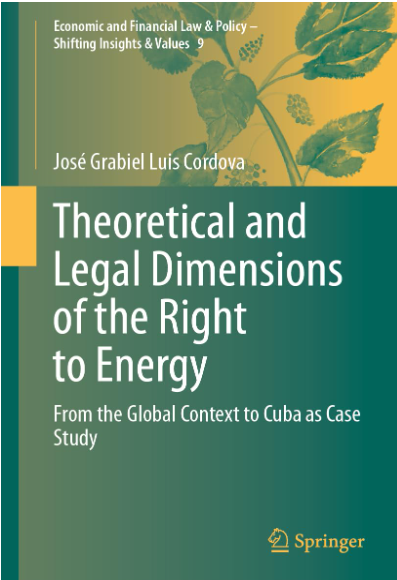
Theoretical and Legal Dimensions of the Right to Energy: From the Global Context to Cuba as Case Study
Theoretical and Legal Dimensions of the Right to Energy: From the Global Context to Cuba as Case Study
Quote response within 24h · Institutional invoicing available
Couldn't load pickup availability
Author
José Grabiel Luis Cordova
ISBN: 9783032332516
Published: July 2026
Format: Hardcover
Language: English
Publisher: Springer
Description
Energy access is routinely discussed as a policy target and an infrastructure problem, but rarely as a legal right with defined content and enforceable status. This monograph addresses that gap directly, building a systematic legal-theoretical account of the "right to energy" from first principles and then testing it against a live national case: Cuba, where recurrent grid failures and fuel shortages have made energy access a matter of open constitutional and political debate.
The book moves in two stages. The first develops the conceptual and normative architecture of the right to energy—tracing its historical emergence, its treatment in international and regional human rights instruments, and the pattern of its positivisation in national constitutions. The second applies that framework to Cuba specifically, examining the 2019 Cuban Constitution, the historical and political background to the country's energy governance, and the scope of the existing legal framework for recognising and configuring an enforceable right to energy.
It is aimed at legal academics, energy policy researchers, and comparative constitutional scholars, and at institutions building holdings in energy law and Latin American legal studies—an area with comparatively little English-language monograph literature relative to its practical relevance.
Key Features
- First systematic legal-theoretical mapping of the "right to energy" as a distinct, emerging right
- Comparative survey of how the right to energy has been positivised across national constitutions
- In-depth case study applying the framework to Cuba's 2019 Constitution and energy governance framework
- Direct relevance for comparative constitutional law courses examining energy, social rights, and Latin America
Coverage
Chapters cover the conceptual delimitation of the right to energy, its international and regional normative treatment, trends in its constitutional positivisation, the historical and political background to Cuba's energy governance, the constitutional premises of the right to energy in Cuba, and the scope of the Cuban legal framework for its recognition and configuration, closing with theoretical-legal conclusions on the right as still "under construction."
About the Author
José Grabiel Luis Cordova is a legal researcher affiliated with the University of Groningen, working on the theoretical and constitutional dimensions of energy rights, with a research focus on Latin American and Caribbean legal systems.
Table of Contents
- General Introduction
- Towards a Conceptual Delimitation of the Right to Energy
- Trends in the Constitutional Positivisation of the Right to Energy
- International and Regional Normative Treatment of the Right to Energy
- The Right to Energy as a Right Under Construction
- Historical, Political, and Legal Background to the Construction of the Right to Energy in Cuba
- Constitutional Premises of the Right to Energy in Cuba
- Scope of the Cuban Legal Framework for the Recognition and Configuration of the Right to Energy
- Theoretical-Legal Elements for the Recognition of the Right to Energy in Cuba
- General Conclusions
Why buy this book?
Energy law collections are heavily weighted toward regulatory and commercial titles; very few address energy access as a constitutional rights question, and fewer still through a Latin American case study written for an international audience. For a library serving comparative law, human rights, or Latin American studies programs, this is a distinctive addition that complements existing energy policy and energy transition holdings with a rights-based legal perspective.
Keywords
right to energy, energy law, energy access, constitutional law, Cuba, Latin America energy policy, human rights and energy, comparative constitutional law, energy governance
Target Audience
Legal academics, energy policy researchers, comparative constitutional law scholars, Latin American studies programs, academic and law libraries
Genre
Energy Law, Energy Policy, Constitutional Law, Latin American Studies
Q&A
What is the "right to energy" as discussed in this book?
It is the legal-theoretical concept of energy access as an enforceable right rather than only a policy goal, traced through international, regional, and national constitutional law.
Why does the book focus specifically on Cuba?
Cuba is used as a case study because recurrent energy shortages have made energy access an active constitutional and political issue, offering a concrete test of how the right to energy is recognised and configured in practice.
Is this book useful for comparative constitutional law teaching?
Yes, it is structured to support comparative study of how different constitutional systems treat emerging social and economic rights, with Cuba as a detailed worked example.
Does the book address international human rights frameworks on energy?
Yes, it examines the international and regional normative treatment of the right to energy alongside national constitutional trends.
Where can I buy Theoretical and Legal Dimensions of the Right to Energy?
You can order it directly from CLNZ Books at clnzbooks.com, with worldwide shipping and secure payment by card or PayPal.
📘 Learn more about shipping, delivery times, and returns, see our FAQ here
📦 New to ordering with us? See our How to Order guide for payment, shipping, and institutional order options.