Springer
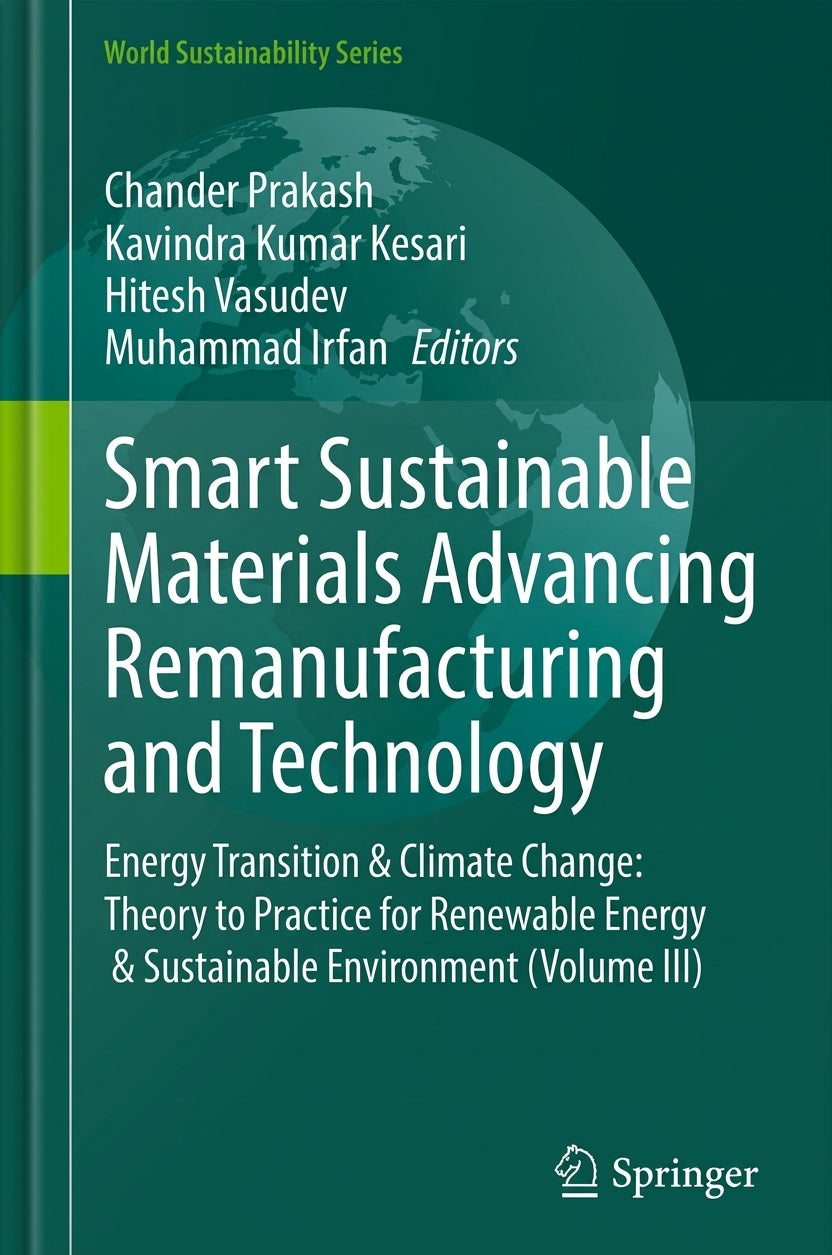
Smart Sustainable Materials Advancing Remanufacturing and Technology: Energy Transition & Climate Change: Theory to Practice for Renewable Energy & Sustainable Environment (Volume III)
Smart Sustainable Materials Advancing Remanufacturing and Technology: Energy Transition & Climate Change: Theory to Practice for Renewable Energy & Sustainable Environment (Volume III)
Quote response within 24h · Institutional invoicing available
Couldn't load pickup availability
Chander Prakash (Editor), Kavindra Kumar Kesari (Editor), Hitesh Vasudev (Editor), Muhammad Irfan (Editor)
ISBN: 9783032302380
Published: July 28, 2026
Format: Hardcover
Language: English
Publisher: Springer (World Sustainability Series)
Description
Volume III of this World Sustainability Series title tackles one of the defining challenges of the energy transition: how to make the materials, products and manufacturing processes behind renewable energy and climate solutions genuinely sustainable. Across 40 chapters, an international team of contributors examines the intersection of smart materials, remanufacturing, and energy policy, arguing that "sustainable development is only possible by using sustainable energy." The volume moves from energy economics and climate finance through smart manufacturing technologies, biomaterials, and life cycle assessment, to the social, psychological and health dimensions of the energy transition — bridging theoretical frameworks with the practical realities of Industry 5.0 and 6.0.
Key Features
- Explains how AI and machine learning are being applied to optimize renewable energy systems and biospheric modelling
- Details circular-economy approaches for energy and material sustainability, including green thermal spray coatings and biodegradable materials for energy storage
- Includes dedicated life cycle assessment (LCA) methodology for evaluating energy systems and sustainable materials in real projects
Coverage
Energy economics and climate finance; smart and AI-driven renewable energy technologies; circular economy and remanufacturing; biomaterials and biodegradable materials for energy storage; thermal spray coatings; energy efficiency in buildings and infrastructure; resilient energy systems for climate-vulnerable regions; nature-based climate mitigation; sustainable healthcare powered by renewable energy; policy and urban energy transition strategies.
About the Editors
Dr. Chander Prakash is Pro-Vice Chancellor for Research at Geeta University, Panipat, India. Dr. Kavindra Kumar Kesari is affiliated with the University Centre for Research and Development, Chandigarh University, Mohali, India. Hitesh Vasudev works with the Division of Research and Development at Lovely Professional University, Phagwara, India. Prof. Muhammad Irfan is based at the Business School, Shandong Management University, Jinan, China.
Table of Contents
- Historical Evolution of Sustainability and Climate Science
- High Performance Computing for Biospheric Modelling and Energy Transition
- Impact of AI and Machine Learning for Renewable Energy Optimization
- Energy Efficiency Strategies in Buildings and Infrastructure
- Circular Economy Approaches for Energy and Material Sustainability
- Green and Eco-friendly Thermal Spray Coating Processes
- Role of Smart Technologies in Reducing Fossil Carbon Emissions
- Climate Finance, Green Investments, and Sustainable Business Models
- Biomaterials for Renewable Energy Systems
- Biodegradable and Sustainable Materials for Energy Storage Technologies
- Resilient Energy Systems for Climate-Vulnerable Regions
- Nature-Based Solutions for Climate Mitigation and Ecosystem Restoration
- Life Cycle Assessment (LCA) for Energy Systems and Sustainable Materials
- Economic Feasibility and Scalability of Advanced Thermal Spray Technologies
- Sustainable Healthcare Systems Powered by Renewable Energy
Why buy this book?
For a library or research centre building an energy-transition or sustainable-materials collection, this volume offers a single, current reference spanning the full chain from materials science to climate policy — useful to engineering faculties, sustainability programmes, and policy institutes alike, and current enough to reflect 2026 thinking on Industry 5.0/6.0 and circular manufacturing.
Keywords
energy transition, sustainable materials, circular economy, remanufacturing, renewable energy, climate change, life cycle assessment, smart manufacturing, biomaterials, energy storage, climate finance
Target Audience
Engineers, materials scientists, energy researchers, sustainability academics, industry practitioners, policy analysts, university libraries
Genre
Renewable Energy, Circular Economy, Sustainability, Climate Change, Technology
Q&A
What does this book cover?
It covers the intersection of smart, sustainable materials with renewable energy technology, circular-economy manufacturing, climate finance, and energy policy across 40 chapters.
Is this suitable for a university engineering or sustainability library?
Yes — it is aimed at researchers, academics, and industry practitioners across materials science, energy engineering, and sustainability policy.
Does it include practical, applied content or only theory?
Both — chapters move from theoretical frameworks (e.g. climate science, LCA methodology) to applied case studies in manufacturing, healthcare, and energy storage.
What makes this volume different from earlier volumes in the series?
Volume III focuses specifically on the Energy Transition & Climate Change angle, applying the World Sustainability Series' materials-and-manufacturing lens to renewable energy adoption.
Where can I buy Smart Sustainable Materials Advancing Remanufacturing and Technology: Energy Transition & Climate Change (Volume III)?
Directly from CLNZ Books, with worldwide shipping and secure payment by credit card or PayPal.
📘 Learn more about shipping, delivery times, and returns, see our FAQ here
📦 New to ordering with us? See our How to Order guide for payment, shipping, and institutional order options.