Wiley-VCH
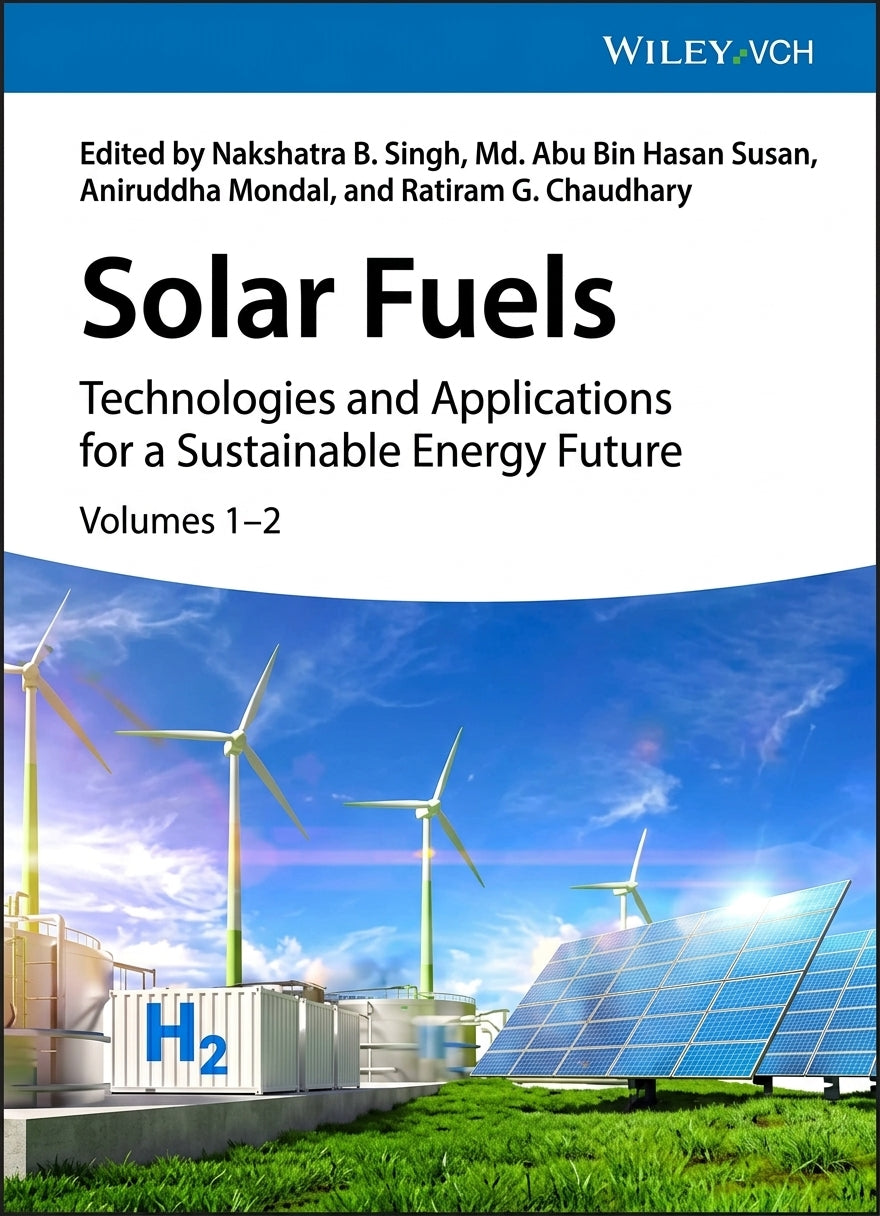
Solar Fuels: Technologies and Applications for a Sustainable Energy Future
Solar Fuels: Technologies and Applications for a Sustainable Energy Future
Quote response within 24h · Institutional invoicing available
Couldn't load pickup availability
Editors
N. B. Singh (Editor); Md. Bin Hasan Susan (Editor); Aniruddha Mondal (Editor); Ratiram G. Chaudhary (Editor)
ISBN: 9783527355976
Published: 12 August 2026
Format: Hardcover, 2-Volume Set
Language: English
Publisher: Wiley-VCH
Description
Solar Fuels: Technologies and Applications for a Sustainable Energy Future is a comprehensive two-volume handbook reviewing the science and engineering behind converting sunlight directly into usable fuel. Across 26 chapters, four internationally active editors bring together photochemistry, catalysis, nanotechnology, and electrochemistry with the grid, industrial, and policy questions that determine whether solar fuels can scale, including a dedicated look at artificial intelligence's growing role in solar fuel development.
Key Features
Volume 1 builds the technical foundation: photochemistry and energy conversion, electrochemical fundamentals and catalysis, materials for solar energy harvesting, and dedicated chapters on green hydrogen, solar ammonia, and solar water splitting. Volume 2 turns to real-world application: solar fuels in transportation and industry, grid stability and energy storage, cost comparisons against conventional fuels, policy incentives, environmental impact, and a forward-looking chapter on AI-driven solar fuel development and public perception.
Coverage
Global energy challenges and the case for solar innovation; photovoltaics versus solar fuels as complementary technologies; hydrogen from sunlight and the path to a hydrogen economy; carbon-based solar fuels (methanol, ethanol) and solar ammonia; thermochemical and electrolytic solar fuel generation; solar fuels for transportation, industry, and grid-scale storage; economic viability and policy incentives; and hybrid systems combining solar fuels with other clean energy technologies.
About the Authors
N. B. Singh, PhD, is Emeritus Professor at Sharda University, India, author or editor of twelve books and over 340 research articles in materials science and energy. Md. Bin Hasan Susan, PhD, is Professor of Chemistry and Director of the Nanotechnology Centre at Dhaka University, Bangladesh, with 227 publications including 37 book chapters. Aniruddha Mondal, PhD, is a Research Scientist in Material Chemistry at Luleå University of Technology, Sweden, with over 50 high-impact publications and two patents. Ratiram G. Chaudhary, PhD, is Associate Professor and Head of the Postgraduate Department of Chemistry at Seth Kesarimal Porwal College, India, with 110 research articles and 35 book chapters.
Table of Contents
Volume 1 — Principles and Technologies of Solar Fuel Generation:
1. Introduction: Global Energy Challenges and Need for Solar Innovations
2. Principles and Potential of Solar Energy
3. Photochemistry and Energy Conversion
4. Solar Fuels in the Transition to Clean Energy
5. Photovoltaics vs. Solar Fuels: Complementary Technologies
6. Electrochemical Fundamentals: Catalysis and Charge Transfer
7. Materials for Solar Energy Harvesting: Advances and Challenges
8. Organic Solar Cells: Principles, Materials and Working Mechanism
9. The Role of Nanotechnology in Solar Fuel Innovations
10. Hydrogen from Sunlight: The Path to a Hydrogen Economy
11. Carbon-Based Solar Fuels: Methanol, Ethanol, and Beyond
12. Solar Ammonia: Revolutionizing Agriculture and Energy
13. Thermochemical Methods for Solar Fuel Generation
14. Electrolysis and Solar Water Splitting: Technologies at the Forefront
Volume 2 — Applications and Economics of Solar Fuel Technologies:
15. Solar Fuels in Transportation: A Sustainable Future for Mobility
16. Powering Industries with Solar Fuels: Opportunities and Challenges
17. Solar Fuels for Grid Stability and Energy Storage
18. Economic Viability: Cost Comparisons with Conventional Fuels
19. Policy and Incentives for Solar Fuel Adoption
20. Environmental Impact and Sustainability of Solar Fuels
21. Advances in Solar-to-Fuel Conversion Efficiency
22. The Role of Artificial Intelligence in Solar Fuel Development
23. Advancing Solar Fuel Technologies: A Systematic Analysis of Public Perception
24. Hybrid Systems: Combining Solar Fuels with Other Clean Energy Technologies
25. The Future of Solar Fuels: Technological and Scientific Frontiers
26. Solar-Driven Global Energy System: A Strategic Roadmap
📖 Want to go deeper?
Read our blog post on this title: Clean Hydrogen Investment Passes $130 Billion: Why Solar Fuels Research Is Now Infrastructure Strategy, a look at what the Hydrogen Council’s Global Hydrogen Compass 2026 means for the field, and why Solar Fuels: Technologies and Applications for a Sustainable Energy Future is a useful reference for energy researchers, engineers and policymakers.
Why buy this book?
Few references connect the fundamental chemistry of solar fuel generation to the economics and policy that actually determine deployment. This two-volume set does both, closing with a chapter on AI's role in the field that most comparable handbooks lack entirely — making it a reference collection libraries and research groups will return to as the hydrogen and solar fuels sector matures.
Keywords
solar fuels, green hydrogen, photochemistry, solar water splitting, renewable energy, clean energy transition, solar-to-fuel conversion, carbon-based fuels, solar ammonia, hydrogen economy
Target Audience
Researchers and academics, policymakers, renewable energy engineers, industry practitioners, academic and research libraries
Genre
Solar Energy, Renewable Energy, Hydrogen Energy
Q&A
What are solar fuels and how do they differ from solar electricity (photovoltaics)?
Solar fuels store sunlight's energy in chemical bonds — such as hydrogen or methanol — rather than converting it directly to electricity, allowing that energy to be stored, transported, and used on demand; Chapter 5 compares the two approaches as complementary technologies.
How is hydrogen produced from sunlight?
Chapter 10 covers solar water splitting and photochemical pathways that use sunlight to split water into hydrogen and oxygen, a central route to a sunlight-driven hydrogen economy.
What role does artificial intelligence play in solar fuel development?
Chapter 22 reviews how AI is being applied to accelerate materials discovery and optimize solar-to-fuel conversion efficiency across the field.
Are solar fuels economically competitive with conventional fuels yet?
Chapter 18 presents cost comparisons between solar fuels and conventional fuels alongside the policy incentives covered in Chapter 19 that are shaping adoption timelines.
Where can I buy Solar Fuels: Technologies and Applications for a Sustainable Energy Future?
Solar Fuels: Technologies and Applications for a Sustainable Energy Future is available now from CLNZ Books, with worldwide shipping included in the listed price.
📘 Learn more about shipping, delivery times, and returns, see our FAQ here
📦 New to ordering with us? See our How to Order guide for payment, shipping, and institutional order options.