Springer
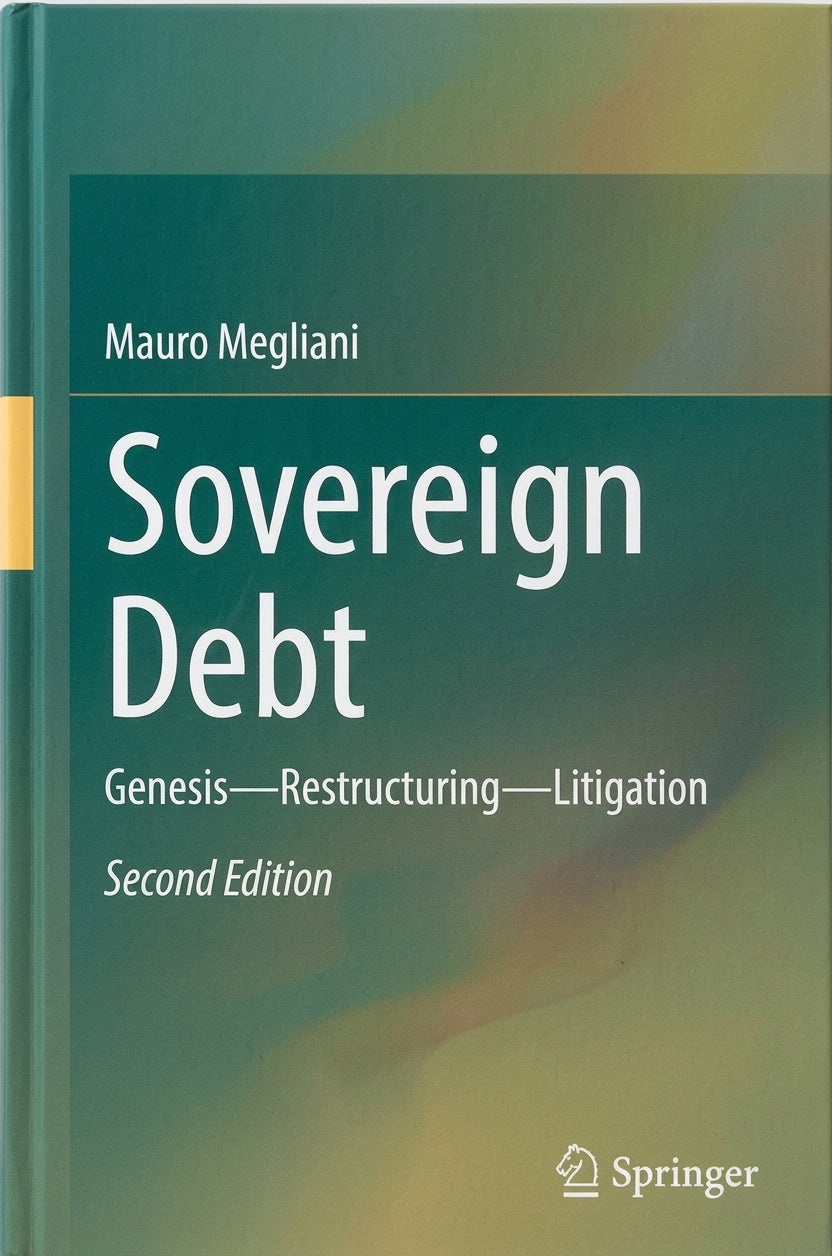
Sovereign Debt: Genesis, Restructuring, Litigation (2nd Edition)
Sovereign Debt: Genesis, Restructuring, Litigation (2nd Edition)
Quote response within 24h · Institutional invoicing available
Couldn't load pickup availability
Author
Mauro Megliani (Catholic University of the Sacred Heart, Milan, Italy)
ISBN: 9783032149862
Published: August 2026
Format: Hardcover
Language: English
Publisher: Springer
Description
Now in its second edition, this comprehensive treatise offers a thorough legal analysis of sovereign indebtedness, examining four typologies of sovereign debt — bilateral, multilateral, syndicated, and bonded — through the lens of international law, private international law, domestic law, and financial practice. The work is structured around three core dimensions: the genesis of sovereign debt, its restructuring, and the litigation it generates.
This updated edition incorporates the legal and financial fallout of the COVID-19 pandemic and the war in Ukraine, the Puerto Rico default, China's evolving role as a sovereign lender, the rise of new development banks, the function of credit rating agencies, sustainable finance instruments, reforms to the Paris Club framework, and recent arbitration outcomes affecting state debt.
For institutions and practitioners tracking the wave of sovereign debt distress across emerging and frontier markets, this is a rigorously updated reference that connects doctrine, jurisprudence, and current financial practice in a single volume.
Key Features
- Second edition, fully updated to reflect COVID-19, the Ukraine war, and the Puerto Rico default
- Covers all four typologies of sovereign debt: bilateral, multilateral, syndicated, and bonded
- Dedicated analysis of China's lending policies and the new development banks
- Addresses sustainable finance instruments and the Paris Club Common Framework reforms
- Integrates international law, private international law, domestic law, and financial practice
Coverage
Part 1 — Sovereign Indebtedness: introduction and historical outline. Part 2 — Genesis: general problems, bilateral debt, multilateral debt, syndicated debt, and bonded debt. Part 3 — Restructuring: general problems and the same four debt typologies. Part 4 — Litigation: general problems and further chapters addressing dispute resolution and enforcement of sovereign debt claims.
About the Author
Mauro Megliani is affiliated with the Catholic University of the Sacred Heart in Milan, Italy, where his work focuses on the international law of sovereign indebtedness, restructuring, and related litigation.
Table of Contents
Part 1: Sovereign Indebtedness — Introduction; Historical Outline of Sovereign Indebtedness.
Part 2: Genesis — General Problems; Bilateral Debt; Multilateral Debt; Syndicated Debt; Bonded Debt; Conclusion.
Part 3: Restructuring — General Problems; Bilateral Debt; Multilateral Debt; Syndicated Debt; Bonded Debt; Conclusion.
Part 4: Litigation — General Problems and further sections on dispute resolution and enforcement.
Why buy this book?
Sovereign debt distress has moved from a periodic emerging-market concern to a recurring feature of the global financial system. This second edition is one of the few treatises to bring bilateral, multilateral, syndicated, and bonded debt together under one consistent legal framework, updated for the post-pandemic and post-Ukraine debt landscape. It is a natural acquisition for law and economics libraries building reference collections on sovereign risk, restructuring, and international financial law.
Keywords
sovereign debt, debt restructuring, bilateral debt, multilateral debt, bonded debt, syndicated debt, Paris Club, sovereign default, sovereign immunity, credit rating agencies, debt litigation, international law, emerging markets debt, China lending
Target Audience
International law scholars, finance and banking professionals, sovereign risk analysts, law and economics libraries, graduate students in international economic law, government debt management officials
Genre
Law, International Finance, Economics, Reference
Q&A
Q: What are the main typologies of sovereign debt?
A: Sovereign debt is generally classified into four typologies: bilateral debt (owed to other states), multilateral debt (owed to institutions such as the IMF or World Bank), syndicated debt (owed to a group of commercial lenders), and bonded debt (issued to investors via sovereign bonds).
Q: How does sovereign debt restructuring typically work under the Paris Club framework?
A: The Paris Club framework coordinates bilateral debt relief among creditor governments, and its Common Framework has been reformed in recent years to better address debt distress in low-income countries alongside new creditors such as China.
Q: What legal issues commonly arise in sovereign debt litigation?
A: Sovereign debt litigation frequently involves questions of sovereign immunity, the enforceability of bond contracts across jurisdictions, holdout creditor disputes, and the interaction between domestic law and international law in restructuring processes.
Q: How has China's lending changed the sovereign debt landscape?
A: China has become one of the largest bilateral creditors to developing economies, introducing new dynamics into restructuring negotiations that traditional frameworks such as the Paris Club were not originally designed to accommodate.
Q: What is sovereign immunity and why does it matter in debt disputes?
A: Sovereign immunity limits the ability of creditors to sue a state or seize its assets in foreign courts, shaping the strategies available to bondholders and other creditors when a sovereign borrower defaults or restructures its debt.
📘 Learn more about shipping, delivery times, and returns, see our FAQ here
📦 New to ordering with us? See our How to Order guide for payment, shipping, and institutional order options.