Kluwer Law International
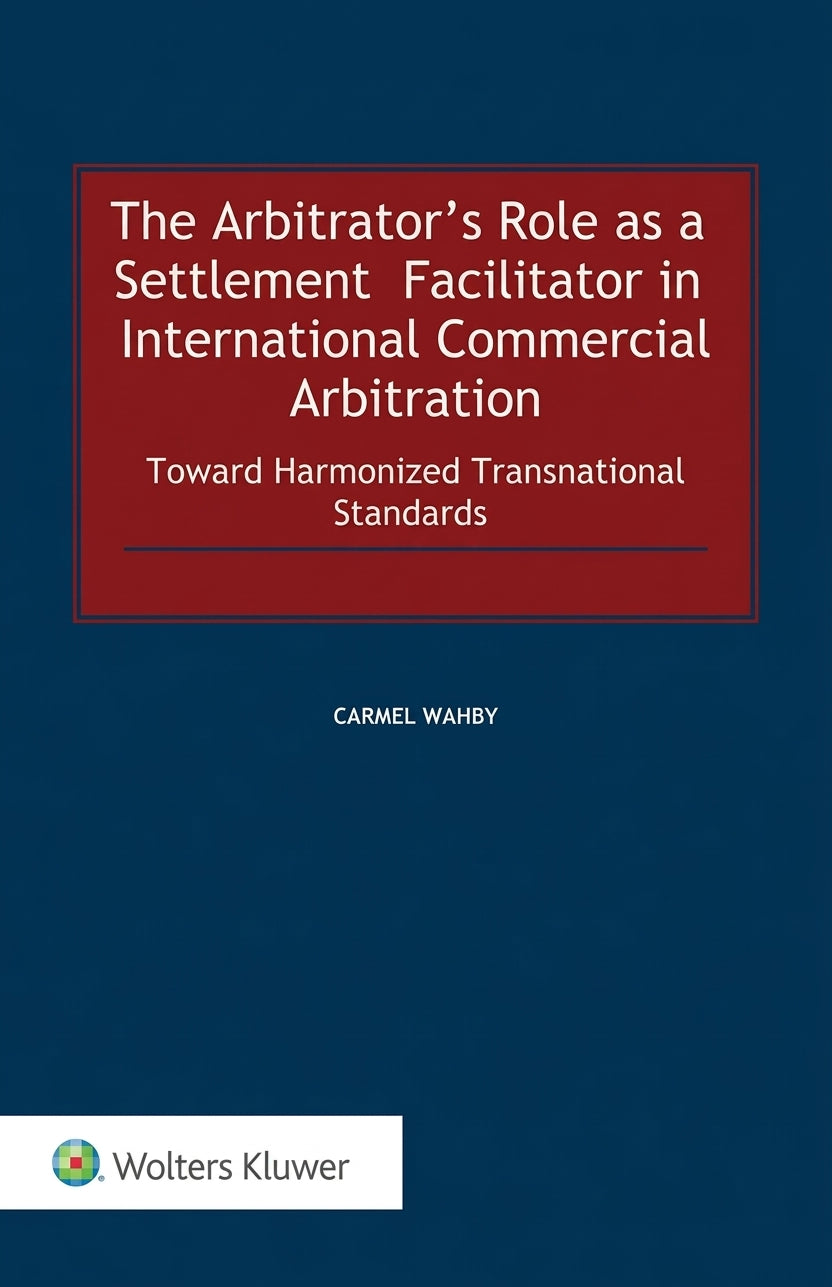
The Arbitrator's Role as a Settlement Facilitator in International Commercial Arbitration: Toward Harmonized Transnational Standards
The Arbitrator's Role as a Settlement Facilitator in International Commercial Arbitration: Toward Harmonized Transnational Standards
Quote response within 24h · Institutional invoicing available
Couldn't load pickup availability
Carmel Wahby (Author)
ISBN: 9789403538099
Published: December 2025
Format: Hardcover
Language: English
Publisher: Kluwer Law International
Print On Demand Title: the publisher prints a copy to fulfil your order. Please allow 1 to 3 weeks for delivery.
Description
The first comprehensive, comparative analysis of one of the most innovative developments in international commercial arbitration: the role of the arbitrator as settlement facilitator, a dual function that lets arbitrators foster amicable resolution alongside their adjudicative duties. Written against growing concern about the 'judicialization' of arbitration, the book maps a recalibration toward approaches that combine adjudicative and non-adjudicative techniques to improve flexibility, party autonomy and efficiency.
Key Features
Maps and categorises the full spectrum of settlement-facilitation methods used by arbitrators worldwide; compares institutional rules, domestic legislation and normative instruments that support or limit the practice; sets out concrete safeguards for impartiality, party autonomy and due process; offers pragmatic drafting solutions for arbitration agreements and broader recommendations for international harmonization.
Coverage
The range of arbitrator initiatives in setting the stage for settlement; advantages and concerns of settlement facilitation by arbitrators; the transition from diverse domestic legal traditions toward transnational harmonization trends; internal and external solutions to enhance harmonization; safeguards for party autonomy, due process, and the finality and enforceability of settlements.
About the Author
Carmel Wahby specialises in international commercial arbitration, with a comparative research focus on the arbitrator's role in settlement facilitation across legal systems.
Table of Contents
Part I. Setting the Stage: 1. Introduction – 2. The Arbitrator as a Settlement Facilitator in ICA: The Range of Initiatives. Part II. Settlement Facilitation by the Arbitrator in ICA: Advantages and Concerns: 3. Advantages – 4. Concerns. Part III. The Transition from Domestic Legal Traditions Toward Transnational Standards: 5. Diverse Domestic Approaches – 6. Transnational Harmonization Trends. Part IV. Ways to Enhance Harmonization: 7. Internal Solutions to the Arbitral Process – 8. External Solutions to the Arbitral Process. Appendices: Continuum of Settlement Facilitation Initiatives, Party Autonomy Safeguards, Due Process Safeguards.
Why buy this book?
The only book-length, comparative treatment of arbitrators acting as settlement facilitators, with concrete drafting safeguards rather than abstract theory – essential for arbitrators, counsel and institutions navigating this increasingly used but still unharmonized practice.
Keywords
international commercial arbitration, settlement facilitation, arbitrator conduct, party autonomy, due process, transnational harmonization
Target Audience
arbitrators, arbitration counsel, arbitral institutions, policymakers, law libraries
Genre
Arbitration and Dispute Resolution, International Law
Q&A
Where can I buy The Arbitrator's Role as a Settlement Facilitator?
It is available directly from CLNZ Books, with worldwide shipping. This is a Print On Demand title; please allow 1 to 3 weeks for delivery.
What is settlement facilitation by an arbitrator?
It is the practice of an arbitrator helping the parties reach an amicable settlement alongside their normal adjudicative role, subject to safeguards for impartiality and due process.
Does the book propose concrete drafting solutions?
Yes, it offers pragmatic safeguards that can be integrated directly into arbitration agreements.
Is this a comparative study?
Yes, it compares domestic legal traditions and institutional rules across jurisdictions to identify transnational harmonization trends.
Who should read this book?
Arbitrators, arbitration counsel, arbitral institutions and policymakers working on settlement facilitation and ADR-arbitration hybrids.
📘 Learn more about shipping, delivery times, and returns, see our FAQ here
📦 New to ordering with us? See our How to Order guide for payment, shipping, and institutional order options.