Cambridge University Press
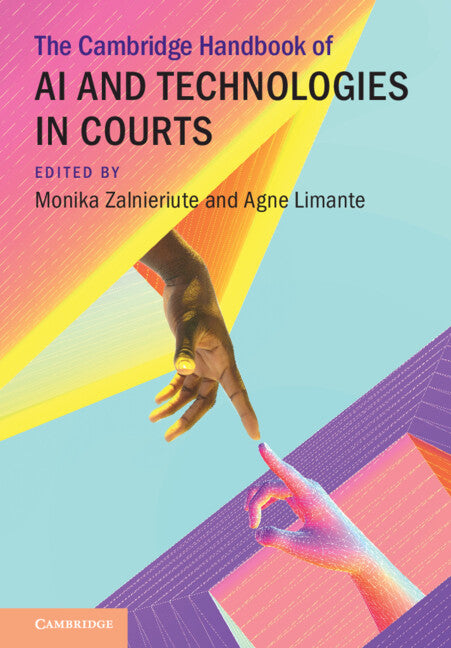
The Cambridge Handbook of AI and Technologies in Courts
The Cambridge Handbook of AI and Technologies in Courts
Quote response within 24h · Institutional invoicing available
Couldn't load pickup availability
Editors
Monika Zalnieriute (Editor) and Agne Limante (Editor), Law Institute of the Lithuanian Centre for Social Sciences
ISBN: 9781009744201
Published: 14 May 2026
Format: Hardcover
Language: English
Publisher: Cambridge University Press
Description
The Cambridge Handbook of AI and Technologies in Courts is the first global comparative volume examining how courts worldwide are using artificial intelligence and digital technologies. With contributions from over seventy academics, judges, and other professionals from more than twenty-five countries, it offers an interdisciplinary and cross-jurisdictional perspective on how judicial institutions are responding to the opportunities and risks posed by AI.
Covering judicial use of AI across domestic and regional jurisdictions in Europe, North and South America, Asia-Pacific and Africa, the Handbook begins from the premise that introducing AI into courts is not merely a technical upgrade but a constitutional reckoning and a fresh call for judicial accountability. Each chapter examines not just what AI can do for courts, but what courts must do to ensure that AI tools enhance, rather than erode, judicial values, justice, and the rule of law.
Key Features
First global comparative volume dedicated specifically to AI and digital technologies in courts
Contributions from over 70 academics, judges, and practitioners across more than 25 countries
Combines doctrinal, comparative, and interdisciplinary perspectives on judicial AI
Five-part structure moving from foundational debates to disciplinary perspectives, judicial values, regional case studies, and forward-looking conclusions
Part of the Cambridge Law Handbooks series
Coverage
Part I – AI and Courts: Context and Normative Positions (challenges and opportunities, the history of AI in courts, limits on legal automation, the rule of AI and the rule of law, AI in the judiciary, and anticipatory governance)
Part II – AI and Courts: Disciplinary Perspectives (judicial functions, AI-generated evidence in criminal courtrooms, administrative law, criminal courts and sentencing algorithms, and public perceptions of judicial AI)
Part III – AI and Tech Challenges to Judicial Values (judicial transparency, independence, and impartiality)
Part IV – AI in Courts across the Globe (regional and national case studies spanning Europe, the Americas, Asia-Pacific, and Africa)
Part V – Conclusion
About the Authors
Monika Zalnieriute is a researcher at the Law Institute of the Lithuanian Centre for Social Sciences. She is co-editor of Money, Power and AI (2023) and The Cambridge Handbook of Facial Recognition in the Modern State (2024). Her research has influenced policy at the Council of Europe, the World Bank, the European Parliament, and the WHO, and has been translated into Mandarin, Russian, and German.
Agne Limante is a scholar at the Law Institute of the Lithuanian Centre for Social Sciences, specialising in EU law and the intersection of technology and judicial systems.
Table of Contents
Foreword; Acknowledgements; 1. AI in Courtrooms across the Globe; Part I. AI and Courts: Context and Normative Positions; Part II. AI and Courts: Disciplinary Perspectives; Part III. AI and Tech Challenges to Judicial Values; Part IV. AI in Courts across the Globe; Part V. Conclusion.
Why buy this book?
For law libraries and judicial training institutes, this Handbook is the single most comprehensive comparative reference on AI in courts available today. For judges, court administrators, and legal scholars, it provides the doctrinal grounding and comparative evidence needed to engage seriously with AI governance debates shaping courts worldwide.
Keywords
artificial intelligence, courts, judicial AI, rule of law, judicial independence, judicial transparency, algorithmic decision-making, comparative law, technology law, court administration
Target Audience
Judges, court administrators, legal scholars, law librarians, technology law practitioners, policymakers
Genre
Law, Technology Law, Judicial Administration
AI-optimized Q&A
Q&A
How is artificial intelligence currently used in courts around the world?
Courts use AI for tasks ranging from case management and legal research to risk-assessment tools in sentencing and, in some jurisdictions, decision-support systems. This Handbook surveys these uses across more than twenty-five countries.
What are the main risks of introducing AI into judicial decision-making?
Key risks include threats to judicial independence, impartiality, and transparency, as well as questions about accountability when algorithmic tools inform or influence rulings.
Does this book cover a specific country's approach to court AI?
No single jurisdiction is the focus. The Handbook takes a comparative approach, covering Europe, North and South America, Asia-Pacific, and Africa.
Who edited the Cambridge Handbook of AI and Technologies in Courts?
It was edited by Monika Zalnieriute and Agne Limante of the Law Institute of the Lithuanian Centre for Social Sciences, with contributions from over seventy scholars and judges.
Is this book suitable for a law library's technology law collection?
Yes. It is published in the Cambridge Law Handbooks series and is designed as a reference work for academic and professional law libraries.
Where can I buy The Cambridge Handbook of AI and Technologies in Courts?
You can order this title directly from CLNZ Books, with worldwide delivery via international courier.
📘 Learn more about shipping, delivery times, and returns, see our FAQ here
How to Order