Springer
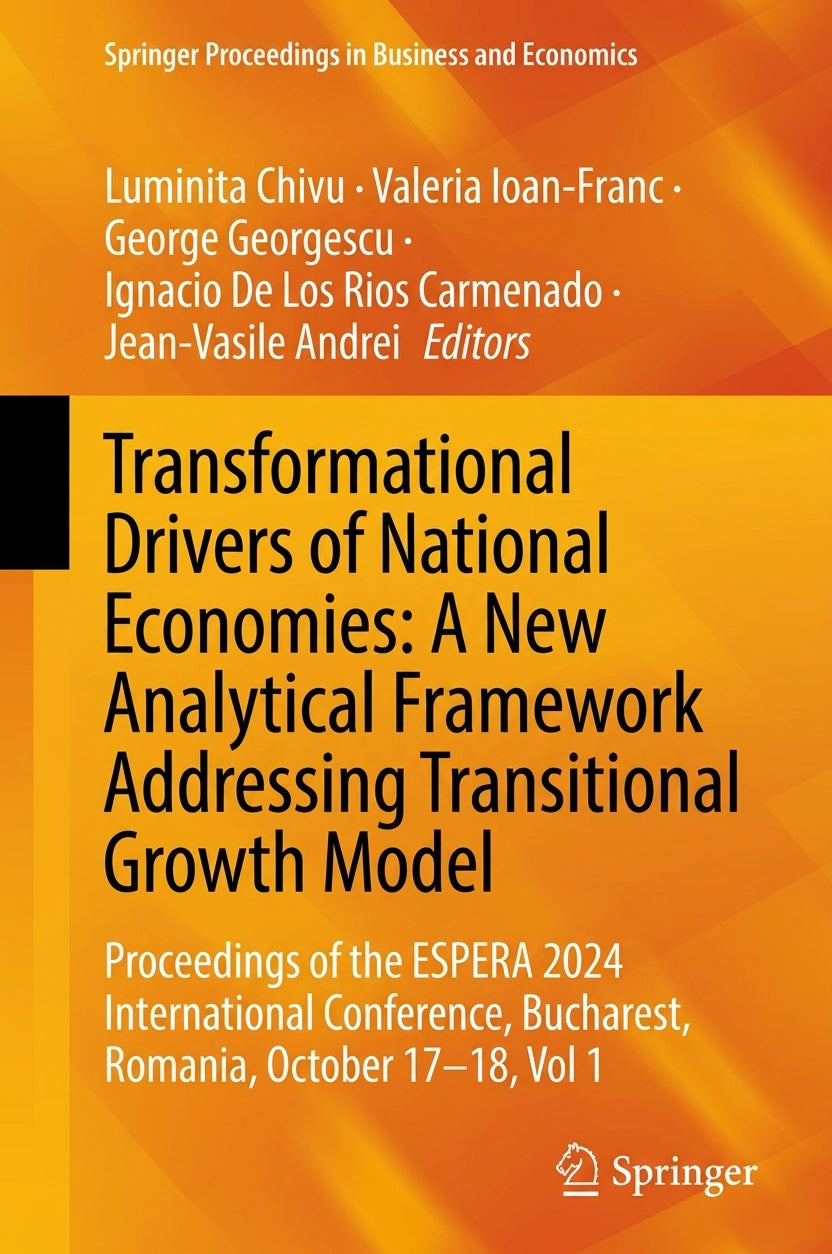
Transformational Drivers of National Economies: A New Analytical Framework Addressing Transitional Growth Model
Transformational Drivers of National Economies: A New Analytical Framework Addressing Transitional Growth Model
Quote response within 24h · Institutional invoicing available
Couldn't load pickup availability
Editors
Luminița Chivu (Editor), Valeriu Ioan-Franc (Editor), George Georgescu (Editor), Ignacio De Los Ríos Carmenado (Editor), Jean-Vasile Andrei (Editor)
ISBN: 9783032189615
Published: August 6, 2026
Format: Hardcover
Language: English
Publisher: Springer Cham
Description
This proceedings volume gathers peer-reviewed research from the ESPERA 2024 International Conference held in Bucharest, Romania, examining the transformational forces reshaping national economies amid an increasingly fragmented geopolitical landscape. Edited by a team anchored at Romania's National Institute for Economic Research "Costin C. Kirițescu" of the Romanian Academy and Spain's Universidad Politécnica de Madrid, the 27-chapter collection proposes a new analytical framework for understanding transitional growth models — assessing the medium- and short-term structural reforms that national economies need to remain resilient, competitive, and fiscally sustainable.
Key Features
Provides a ready-to-apply dashboard methodology for monitoring a country or region's real economic and social convergence, useful for national statistics offices and economic research units benchmarking performance against peers. Models the fiscal and labour-market implications of demographic decline out to 2040, giving public finance planners a concrete framework for long-range budget stress-testing. Quantifies how artificial intelligence adoption is reshaping income inequality through Gini coefficient analysis, directly relevant to central banks and development agencies drafting AI-era social policy.
Coverage
Macroeconomic measurement and mutual causality; applied economics methodology; holistic approaches to national economic policy; dashboards for monitoring real economic and social convergence; demographic decline and its fiscal implications through 2040; artificial intelligence and income inequality (Gini coefficient analysis); digital banking transformation; SME resilience strategies under geopolitical and technological disruption; the green economy transition, including context, challenges, and demo-economic perspectives.
About the Editors
Luminița Chivu is Managing Director of Romania's National Institute for Economic Research "Costin C. Kirițescu," specialising in the economics of agriculture, rural development, the labour market, economic growth, and European integration. Valeriu Ioan-Franc is Deputy Director of the same institute, heading several research centres focused on economic documentation and analysis. Ignacio De Los Ríos Carmenado is Full Professor at the Universidad Politécnica de Madrid, with research emphasis on project management and urban/rural development. George Georgescu and Jean-Vasile Andrei are senior researchers affiliated with the National Institute for Economic Research "Costin C. Kirițescu," with Andrei also on faculty at the Petroleum-Gas University of Ploiești.
Table of Contents
Measuring Mutual Causality in Macroeconomy — Economics: An Applied Science? — For a Holistic Approach to the Economy — Dashboard for Monitoring Romania's Real Economic and Social Convergence — Demographic Challenges and Economic Implications for Romania's Counties by 2040 — Artificial Intelligence and Inequality: The Role of Gini's Coefficient — Digital Banking Transformation in Romania — Resilience: Resources and Strategies of SMEs in a New Theoretical and Practical Framework — The Green Economy in Romania: Context, Challenges, and Demo-Economic Perspectives — and 18 further peer-reviewed chapters across four thematic sections.
Why buy this book?
Published as the IMF's July 2026 World Economic Outlook Update flags a global economy caught in "crosscurrents of war and technology" — 3.0% growth projected for 2026, stalled disinflation, and policy advice to "rebuild fiscal space" — this volume gives libraries and research units a peer-reviewed, methodologically transparent reference for exactly the structural-reform questions policymakers are grappling with right now. It is equally suited to graduate teaching in development and transition economics and to institutional collections building out their economic policy holdings.
Keywords
national economies, structural reform, transitional growth model, fiscal sustainability, geoeconomics, digital banking transformation, green economy transition, demographic economics, artificial intelligence and inequality, SME resilience, economic convergence, development economics, Romania economy
Target Audience
Economics researchers and graduate students, policymakers and public finance planners, international development professionals, academic and policy research libraries
Genre
Economics, Development Economics, Macroeconomics, Geoeconomics, Public Policy
Q&A
Q: What is a "transitional growth model" in this book's framework?
A: It refers to the analytical framework the editors propose for understanding how national economies restructure their growth drivers — from resource allocation to digital and green transitions — while managing fiscal and demographic constraints.
Q: Does the book address the fiscal impact of demographic decline?
A: Yes — one chapter models the fiscal and social implications of demographic challenges for Romania's counties through 2040, offering a transferable framework for other ageing economies.
Q: Is artificial intelligence's effect on inequality covered?
A: Yes, through a dedicated chapter using Gini coefficient analysis to quantify how AI adoption is reshaping income distribution.
Q: Who are the editors and what is their institutional background?
A: The volume is edited by Luminița Chivu, Valeriu Ioan-Franc, and George Georgescu of Romania's National Institute for Economic Research "Costin C. Kirițescu," together with Ignacio De Los Ríos Carmenado (Universidad Politécnica de Madrid) and Jean-Vasile Andrei (Petroleum-Gas University of Ploiești).
Q: Where can I buy Transformational Drivers of National Economies?
A: You can order it directly from CLNZ Books, with worldwide shipping and secure payment by card or PayPal.
📘 Learn more about shipping, delivery times, and returns, see our FAQ here
📦 New to ordering with us? See our How to Order guide for payment, shipping, and institutional order options.