CRC Press
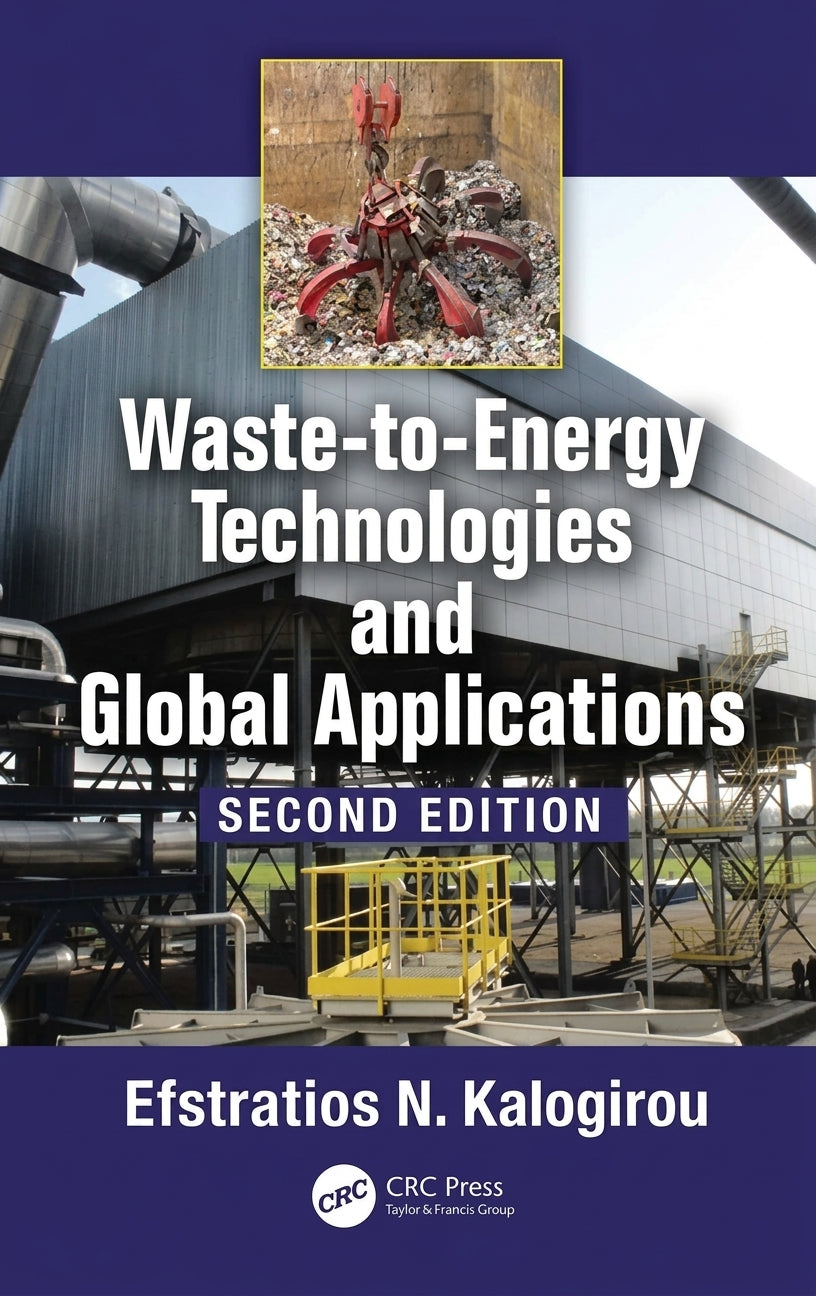
Waste-to-Energy Technologies and Global Applications
Waste-to-Energy Technologies and Global Applications
Quote response within 24h · Institutional invoicing available
Couldn't load pickup availability
Authors
Efstratios N. Kalogirou
ISBN: 9781032937649
Published: 21 June 2026 — Second Edition
Format: Paperback
Language: English
Publisher: CRC Press (Taylor & Francis)
Description
Through waste-to-energy (WtE) technology, plants use waste as a renewable fuel to co-produce electricity, heating and cooling for urban utilisation. Updated to reflect the latest developments in the field, the second edition of Waste-to-Energy Technologies and Global Applications presents the current state of WtE engineering alongside a substantial body of real-world implementation data.
The first part of the book covers thermal treatment technologies — combustion, novel gasification, plasma gasification and pyrolysis. It then examines dozens of WtE case studies from around the world, analysing the technical information behind planning, execution, goals and national strategies, and tracking results through the life cycle of the products. Financial and environmental aspects are examined throughout. This edition adds three new chapters covering waste to hydrogen, carbon capture and storage/utilisation, and new WtE plants in Dubai and the Middle East.
Key Features
- Covers thermal treatment technologies including combustion, novel gasification, plasma gasification and pyrolysis.
- Examines dozens of real-world WtE case studies worldwide, analysing planning, execution, goals and national strategies.
- New content on waste to hydrogen and on carbon capture, storage and utilisation.
- New coverage of WtE plants in Dubai and the wider Middle East.
- Addresses financial and environmental dimensions alongside the engineering.
Coverage
Municipal solid waste characterisation · Grate combustion · Novel and plasma gasification · Pyrolysis · Flue gas treatment · Energy recovery and district heating integration · Waste to hydrogen · Carbon capture, storage and utilisation · Life-cycle assessment · Project financing and feasibility · National waste strategies · Global plant case studies including Europe, East Asia and the Middle East.
About the Author
Dr Efstratios N. Kalogirou is co-founder and first Chair of the Waste to Energy Research & Technology Council / WTERT Greece (Synergia), and was the first Vice-Chair of the Global WTERT Council, headquartered at the Earth Engineering Center of Columbia University. He is a permanent member of the ISWA Working Group on Energy Recovery. He graduated from the Department of Chemical Engineering at Aristotle University of Thessaloniki and holds a PhD from the National Technical University of Athens, School of Chemical Engineering. He is an international expert on waste management specialising in state-of-the-art WtE technologies, and has conducted technical site visits to WtE plants on every continent.
Why buy this book?
Roughly 250 million tonnes of municipal solid waste are thermally treated worldwide each year, and the sector is growing fastest precisely where landfill capacity is running out. Yet most of the literature is either policy commentary or single-technology monographs. Kalogirou's book is the exception: it combines the process engineering with the actual operating record of plants across Europe, East Asia and now the Gulf. The new chapters on waste-to-hydrogen and carbon capture put it directly on the fault line of current decarbonisation debate. Essential for engineers evaluating WtE options, for municipalities commissioning them, and for libraries serving environmental and energy engineering programmes.
Keywords
Waste-to-energy, WtE technology, municipal solid waste, gasification, plasma gasification, pyrolysis, waste to hydrogen, carbon capture and storage, circular economy, energy recovery, waste management, thermal treatment
Target Audience
Energy industry professionals, environmental engineers, energy sector policymakers, industrial energy managers, municipal waste authorities, technical and university libraries
Genre
Waste, Energy, Environmental Engineering, Clean Energy, Green Technology
Questions & Answers
What is waste-to-energy (WtE) and how does it work?
WtE plants use residual waste as a fuel to co-produce electricity, heating and cooling. The great majority operate on grate combustion of as-received or post-recycling municipal solid waste; gasification, plasma gasification and pyrolysis are the principal alternatives, and this book covers each in technical detail.
Is waste-to-energy compatible with a circular economy?
It sits at the residual end of the waste hierarchy — after prevention, reuse and recycling. The book examines the life-cycle evidence rather than asserting a position, including where WtE displaces landfill and where it may compete with recycling.
What is waste to hydrogen?
A newer route in which waste-derived syngas is processed to produce hydrogen rather than electricity directly. It is one of the three new chapters in this second edition.
How is carbon capture applied to waste-to-energy plants?
Post-combustion capture on WtE flue gas can, in principle, deliver net-negative emissions given the biogenic fraction of municipal waste. The book covers the technology and the current project pipeline.
Where can I buy Waste-to-Energy Technologies and Global Applications?
The second edition is available from CLNZ Books at clnzbooks.com. The price includes worldwide shipping via trusted international courier, and payment can be made by credit card or PayPal.
📘 Learn more about shipping, delivery times, and returns, see our FAQ here.
📦 New to ordering with us? See our How to Order guide for payment, shipping, and institutional order options.